PuniCodex

Extended Lore

Rongo

Etymology · Orthography · Cult · Iconography · Reception · Sources

Tier 2 Rongo
Rongo — Agriculture, Peace, Cultivated Foods
01

Quick Facts

Essential information about Rongo, Agriculture, Peace, Cultivated Foods

Scholarly TransliterationRongo
Unicode RestorationRongo
Reconstructed Pronunciation/ˈɾɔ.ŋɔ/
PantheonPolynesian
DomainAgriculture, Peace, Cultivated Foods
MeaningPeace, news (from Proto-Polynesian *longo)
ClassificationTier 2
Primary DomainRongo
Sacred SymbolsKūmara, The digging-stick (kō), The storage pit (rua kūmara), The Makahiki images
02

Etymology & Word Family

From original script to Unicode restoration

Proto-polynesian *longo Peace, news
Scholarly Transliteration Rongo Rongo — "Peace, news (from Proto-Polynesian *longo)"
Unicode Restoration Rongo Canonical scholarly spelling — ASCII-identical
Modern ASCII rongo Plain-ASCII fallback

Peace, news (from Proto-Polynesian *longo)

03

Unicode Character Breakdown

Character-by-character philological analysis

CharacterUnicodeNameBlockPhonetic Role
RU+0052Latin Capital Letter RBasic LatinSame
oU+006FLatin Small Letter OBasic LatinSame
nU+006ELatin Small Letter NBasic LatinSame
gU+0067Latin Small Letter GBasic LatinSame
oU+006FLatin Small Letter OBasic LatinSame

The Tier 2 classification here reflects fidelity to the attested tradition, not recovered diacritics: every character of Rongo already survives in ASCII. What the restoration preserves is the canonical spelling itself — the form scholarship standardised.

04

Cult & Worship

How the sacred was kept — rites, sanctuaries, remains

The Cult

Rongo’s cult ran on the agricultural year. The tohunga opened the māra kūmara with karakia addressed to Rongomatāne — the fuller name, ‘Rongo of the abundant soil’ — before the first seed-tuber went into the ground with the digging-stick; the first fruits of the old crop went back to the god before any person ate, and the rua storehouses stood under his tapu until the new year. The evidence is practice rather than monument: thousands of rua kūmara pits pock the volcanic fields of Tāmaki Makaurau, and the kō, the digging-stick, is the god’s ritual instrument. Priesthood was the tohunga’s hereditary craft — family rites at the garden’s edge, not congregational worship. In Mangaia the same god was the paramount war-god, fed by marae cult; in Hawai‘i, Lono’s Makahiki circuit received the islands’ great annual festival. Peace, it turns out, also has liturgy.

In the Earth

Rongo leaves no temples — Polynesian religion built few — but his archive is underfoot. Thousands of rua kūmara (storage pits), dug into the volcanic soils of the Auckland region and preserved by the geochemistry that protected the crop, survive from the fourteenth century onward and mark the god's territory field by field. In Hawai'i the heiau platforms dedicated to Lono survive along the Kona coast, among them Hikiau Heiau above Kealakekua Bay, beside which Cook's party recorded the Makahiki rites in 1779; its stone terraces still overlook the water. The digging-stick itself, the kō, survives in museum collections — a plain agricultural tool whose every use was once prayer.

05

Iconography

How Rongo was imaged across the ages

The Image

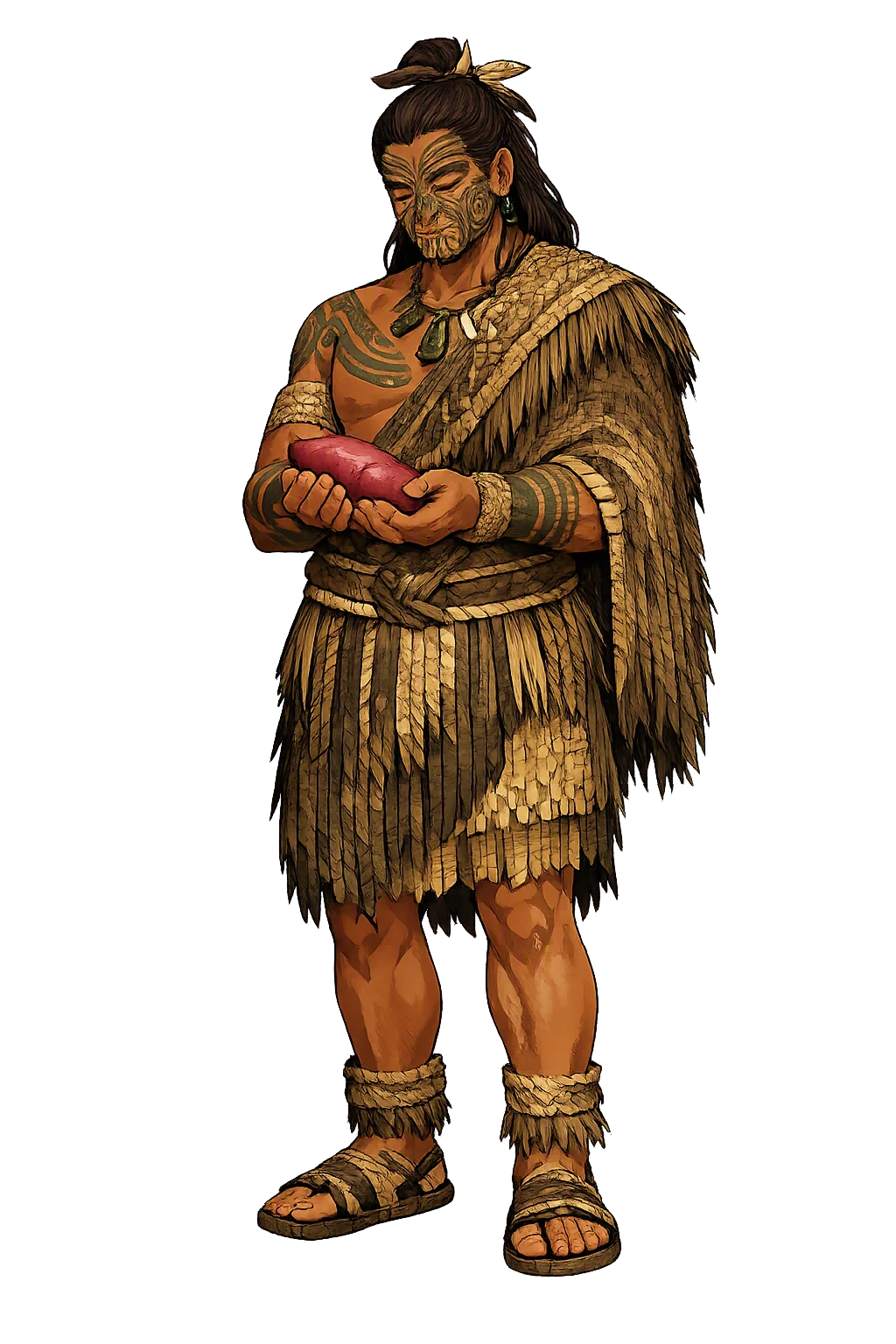
Rongo’s ancient images were built to travel. In Hawai‘i the Makahiki image of Lono was a portable god: a tall wooden pole with a crossbar hung with feathers and a small figure at its head, carried on the ritual circuit of the island’s districts; Cook’s companions, watching it move along the shore, thought of a ship’s mast and yard. On the marae it stood among the drums and feathered regalia of the temple precinct. In Aotearoa, Rongo lives in wood carving: he appears among the children of Rangi and Papa on the posts of the meeting house, and the kūmara itself — the swollen tuber sleeping in the god’s own pits — is his most eloquent portrait. No monumental idol survives; Polynesian gods were carved of perishable wood and left to be renewed, like the fields, generation by generation.

06

Reception & Transformation

The name after its own age — transmission, translation, survival

Afterlives

Rongo’s transmission runs through philology before it runs through ritual. His name crossed the ocean in nineteenth-century comparative work: Tregear’s Maori-Polynesian Comparative Dictionary (1891) aligned Māori Rongo with Hawaiian Lono, Tahitian Ro‘o, and Cook Islands Rongo, proving the god older than any single island’s memory; Grey’s Polynesian Mythology (1855) and White’s Ancient History (1887–90) had preserved the narratives the philologists parsed. The twentieth century turned him into a case study: Beckwith’s Hawaiian Mythology (1940) documented the Makahiki corpus, and the 1990s Sahlins–Obeyesekere controversy over Cook’s reception at Kealakekua made Lono — and the whole question of how Polynesia met Europe — the most argued episode in modern anthropology. In scholarship he remains the proof that a quiet god of the garden mapped the greatest voyages: wherever the canoes landed, Rongo was already home.

Identifications Across Traditions

Rongo is one half of the oldest Polynesian pairing: the agriculture-god beside the sea-god Tangaroa. From Aotearoa to Hawai'i his name barely changes — Māori Rongo, Hawaiian Lono, Tahitian Ro'o, Cook Islands Rongo — a stability that marks him as a first-generation deity carried in the great voyaging canoes (Tregear; Beckwith; Henry, Ancient Tahiti). In Mangaia, strikingly, Rongo is the paramount god of war as well as of the cultivated field — the inversion shows the two faces of the planted life, which must be defended as well as tended. The Hawaiians pressed him furthest: Lono's Makahiki circuit made him a visiting king whose arrival ends warfare, and the eighteenth-century encounter with Cook turned the old theology into world history. Christian missionaries suppressed the cult, but the name survived in whakataukī, in the school calendars of the Hawaiian Renaissance, and in the revived Makahiki itself.

Modern Legacy

Rongo's legacy is a foodway. The kūmara — a tropical plant coaxed to fruit in temperate Aotearoa — remains the emblem of Māori horticulture, and the storage pits that held it still pock the volcanic fields around Tāmaki Makaurau. In Hawai'i the Makahiki has been publicly revived since the 1970s, with canoes and schoolchildren carrying Lono's images round the coast as of old. Rongo endures as a given name across Polynesia, and the scholarship built on Grey, Tregear, and Beckwith keeps his cycle — separation, storm, hiding, harvest — the standard account of how the Pacific's peoples explain their bread. Few gods live so quietly and so persistently: in the ground, in the storehouse, in the season of peace.

07

The Meditation

What Rongo means — beyond the dictionary

Rongo is the god of the planted world, and his theology is a parable of gentle extraction. He does not demand conquest or ecstasy; he asks that the earth be opened carefully, that the first fruits be returned, that peace hold while the crop ripens. In an age that treats food as logistics, Rongo remembers that eating is a relationship — between the digger and the hidden god, between the season of war and the season of the storehouse.

His pan-Polynesian name is itself a map of voyaging: wherever the canoes landed, Rongo landed with them, taking local form but keeping his office. That a whole ocean could agree on one quiet god of the garden says something the loud gods never manage: the things that feed us are the things we hold most in common.

08

Frequently Asked Questions

Common questions about Rongo, Agriculture, Peace, Cultivated Foods, and Unicode restoration

01How do you pronounce Rongo?

In reconstructed pronunciation, Rongo is /ˈɾɔ.ŋɔ/ — approximately 'RAW-ngaw' — tap the r lightly, keep both o's short and pure, and sound the ng as in 'singer'. Stress falls on the first syllable.

02What does Rongo mean?

Rongo means Peace, news (from Proto-Polynesian *longo) in the polynesian tradition.

03What are the symbols of Rongo?

Rongo is associated with Kūmara (The sweet potato, staple crop of the Māori; Rongo is the kūmara's guardian, and the garden's tapu is his.), The digging-stick (kō) (The tool that finds the hidden god; planting with the kō is a ritual approach to Rongo, not mere labour.), The storage pit (rua kūmara) (The earth-store where the harvest sleeps safe through winter — the tangible shape of the peace Rongo guards.), The Makahiki images (Hawaiian Lono's woven standards, carried around the islands in the season when war is suspended and games begin.).

04Why restore Rongo in Unicode?

Rongo is written entirely in ASCII letters, so its restoration is about canonical fidelity rather than recovered diacritics: the temple fixes the name in its scholarly standard spelling, attested in the source tradition, instead of leaving it to drift.

05What is the most important myth about Rongo?

“A Son Between Sky and Earth” — the The Separation story that anchors the mythology of Rongo, told in full on the lore page.

09

Scholarly Sources

The philological foundations of this restoration

Every claim on this page is grounded in established scholarship. The orthographic restorations follow disciplinary convention. The etymological chain follows the best available reference works. This is not invention — it is resurrection through scholarship.

◈

Lexicography & Philology

  • Tregear
◎

Primary Texts

  • Primary sources in the polynesian tradition for Rongo.
◉

Archaeology & Art History

  • Material evidence — iconography, inscriptions, and temple archaeology — for Rongo and related cults.
✦

Religious Studies

  • Grey, Polynesian Mythology (1855)
  • Tregear, The Maori-Polynesian Comparative Dictionary (1891), s.v. Rongo
  • Best, Māori Religion and Mythology
  • Beckwith, Hawaiian Mythology (1940), on Lono and the Makahiki
  • Henry, Ancient Tahiti (1928), on Ro'o and Tū
  • Sahlins, Islands of History (1985); Obeyesekere, The Apotheosis of Captain Cook (1992)
Return

The Surface Awaits

You have traced the name from its earliest attestation to its Unicode restoration. Now return to the myth. The story is where the name lives.

Back to Lore
Rongo mascot