PuniCodex

Extended Lore

𓂋𓈖𓈖𓅱𓏏𓏏𓆗 Rnnwtt

Etymology · Orthography · Cult · Iconography · Reception · Sources

ASCII-equivalent form Rnnwtt
Rnnwtt — Nursing, Harvest
01

Quick Facts

Essential information about Rnnwtt, Nursing, Harvest

Original Script𓂋𓈖𓈖𓅱𓏏𓏏𓆗
Unicode RestorationRnnwtt
Reconstructed Pronunciation/rəˌnɛnuːˈtɛt/ (conventional)
PantheonEgyptian
DomainNursing, Harvest
MeaningThe nursing snake
ClassificationASCII-equivalent form
Primary DomainRnnwtt
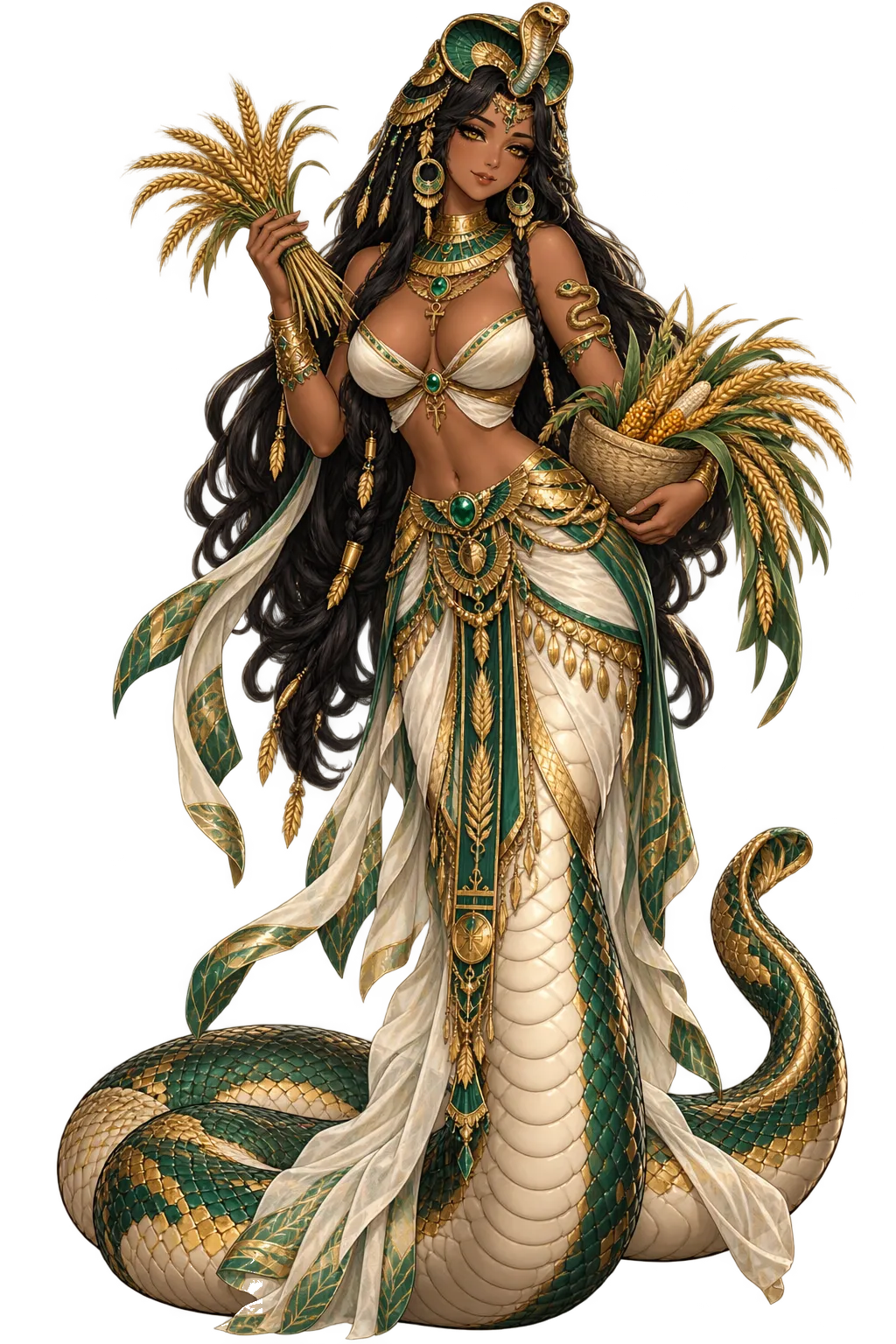
Sacred SymbolsThe Harvest Cobra, Lady of the Granary, The Nursing Goddess, Goddess of the Vineyard
02

Etymology & Word Family

From original script to Unicode restoration

Original Script 𓂋𓈖𓈖𓅱𓏏𓏏𓆗 Rnnwtt — "The nursing snake"
Unicode Restoration Rnnwtt Canonical scholarly spelling — ASCII-identical
Modern ASCII renenutet Plain-ASCII fallback

The name Rnnwtt reaches the modern world through scholarly transliteration of the egyptian tradition. Because the conventional spelling uses only Latin letters, its Unicode and ASCII forms coincide — the tradition it carries is in the name itself, not in diacritics.

03

Unicode Character Breakdown

Character-by-character philological analysis

CharacterUnicodeNameBlockPhonetic Role
RU+0052Latin Capital Letter RBasic LatinSame, capitalized
nU+006ELatin Small Letter NBasic LatinSpecial phonetic character
nU+006ELatin Small Letter NBasic LatinSame
wU+0077Latin Small Letter WBasic LatinSpecial phonetic character
tU+0074Latin Small Letter TBasic LatinSpecial phonetic character
—N/ADropped characterEgyptian orthographyDropped: vowel not written

This restoration reflects fidelity to the attested tradition, not recovered diacritics: every character of Rnnwtt already survives in ASCII. What the restoration preserves is the canonical spelling itself — the form scholarship standardised.

04

Cult & Worship

How the sacred was kept — rites, sanctuaries, remains

The Cult

Every threshing-floor kept her image; the harvest’s end brought her festival of the last sheaf. Nurses and mothers wore her amulets, and the state’s grain-auditors sealed their measures in her name — she was simultaneously pantry-goddess and auditor of the realm’s food.

In the Earth

Her finest surviving monument is the temple of Dendera’s granary quarter; the Fayum’s Tebtunis papyri preserve her vineyard accounts. Serpent-cult objects from the harvest festivals — plumed cobra figurines — fill the Late Period strata of sites across the valley.

05

Iconography

How Rnnwtt was imaged across the ages

The Image

A rearing cobra, hood flared, crowned with two plumes or horns and sun-disc; in anthropomorphic form a woman with the cobra-head nursing a child. The sheaf, the wine-jar and the plough accompany her in harvest scenes.

06

Reception & Transformation

The name after its own age — transmission, translation, survival

Afterlives

Through Thermouthis she entered the Isis-circles of the Roman Empire, and her ‘last sheaf’ rite was recorded by every traveller who saw the Egyptian harvest from Herodotus to the nineteenth century. Modern agricultural anthropology still cites her as the type-case of the harvest-mother goddess.

Identifications Across Traditions

Renenutet merged early with Wadjet, the cobra of Lower Egypt — both are the rearing uraeus — and with Meretseger of the Theban necropolis in her serpent aspect. As Thermouthis she was equated with Isis and Demeter, the two great maternal goddesses of the classical world; the triangulation made her the most exported of Egypt’s agricultural deities.

Modern Legacy

The ‘last sheaf’ custom survived in Egyptian folk practice into the modern era, one of the longest-lived ritual continuities on earth. Her name, in the Greek dress of Thermouthis, entered the magical papyri and the romance-literature of the ancient novel; and every study of Egyptian food-economy begins with her shrines at the granary door.

07

The Meditation

What Rnnwtt means — beyond the dictionary

Rnnwtt: the name suckles. Its restoration in plain letters is a granary-stela — six consonants standing like six full jars in a row, each one sealed, each one feeding the next. No diacritic could improve a name that means milk.

08

Frequently Asked Questions

Common questions about Rnnwtt, Nursing, Harvest, and Unicode restoration

01How do you pronounce Rnnwtt?

In reconstructed pronunciation, Rnnwtt is /rəˌnɛnuːˈtɛt/ (conventional) — approximately “reh-nuh-NOO-tet”.

02What does Rnnwtt mean?

Rnnwtt means The nursing snake in the egyptian tradition.

03What are the symbols of Rnnwtt?

Rnnwtt is associated with The Harvest Cobra (A rearing cobra crowned with the harvest’s plumes; the last sheaf of the field is her shrine.), Lady of the Granary (Every storehouse and threshing floor fell under her protection — and her audit.), The Nursing Goddess (Her name means “she who nurses”; the pharaoh himself was her nursling.), Goddess of the Vineyard (Wine-presses and wine-jars carried her name; the vintage was her second harvest.).

04Why restore Rnnwtt in Unicode?

Rnnwtt is written entirely in ASCII letters, so its restoration is about canonical fidelity rather than recovered diacritics: the temple fixes the name in its scholarly standard spelling, attested in the source tradition, instead of leaving it to drift.

05What is the most important myth about Rnnwtt?

“The Cobra in the Last Sheaf” — the Harvest Theology story that anchors the mythology of Rnnwtt, told in full on the lore page.

09

Scholarly Sources

The philological foundations of this restoration

Every claim on this page is grounded in established scholarship. The orthographic restorations follow disciplinary convention. The etymological chain follows the best available reference works. This is not invention — it is resurrection through scholarship.

◈

Lexicography & Philology

  • Faulkner, R. O. A Concise Dictionary of Middle Egyptian. Oxford: Griffith Institute, 1962.
  • Wb
◎

Primary Texts

◉

Archaeology & Art History

  • Material evidence — iconography, inscriptions, and temple archaeology — for Rnnwtt and related cults.
✦

Religious Studies

  • Harvest and vintage scenes, Old Kingdom tombs
  • Fayum temple hymns (Renenutet-Sobek theology)
  • Dendera granary dockets and wine tithes
  • Greco-Roman Thermouthis cult inscriptions
Return

The Surface Awaits

You have traced the name from its earliest attestation to its Unicode restoration. Now return to the myth. The story is where the name lives.

Back to Lore
Rnnwtt mascot