PuniCodex

Extended Lore

ᚱᛅᛏᛅᛏᚢᛋᚴᚱ Ratatoskr

Etymology · Phonology · Orthography · Cultural Legacy · Primary Sources

Tier 2 Ratatoskr
Ratatoskr — Squirrel of Yggdrasil
01

Quick Facts

Essential information about Ratatoskr, Squirrel of Yggdrasil

Original Scriptᚱᛅᛏᛅᛏᚢᛋᚴᚱ
Unicode RestorationRatatoskr
Reconstructed Pronunciation/ˈrɑ.tɑ.toskr/
PantheonNorse
DomainSquirrel of Yggdrasil
MeaningDrill-tooth
ClassificationTier 2
Primary DomainRatatoskr
Sacred SymbolsThe world-ash, The malicious message (öfundarorð), The drill-tooth, The hawk between the eyes
02

Etymology & Word Family

From original script to Unicode restoration

Original Script ᚱᛅᛏᛅᛏᚢᛋᚴᚱ Ratatoskr — "Drill-tooth"
Unicode Restoration Ratatoskr Restored stress, length, and script
Modern ASCII ratatoskr Plain-ASCII fallback

Old Norse Ratatoskr is a compound whose second element is toskr, 'tusk, tooth'. The first is usually taken as rati, 'borer, auger' — the very name of the gimlet Óðinn drives through the mountain in the mead-myth — whence the standard gloss 'drill-tooth'. A rival reading takes rata, 'to travel, find one's way', yielding 'travel-tooth', a fit almost too neat for the squirrel who runs the world-tree's trunk; Cleasby-Vigfusson prints the word, Lindow registers both derivations, and the dispute is honest. Ratatoskr is Tier 2 by the mechanical rule: normalized Old Norse writes the name in plain Latin letters, so the ASCII form loses nothing — there is no diacritic and no distinctive letter to restore.

03

Unicode Character Breakdown

Character-by-character philological analysis

CharacterUnicodeNameBlockPhonetic Role
RU+0052Latin Capital Letter RBasic LatinSame, capitalized
aU+0061Latin Small Letter ABasic LatinSame
tU+0074Latin Small Letter TBasic LatinSame
aU+0061Latin Small Letter ABasic LatinSame
tU+0074Latin Small Letter TBasic LatinSame
oU+006FLatin Small Letter OBasic LatinSame
sU+0073Latin Small Letter SBasic LatinSame
kU+006BLatin Small Letter KBasic LatinSame
rU+0072Latin Small Letter RBasic LatinSame

The Tier 2 classification reflects how much of the original phonology this restoration preserves — stress and vowel length for Greek names, distinctive letters and diacritics for every other tradition.

04

Cultural Significance

From ancient cult to modern Unicode

Ancient Domain

Ratatoskr is the squirrel of the world-ash Yggdrasill: the small tireless runner of Grímnismál who bears the eagle's words down from the crown and carries Níðhǫggr's answers back up from the roots — and whom Snorri names as the courier of öfundarorð, malicious messages, between the two great enemies of the tree.

Ratatoskr in Later Traditions

Ratatoskr belongs to a pattern far older and wider than Iceland: the tree that holds the worlds, the eagle in its crown, the serpent at its root. The famous ancient parallel is the Mesopotamian Etana myth, where the eagle and the serpent dwell in the same great tree and their broken pact drives the story — a resemblance scholars have noted for over a century without being able to trace a line of borrowing; Lindow and Simek treat the configuration as a widely distributed world-tree motif rather than a loan. Within the North, the squirrel has no counterpart at all: he is the Edda's own invention, the one member of the tree's menagerie defined by speech rather than appetite. His nearest functional kin are Óðinn's ravens, who likewise range the world and return with words — but the ravens gather news, and Ratatoskr manufactures a feud. Comparativists have also pointed to the squirrel as the classic trickster go-between: small, deniable, and indispensable to enemies who must not be seen to speak.

Modern Legacy

Ratatoskr's afterlife grew with the tree he runs. Padraic Colum's The Children of Odin (1920) carried the squirrel into English-language retellings for children, and every popular handbook since has kept him running. Modern readings have made him the patron of the poisonous go-between — the forwarder of insults, the courier of feuds — a role that has only sharpened in the age of the message-board and the screenshot. He has become a minor star of games and pop culture: a playable god in Smite (2015), and the scene-stealing squirrel of God of War Ragnarök (2022), where the ancient slander-courier is played, faithfully to Snorri, as the most insulting creature in the Nine Realms. In Iceland the name lives on as Ratatoskur, and modern Heathen and Ásatrú retellings keep him as the comic-dark emblem of how small tongues keep great hatreds fed.

Unicode Restoration as Cultural Act

Restoring Ratatoskr in a domain name is more than orthographic accuracy. It is a statement that the internet should recognize the full range of human writing — not only the ASCII keyboard.

05

Frequently Asked Questions

Common questions about Ratatoskr, Squirrel of Yggdrasil, and Unicode restoration

01How do you pronounce Ratatoskr?

In reconstructed pronunciation, Ratatoskr is /ˈrɑ.tɑ.toskr/ — approximately 'RAH-tah-toskr' — stress on the first syllable, as in every Old Norse word; all vowels short; the final -r is the nominative ending, lightly sounded as in modern Icelandic Ratatoskur..

02What does Ratatoskr mean?

Ratatoskr means Drill-tooth in the norse tradition.

03What are the symbols of Ratatoskr?

Ratatoskr is associated with The world-ash (The vertical axis of the cosmos — and the only road Ratatoskr ever runs, crown to root and back), The malicious message (öfundarorð) (Snorri's word for the squirrel's cargo: slander carried between powers too proud to speak to each other), The drill-tooth (The name itself — rati, the boring auger, and toskr, the tusk: a tooth that drills, a tongue that bores), The hawk between the eyes (Veðrfölnir, set in the eagle's brow — the unblinking audit above the squirrel's errands).

04Why restore Ratatoskr in Unicode?

Plain ASCII ratatoskr strips the stress, length, and script that make the name specific. Unicode restoration returns the name to its original written dignity.

05What is the most important myth about Ratatoskr?

In Grímnismál, Óðinn — masked and bound between the fires of King Geirrøðr — recites the inhabitants of the world-ash, and the squirrel gets his stanza: Ratatoskr is the íkorni who must run on Yggdrasill's ash; the eagle's words he must carry from above and tell to Níðhǫggr below. The verb is skal — 'shall, must': the running is not a habit but an office, written into the tree's economy as fixedly as the dew that falls from its branches. In a single stanza the Edda gives the smallest creature in the cosmos a route that spans it.

06

Scholarly Sources

The philological foundations of this restoration

Every claim on this page is grounded in established scholarship. The orthographic restorations follow disciplinary convention. The etymological chain follows the best available reference works. This is not invention — it is resurrection through scholarship.

Lexicography & Philology

  • Poetic Edda
  • Cleasby-Vigfusson

Primary Texts

  • Poetic Edda: Grímnismál 32 (Ratatoskr's stanza), 33-35 (the harts, the serpents, the suffering ash); Völuspá 66 (Níðhǫggr at the end)
  • Snorri Sturluson, Prose Edda: Gylfaginning 15-16 (the roots and wells; the eagle, Veðrfölnir, Ratatoskr and his öfundarorð, the four harts)

Archaeology & Art History

  • Material evidence — iconography, inscriptions, and temple archaeology — for Ratatoskr and related cults.
  • Ratatoskr is an entirely textual creature: no picture stone, runestone, amulet, or toponym preserves him, and the squirrel is otherwise invisible in Norse material culture. His two attestations hang on the great codices: Grímnismál in the Codex Regius of the Poetic Edda (c. 1270), and Gylfaginning in the Codex Regius of the Prose Edda and its sister manuscripts (early 14th c.), with the poem's stanza also copied into the Codex Wormianus and the Uppsala Edda tradition. The world-ash itself has material echoes — the tree-and-beasts carvings sometimes compared to Yggdrasill's menagerie — but none can be tied to the squirrel by name. His evidence is the manuscript page alone, which is fitting: Ratatoskr was always made of words.

Religious Studies

  • Cleasby-Vigfusson, An Icelandic-English Dictionary, s.v. ratatoskr, toskr (drill-tooth)
  • Zoëga, A Concise Dictionary of Old Icelandic, s.v. ratatoskr
  • Simek, Dictionary of Northern Mythology; Orchard, Dictionary of Norse Myth and Legend; Lindow, Norse Mythology: A Guide — s.v. Ratatoskr (etymology; the eagle-serpent tree motif)
Return

The Surface Awaits

You have traced the name from its earliest attestation to its Unicode restoration. Now return to the myth. The story is where the name lives.

Back to Lore
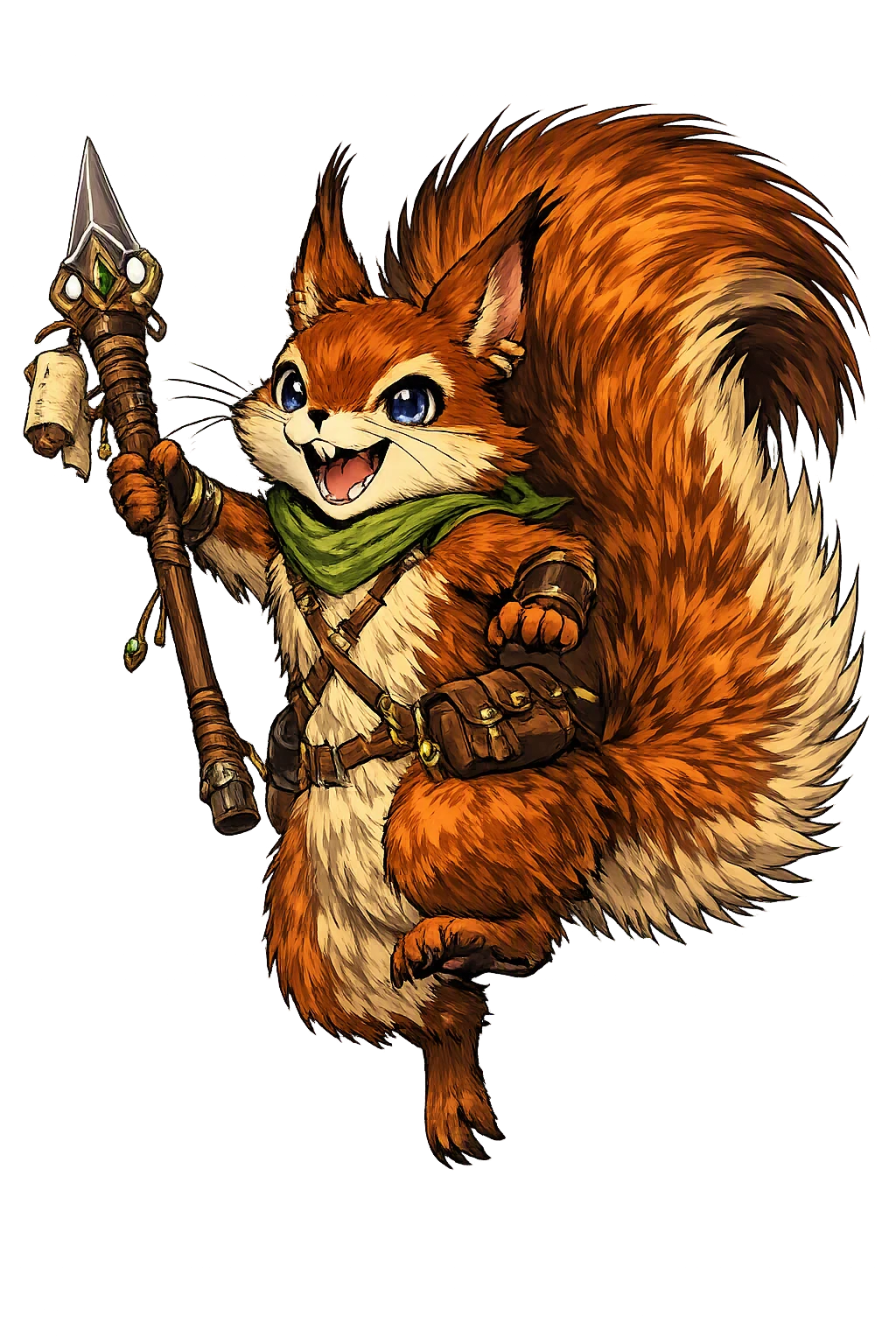
Ratatoskr mascot