PuniCodex

Extended Lore

雷神 Raijin

Etymology · Orthography · Cult · Iconography · Reception · Sources

Tier 2 Raijin
Raijin — Thunder, Lightning
01

Quick Facts

Essential information about Raijin, Thunder, Lightning

Original Script雷神
Unicode RestorationRaijin
Reconstructed Pronunciation/ɾa.i.dʑiɴ/
PantheonJapanese
DomainThunder, Lightning
MeaningThunder god
ClassificationTier 2
Primary DomainRaijin
Sacred SymbolsThunder drums, Lightning bolts, Demon face, Storm clouds
02

Etymology & Word Family

From original script to Unicode restoration

Original Script 雷神 Raijin — "Thunder god"
Unicode Restoration Raijin Canonical scholarly spelling — ASCII-identical
Modern ASCII raijin Plain-ASCII fallback

The name Raijin reaches the modern world through scholarly transliteration of the japanese tradition. Because the conventional spelling uses only Latin letters, its Unicode and ASCII forms coincide — the tradition it carries is in the name itself, not in diacritics.

03

Unicode Character Breakdown

Character-by-character philological analysis

CharacterUnicodeNameBlockPhonetic Role
RU+0052Latin Capital Letter RBasic LatinSame, capitalized
aU+0061Latin Small Letter ABasic LatinSame
iU+0069Latin Small Letter IBasic LatinSame
jU+006ALatin Small Letter JBasic LatinSame
iU+0069Latin Small Letter IBasic LatinSame
nU+006ELatin Small Letter NBasic LatinSame

The Tier 2 classification here reflects fidelity to the attested tradition, not recovered diacritics: every character of Raijin already survives in ASCII. What the restoration preserves is the canonical spelling itself — the form scholarship standardised.

04

Cult & Worship

How the sacred was kept — rites, sanctuaries, remains

The Cult

Raijin was propitiated at moments of meteorological danger: thunder rituals, agricultural prayers for rain, and apotropaic rites to avert lightning-strike and fire. His cult was diffuse rather than centralized, expressed through neighborhood thunder shrines, mountain ascetics, and the protective symbolism of the shimenawa rope. The Kaminarimon of Sensō-ji in Asakusa — the 'Thunder Gate' — became his most famous urban cult site after its first building in 942 CE, rebuilt most recently in 1960. Sumo, folk performance, and festival floats invoke him alongside Fūjin; no single priesthood controlled his worship, but amulets, gate guardians, and storm-season observances kept him present in popular religion.

In the Earth

Raijin's material record is pictorial and architectural rather than inscriptional. The supreme witness is Tawaraya Sōtatsu's Fūjin-Raijin-zu (early seventeenth century, ink and color on paper, National Treasure, Kennin-ji, Kyoto), which fixed the modern image of the drum-ringed thunderer. The Kaminarimon ('Thunder Gate') of Sensō-ji, Asakusa, first built in 942 and rebuilt in 1960 after the 1865 fire, enshrines Fūjin and Raijin statues above its famous lantern. Sets of the Twelve Devas (Jūni-ten) at esoteric temples such as Tō-ji in Kyoto preserve Heian-period sculptural lineages of the thunder guardian, and Hokusai's manga sketches spread his likeness to every corner of Japan.

05

Iconography

How Raijin was imaged across the ages

The Image

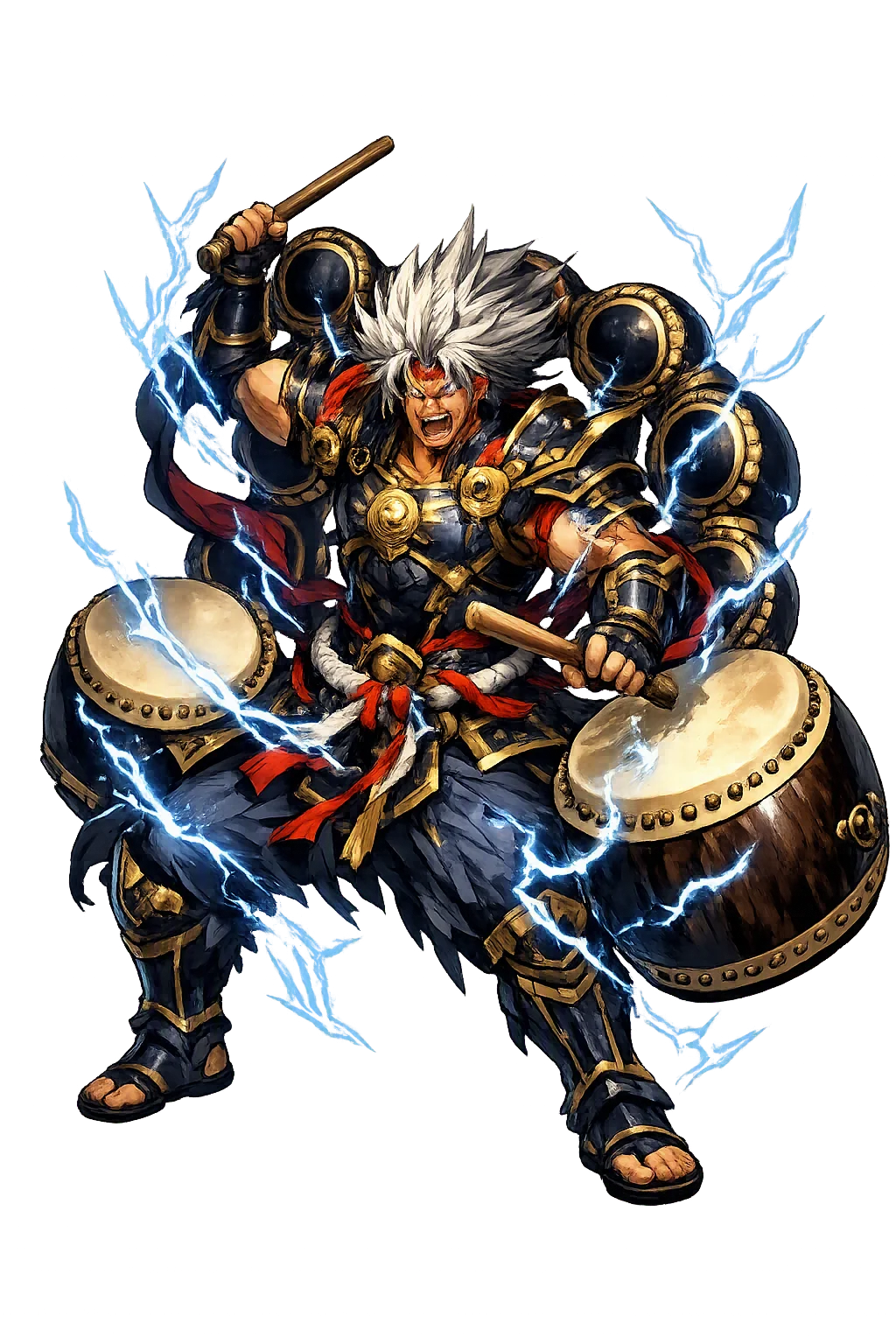
Raijin's modern image was fixed by Tawaraya Sōtatsu's early-seventeenth-century Fūjin-Raijin-zu (National Treasure, Kennin-ji, Kyoto): a muscular, red-skinned thunderer enclosed in a drum-ring, beating taiko with forked lightning falling from the drums. This iconography draws on earlier Buddhist and Daoist wind-and-thunder god depictions imported from China, filtered through Japanese screen painting and temple banners. Vase paintings and emaki show him as a fierce oni-like figure; Edo-period prints and festival banners simplified the drum-circle motif. Today his image guards temple gates and appears in manga, anime, and video games as the default personification of Japanese thunder.

06

Reception & Transformation

The name after its own age — transmission, translation, survival

Afterlives

Raijin descends from a confluence of Japanese native thunder kami, Chinese Leigong iconography, and Buddhist guardian imagery. The Kojiki and Nihon Shoki place him among the deities born from Izanami's death and Izanagi's purifications, anchoring him in the classical pantheon. Medieval Buddhism paired him with Fūjin as protectors of temple compounds, and the pair entered the visual imagination of Zen ink painting. The early modern period turned him into a popular emblem of elemental force, reproduced on screens, fans, and festival floats. In the twentieth and twenty-first centuries, Raijin became a global marker of Japanese visual culture, appearing in film, comics, sports mascots, and video games, while remaining tied to Asakusa's Kaminarimon and the Kennin-ji masterpiece.

Identifications Across Traditions

Raijin descends from Indian Indra through the Buddhist Taishakuten, but he is no simple borrowing: the Kojiki's thunder spirits born of Izanami's body are native and older, and the mature Raijin is the fusion of both lines. In esoteric Buddhism he serves among the Twelve Devas, and his permanent pairing with Fūjin expresses the Japanese reading of storms as coupled powers — wind and thunder — rather than as one god's attribute. The medieval kamikaze legend added a third layer, national salvation; the nursery warning a fourth, domestic discipline. Each tradition kept the same figure because each needed the same thing: a way to say that the storm is not random.

Modern Legacy

Raijin remains one of Japan's most visually striking deities. His most famous portrait, Tawaraya Sōtatsu's Fūjin-Raijin-zu screens (early seventeenth century, now a National Treasure at Kennin-ji in Kyoto), is a canonical image of Japanese art, endlessly reproduced. The Kaminarimon — 'Thunder Gate' — of Sensō-ji in Asakusa has guarded the temple approach since 942, its great red lantern one of Tokyo's landmarks. He drums his way through ukiyo-e, manga, anime, and video games as the archetype of overwhelming natural power, and the old folk instruction to cover one's navel in a storm is still spoken to Japanese children. Few gods so terrifying in appearance live so comfortably in a modern city.

07

The Meditation

What Raijin means — beyond the dictionary

Raijin is the sound of the sky's anger and the light that splits the darkness. He reminds us that nature is not merely beautiful; it is also loud, dangerous, and alive. To stand before Raijin is to feel small before the storm — and Japan, sitting in the typhoon belt on the Pacific Ring of Fire, has more reason than most civilizations to keep that feeling close.

Yet the same tradition that made him a demon made him a guardian. The drum that terrifies the child also warns the temple; the lightning that burns the tree also marks the god who protects the gate. Raijin holds both truths without embarrassment. In an age that likes to separate danger from safety, he is the older, wiser figure: the same sky does both, and the wise household covers its navel and keeps its gate.

08

Screen & Culture

Where Raijin echoes through film, television, and games — and how

09

Frequently Asked Questions

Common questions about Raijin, Thunder, Lightning, and Unicode restoration

01How do you pronounce Raijin?

In reconstructed pronunciation, Raijin is /ɾa.i.dʑiɴ/ — approximately 'RAH-ee-jeen' — the 'r' is a light tap, and the final 'n' is a soft nasal.

02What does Raijin mean?

Raijin means Thunder god in the japanese tradition.

03What are the symbols of Raijin?

Raijin is associated with Thunder drums (The ring of drums around his body; each beat of thunder is a drumstroke, and the rings on the drumheads count them), Lightning bolts (The arrows or thunder-snakes (raiki) he casts from the clouds), Demon face (His fierce oni expression — the standard visual grammar of Japanese protective deities, whose ugliness is a shield), Storm clouds (The dark clouds from which he emerges, drawn as a floating island of thunder).

04Why restore Raijin in Unicode?

Raijin is written entirely in ASCII letters, so its restoration is about canonical fidelity rather than recovered diacritics: the temple fixes the name in its scholarly standard spelling, attested in the source tradition, instead of leaving it to drift.

05What is the most important myth about Raijin?

“Thunder Born of the Dead Goddess” — the Kojiki story that anchors the mythology of Raijin, told in full on the lore page.

10

Scholarly Sources

The philological foundations of this restoration

Every claim on this page is grounded in established scholarship. The orthographic restorations follow disciplinary convention. The etymological chain follows the best available reference works. This is not invention — it is resurrection through scholarship.

◈

Lexicography & Philology

  • Lexical and philological sources for Raijin.
◎

Primary Texts

  • Kojiki
  • Nihon Shoki
  • Kojiki (thunder deities born of Izanami; Fūjin born of Izanagi's breath)
  • Nihon Shoki (parallel variants)
◉

Archaeology & Art History

  • Material evidence — iconography, inscriptions, and temple archaeology — for Raijin and related cults.
✦

Religious Studies

  • Takezaki Suenaga, Mōko Shūrai Ekotoba (c. 1293)
  • Bocking, A Popular Dictionary of Shinto
  • Ashton, S. R., The Japanese Storm-God in the Image and the Legend (1965)
Return

The Surface Awaits

You have traced the name from its earliest attestation to its Unicode restoration. Now return to the myth. The story is where the name lives.

Back to Lore
Raijin mascot