
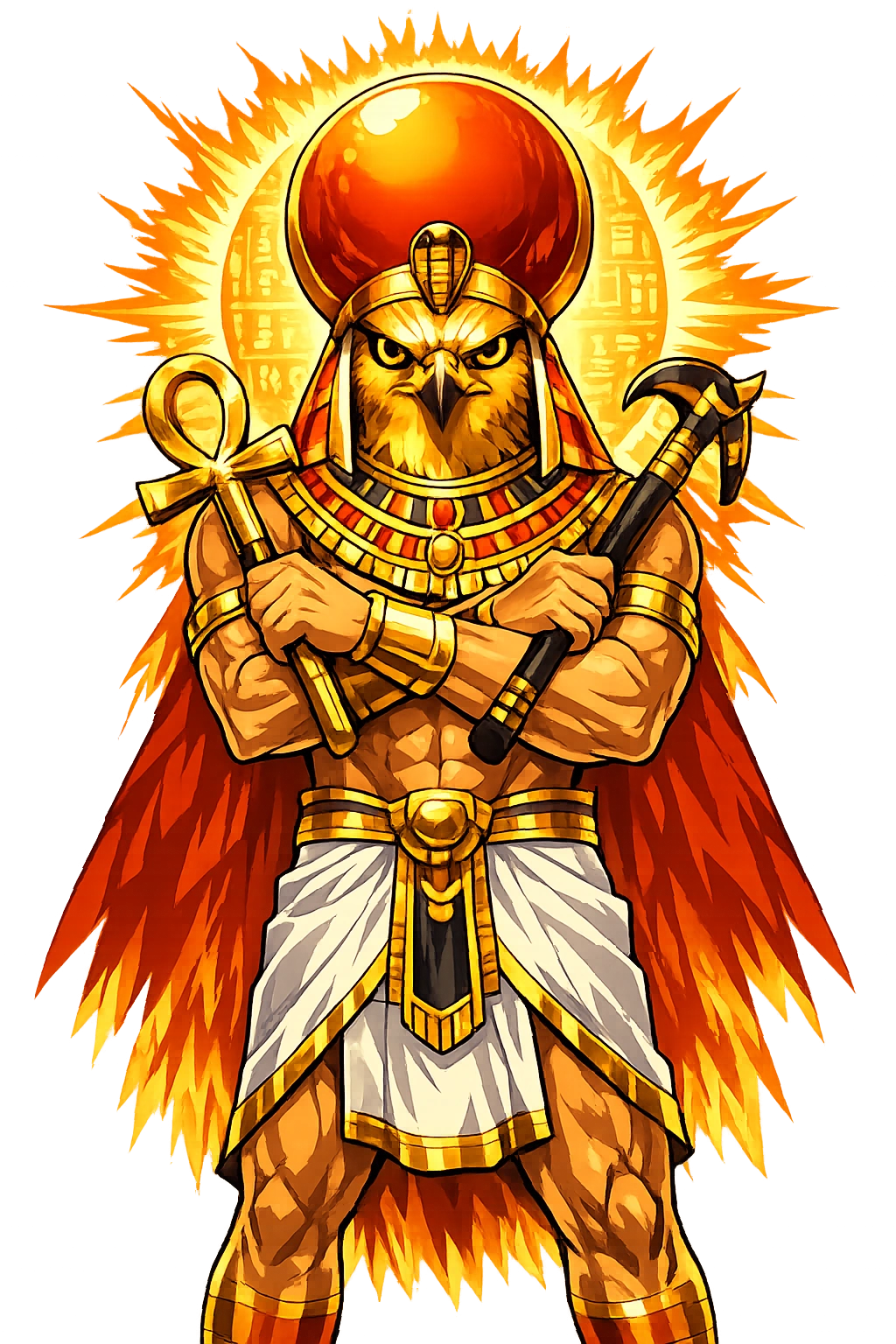
Why Rꜥ is spelled that way — and what it costs to get it right
There is a version of this name the early internet had to settle for: ra. This is the file on how Rꜥ replaced it.
Rꜥ's theology is Egypt's most complete vision of order (maat): the sun's daily circuit is a voyage, a kingship and a war. Each dawn the god is born in the east; each night he dies and must be defended; every royal tomb and solar temple re-stages that victory on earth.
At a Glance
- Restored name: Rꜥ
- ASCII form: ra
- Meaning: "Sun (from Egyptian rꜥ)"
- Domain of influence: Sun, Creation, Kingship
- Pantheon: Egyptian
- Classification: Tier 1
- Original script: 𓂋𓂝𓇳
- Series: The Restoration Files, No. 406 of 546
The Name Before the Marks
Spoken, the name runs `/raʕ/` — 'rah-ʿA' — a rolled or tapped 'r', then a deep throaty 'ah' like the Arabic ع.
The Temple That Stands Now
The restored name is not a plaque; it is an address. The temple of Rꜥ lives at /ra/, with its mythology in the lore halls, its peer-reviewed record in the Scholarly Edition, and its place in the pattern atlas on the patterns floor.
Tier-1 is not a compliment; it is a measurement. This restoration keeps something the ASCII form provably loses, and the measurement is repeatable.
Where the Name Stood First
Solar cult is visible in the pyramid complexes of the Old Kingdom, the solar temple of Nyuserre at Abu Ghurab, and the great temples of Heliopolis, Karnak and Abu Simbel — whose facade colossi face the sun's rays at the equinoxes. The colossal obelisks of Heliopolis and Luxor, single shafts of Aswan granite, stood before the sun's temples; pairs from Luxor now stand in London and Paris. The Amarna boundary stelae and the Great Hymn to the Aten preserve Akhenaten's solar theology, and tomb paintings from the Valley of the Kings show Ra in his day- and night-barks, surrounded by protective deities. The temple on the web is the newest of these addresses — the first one that fits in a pocket.
The Archetype at Work
The pattern atlas seats this temple in 4 industries, each match argued and weighted: Leadership, Governance & Public Administration (creator and king; the state’s first solar brand.); Solar & Renewable Energy (the sun ferried across the sky in his barque each day, creator and king of the gods — Egypt’s solar engine.); Automotive & Mobility (the solar barque crossing heaven by day and the underworld by night — the vessel as archetype of travel.). The Resonance File reads those seats through the myths themselves.
In the Sacred Texts
The Egyptian tradition is not a vibe; it is a library. The Sacred Texts collection holds The Book of the Dead — the primary sources the temple's scholarship is built on. The temple is the argument; the texts are the evidence.
The File Continues
The temple's founding dispatch tells the name's story; its Resonance File reads the myths into the industries; the blog index holds the whole archive.
Continue the series — previous file: Quetzalcōātl (read it here) · next file: Radagast (read it here).
The Restoration Files are written from the same canonical record as the temples themselves: the lexicon, the lore catalog, the pattern atlas, and the cited scholarly sources. If a file ever disagrees with its temple, the temple is right — tell us, and the file will be corrected.