PuniCodex

Extended Lore

Pryderi

Etymology · Orthography · Cult · Iconography · Reception · Sources

Tier 2 Pryderi
Pryderi — Son of Pwyll, King
01

Quick Facts

Essential information about Pryderi, Son of Pwyll, King

Scholarly TransliterationPryderi
Unicode RestorationPryderi
Reconstructed Pronunciation/prəˈdɛr.i/
PantheonCeltic
DomainSon of Pwyll, King
MeaningCare, anxiety
ClassificationTier 2
Primary DomainPryderi
Sacred SymbolsThe silk brocade wrapping, The clawed hand, The golden bowl on its chains, The gate-hammer about his neck, The swine of Annwn
02

Etymology & Word Family

From original script to Unicode restoration

Scholarly Transliteration Pryderi Pryderi — "Care, anxiety"
Unicode Restoration Pryderi Canonical scholarly spelling — ASCII-identical
Modern ASCII pryderi Plain-ASCII fallback

The name Pryderi reaches the modern world through scholarly transliteration of the celtic tradition. Because the conventional spelling uses only Latin letters, its Unicode and ASCII forms coincide — the tradition it carries is in the name itself, not in diacritics.

03

Unicode Character Breakdown

Character-by-character philological analysis

CharacterUnicodeNameBlockPhonetic Role
PU+0050Latin Capital Letter PBasic LatinSame, capitalized
rU+0072Latin Small Letter RBasic LatinSame
yU+0079Latin Small Letter YBasic LatinSame
dU+0064Latin Small Letter DBasic LatinSame
eU+0065Latin Small Letter EBasic LatinSame
rU+0072Latin Small Letter RBasic LatinSame
iU+0069Latin Small Letter IBasic LatinSame

The Tier 2 classification here reflects fidelity to the attested tradition, not recovered diacritics: every character of Pryderi already survives in ASCII. What the restoration preserves is the canonical spelling itself — the form scholarship standardised.

04

Cult & Worship

How the sacred was kept — rites, sanctuaries, remains

The Cult

Pryderi was never worshipped, and the point matters: he is a figure of Welsh prose fiction, not of cult. The Four Branches were composed around 1060–1120 and survive complete in the White Book of Rhydderch (c. 1350) and the Red Book of Hergest (c. 1382–1410) — no sanctuary, festival, priesthood, or votive deposit anywhere in Wales or beyond is connected with his name, and no early Welsh inscribed stone invokes him. What the tales preserve instead is a faint pre-Christian resonance the handbooks register honestly: the Triads of the Island of Britain remember him among the Three Powerful Swineherds, and comparatists set his birth-and-loss story beside the divine-son type of Mabon and the Gaulish Maponos — possible echoes of an older mythology, never evidence of a cult. The Pryderi honoured in modern Welsh pagan and Druid practice is a revival construction of the twentieth century, built on the medieval prose, not a survival of ancient rite.

In the Earth

Pryderi is a textual figure: no temple, votive deposit, or inscription names him, and the early inscribed stones of Wales — Latin and ogham memorial stones of roughly the fifth to seventh centuries — record personal names in funerary formulae, not the heroes of story. His evidence is manuscript evidence. The Four Branches survive complete in the White Book of Rhydderch (Aberystwyth, NLW Peniarth MSS 4–5, c. 1350) and the Red Book of Hergest (Oxford, Jesus College MS 111, c. 1382–1410), with earlier fragments in Peniarth 6; the tales' date of composition is argued rather than documented — Ifor Williams placed them in the later eleventh century, and current scholarship generally holds a range around 1060–1120. The geography of his story is real and walkable: Arberth, the chief court of Dyfed, stands by modern Narberth in Pembrokeshire; Y Felenrhyd, where the fatal combat was fought, lies in the country toward the border of Gwynedd and Dyfed; and the Fourth Branch points to his grave at Maen Tywynog above it. The nearest epigraphic horizon is comparative, not his: the Gaulish Maponos of the Chamalières tablet and the northern British dedications to Apollo Maponus — the divine son whose figure-type the handbooks read him against.

05

Iconography

How Pryderi was imaged across the ages

The Image

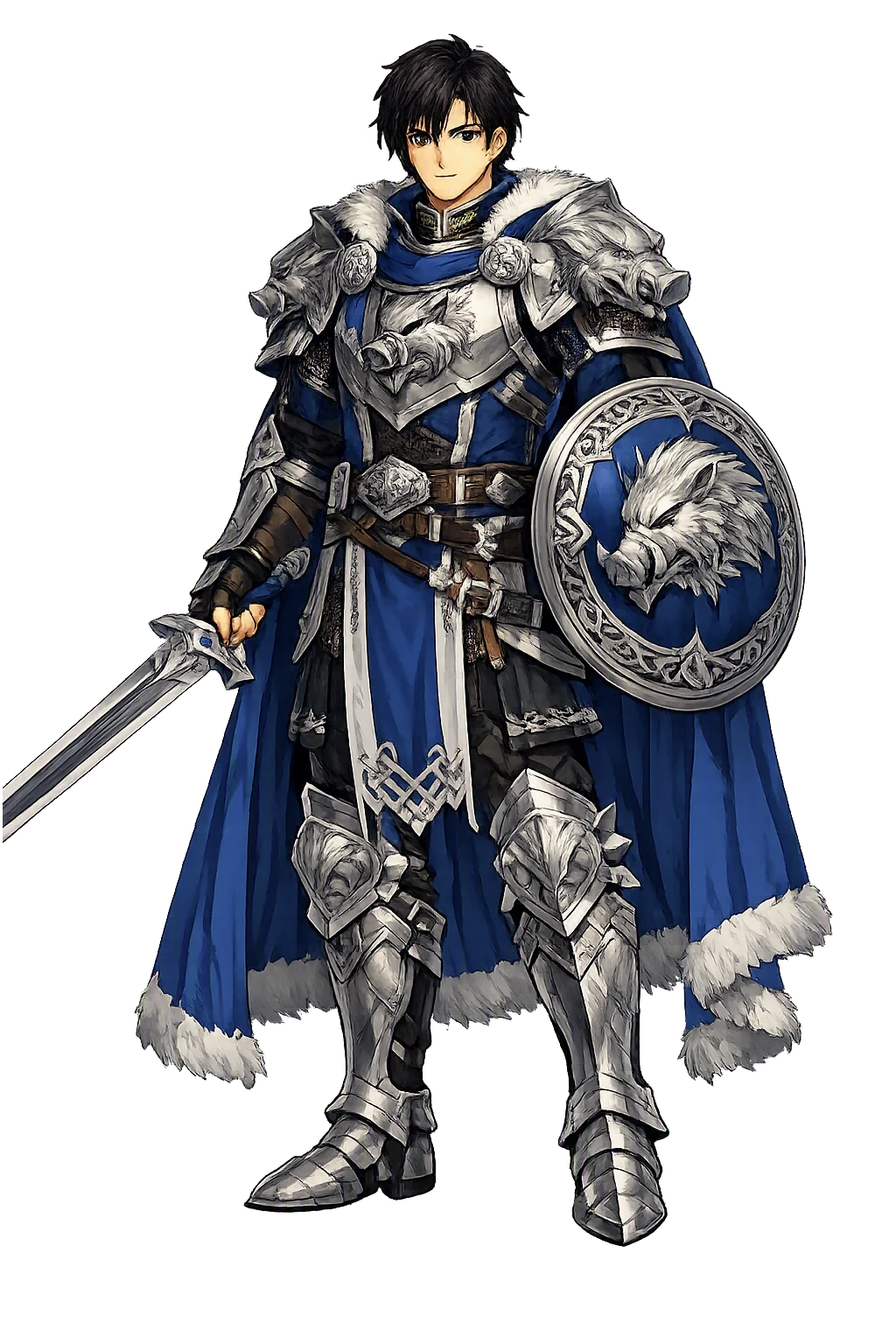
No image of Pryderi survives from any period before the age of book illustration. The White Book and the Red Book transmit the Four Branches as prose — their decoration is the calligrapher's, not the narrative artist's — and medieval Wales produced no cycle of images for its native tales: no carved Teyrnon, no stained-glass Arberth, no illuminator's stable door. What the texts supply is an attribute-system any image-maker could recognize: the silk brocade in which the foundling lies at the stable door, the golden bowl hung on its chains above the marble fountain, the gate-hammer he wears home out of the enchantment, and the hobeu, the first swine of Wales, whose theft costs him his life. The visual tradition begins only when the Mabinogion reached print: the illustrators of Lady Charlotte Guest's translation, and after them the painters and children's-book artists of the Welsh twentieth century, fixed the stable-door scene and the shining boar as the canonical images. Every depiction of Pryderi is thus a modern one, built wholly from the tale's own props.

06

Reception & Transformation

The name after its own age — transmission, translation, survival

Afterlives

Pryderi's afterlife is the afterlife of the book that holds him. The Four Branches were copied into the two great Welsh codices — the White Book of Rhydderch (c. 1350) and the Red Book of Hergest (c. 1382–1410), with fragments in Peniarth 6 — and reached print only with the Welsh revival: William Owen Pughe issued a serial translation between 1795 and 1821, and Lady Charlotte Guest's three-volume Mabinogion (1838–49) carried the boy of the stable door into the reading of the English-speaking world. Scholarship then made him its own. Ifor Williams's Pedeir Keinc y Mabinogi (1930) established the modern Welsh text and the now-standard dating of composition to the decades around 1100; W. J. Gruffydd's Rhiannon (1953) built an entire comparative argument around the Pryderi complex; Proinsias Mac Cana's study of the Mabinogi fixed his modern standing as the figure who alone spans all Four Branches. Meanwhile the word itself kept living its own quiet life: Welsh pryder, 'care, anxiety', remains an ordinary word of the modern language, so that every Welsh speaker who worries pronounces, without knowing it, the name of the king who was named out of relief.

Identifications Across Traditions

Pryderi's great comparative frame is the Celtic divine son. The handbooks set him beside Mabon ap Modron — 'Son son of Mother' — the youth of Culhwch ac Olwen who was taken from his mother Modron when he was three nights old and found again after a search that outlasts every living memory, and behind Mabon the Gaulish Maponos, the 'Divine Son' whom Romano-Celtic dedications pair with Apollo. A child of an Otherworld mother, stolen at birth and restored, whose name carries his story: the figure-type is one, and Mac Cana and Koch both register the comparison — but the names are not cognate, and no scholar claims identity. The second frame is sovereignty-by-loss: like the stricken kings of Irish tradition, Pryderi holds a kingdom that enchantment can empty in a night, and his rescue comes not by his own strength but by Manawydan's patience — the Third Branch's quiet thesis about where a king's real safety lies. Within the corpus his closest kin are his parents [[rhiannon|Rhiannon]] and Pwyll Pen Annwn, his stepfather and rescuer [[manawydan|Manawydan]], his benefactor [[arawn|Arawn]] of [[annwn|Annwn]], and his slayer [[gwydion|Gwydion]] — the enchanter whose conjured wealth bought the pigs and, with them, the war.

Modern Legacy

Lady Charlotte Guest's translation of the Mabinogion (1838–49) carried Pryderi out of the Welsh manuscripts and into English, and the Victorian Celtic revival made the vanished child of the First Branch one of its set-pieces. Twentieth-century scholarship gave him his modern standing: Ifor Williams's edition fixed the standard Welsh text, W. J. Gruffydd's Rhiannon (1953) built its whole argument about the First and Third Branches around the Pryderi complex, and Mac Cana's study of the Mabinogi made the boy who spans all four branches the structural key to the cycle. Evangeline Walton's Mabinogion tetralogy retold his theft and naming for modern readers, and Lloyd Alexander's Chronicles of Prydain — five novels built openly on the Mabinogi's world — carried the matter of Pryderi's branches to a vast young readership, though the boy himself never appears under his own name. In modern Druid and pagan practice he is honoured as the lost-and-found divine son and the lord who endured the emptied land, and the name survives in scholarship as the standing example of the Mabinogi's own method: a person named, deliberately and explicitly, out of a single spoken word of grief relieved.

07

The Meditation

What Pryderi means — beyond the dictionary

Pryderi is named out of relief. His mother has carried a false charge for years — sitting by the horse-block, offering her back to strangers — and when the lost boy is set before her she does not say vengeance, or justice, or even joy: she says her care is lifted, and the court builds the child's name out of that word. Anxiety, made into a name and then, astonishingly, into a king. The rest of his story keeps faith with the naming. His is the kingdom a mist can empty between one hour and the next; his is the hand that sticks to the golden bowl; his is the herd of otherworld pigs that a poet's illusion can buy; his is the grave above Y Felenrhyd. Nothing in the Four Branches is safe, and Pryderi is the figure through whom the Mabinogi says so — the lord who loses everything except the thread of the tale, and who walks through all four branches carrying it. Care, the Welsh word means; and also what care is for: the watch kept, the debt counted, the mother who waited at the gate.

08

Frequently Asked Questions

Common questions about Pryderi, Son of Pwyll, King, and Unicode restoration

01How do you pronounce Pryderi?

In reconstructed pronunciation, Pryderi is /prəˈdɛr.i/ — approximately 'pruh-DEH-ree' — the y is a soft 'uh', the stress falls on 'der' (the Welsh penult), and the final i is a short 'ee'.

02What does Pryderi mean?

Pryderi means Care, anxiety in the celtic tradition.

03What are the symbols of Pryderi?

Pryderi is associated with The silk brocade wrapping (Royal blood declaring itself at a stable door — the foundling child whose swaddling says what no witness can), The clawed hand (The Otherworld reaching through the window on May-eve — the unseen power that takes foals and princes alike), The golden bowl on its chains (Bait that looks like treasure — the trap at the heart of the enchanted fortress, and the cost of touching what is not yours), The gate-hammer about his neck (What he wore out of the enchantment — the humiliation of the Third Branch, borne home and buried in silence), The swine of Annwn (Otherworld wealth with a geis upon it — not to be sold or given until the herd had doubled — and the war a broken promise bought).

04Why restore Pryderi in Unicode?

Pryderi is written entirely in ASCII letters, so its restoration is about canonical fidelity rather than recovered diacritics: the temple fixes the name in its scholarly standard spelling, attested in the source tradition, instead of leaving it to drift.

05What is the most important myth about Pryderi?

“The May-Eve Vanishing” — the First Branch · Pwyll Pendefig Dyfed story that anchors the mythology of Pryderi, told in full on the lore page.

09

Scholarly Sources

The philological foundations of this restoration

Every claim on this page is grounded in established scholarship. The orthographic restorations follow disciplinary convention. The etymological chain follows the best available reference works. This is not invention — it is resurrection through scholarship.

◈

Lexicography & Philology

  • Mabinogion
  • MacKillop
◎

Primary Texts

  • The Immram Brain (Voyage of Bran); Tochmarc Étaíne; Cóir Anmann; medieval Irish saga literature.
◉

Archaeology & Art History

  • Material evidence — iconography, inscriptions, and temple archaeology — for Pryderi and related cults.
✦

Religious Studies

  • The Mabinogi — all Four Branches (Pwyll Pendefig Dyfed; Branwen ferch Llŷr; Manawydan fab Llŷr; Math fab Mathonwy): trans. Sioned Davies (Oxford, 2007); Welsh text ed. Ifor Williams, Pedeir Keinc y Mabinogi (1930)
  • The Mabinogion, trans. Lady Charlotte Guest (1838–49)
  • Bromwich, Rachel, ed. and trans., Trioedd Ynys Prydein: The Triads of the Island of Britain, 4th ed. (University of Wales Press, 2014) — the Three Powerful Swineherds: Pryderi tending the swine of Pendaran Dyfed
  • Gruffydd, W. J., Rhiannon: An Inquiry into the Origins of the First and Third Branches of the Mabinogi (University of Wales Press, 1953)
  • Mac Cana, Proinsias, The Mabinogi, 2nd ed. (University of Wales Press, 1992) — Pryderi as the figure spanning all Four Branches; the Mabon comparison
  • Koch, John T., ed., Celtic Culture: A Historical and Comparative Encyclopedia (ABC-CLIO, 2006), s.vv. Pryderi, Mabon, Maponos
  • MacKillop, James, Dictionary of Celtic Mythology (Oxford, 1998), s.vv. Pryderi, Teyrnon, Gwri Wallt Euryn
  • Geiriadur Prifysgol Cymru / A Dictionary of the Welsh Language (GPC), s.vv. Pryderi, pryder
Return

The Surface Awaits

You have traced the name from its earliest attestation to its Unicode restoration. Now return to the myth. The story is where the name lives.

Back to Lore
Pryderi mascot