PuniCodex

Extended Lore

प्रजापति Prajāpati

Etymology · Orthography · Cult · Iconography · Reception · Sources

Tier 1 Prajāpati.com
Prajāpati — Lord of Creatures
01

Quick Facts

Essential information about Prajāpati, Lord of Creatures

Original Scriptप्रजापति
Unicode RestorationPrajāpati
Reconstructed Pronunciation/prɐ.dʑaː.pɐ.ti/
PantheonSanskrit
DomainLord of Creatures
Meaning'Lord of Creatures' — the creator and progenitor ranked above or among the Vedic gods
ClassificationTier 1
Primary DomainPrajāpati.com
Sacred SymbolsEgg (aṇḍa), Fire altar, Year, Puruṣa, Swan or goose (haṃsa)
02

Etymology & Word Family

From original script to Unicode restoration

Original Script प्रजापति Prajāpati — "'Lord of Creatures' — the creator and progenitor ranked above or among the Vedic gods"
Unicode Restoration Prajāpati Restored stress, length, and script
Modern ASCII prajapati Plain-ASCII fallback

Sanskrit tatpuruṣa compound prajā- 'offspring, creatures' + pati- 'lord, master', meaning 'Lord of Creatures'.

03

Unicode Character Breakdown

Character-by-character philological analysis

CharacterUnicodeNameBlockPhonetic Role
PU+0050Latin Capital Letter PBasic LatinSame, capitalized
rU+0072Latin Small Letter RBasic LatinSame
aU+0061Latin Small Letter ABasic LatinSame
jU+006ALatin Small Letter JBasic LatinSame
āU+0101Latin Small Letter A with MacronLatin Extended-ALong vowel
pU+0070Latin Small Letter PBasic LatinSame
aU+0061Latin Small Letter ABasic LatinSame
tU+0074Latin Small Letter TBasic LatinSame
iU+0069Latin Small Letter IBasic LatinSame

The Tier 1 classification reflects how much of the original phonology this restoration preserves — stress and vowel length for Greek names, distinctive letters and diacritics for every other tradition.

04

Cult & Worship

How the sacred was kept — rites, sanctuaries, remains

The Cult

Prajāpati’s cult is the Vedic śrauta sacrifice rather than temple worship. The Agnicayana fire-altar, filmed and analyzed by Frits Staal among Kerala Nambudiri Brahmins in 1975, enacts the body of Prajāpati in bricks and hymns, preserving a technology already described in the Śatapatha Brāhmaṇa. Royal consecration inscriptions of the Sātavāhana, Gupta, and Chola dynasties invoke him as the ritual source of kingship. The Puruṣa Sūkta’s cosmic man is visualized in Gupta relief, notably at Deogarh’s Dashavatara temple (6th century CE). No ancient festival calendar outside the Vedic year is attested, and modern public pilgrimage is minimal; his living cult survives in the Agnicayana and in domestic pañcamahāyajña routines.

In the Earth

Prajāpati's archaeology is ritual rather than sculptural. The Agnicayana fire-altar construction, documented by Frits Staal among Kerala Nambudiri Brahmins in 1975, preserves the śrauta technology in which the altar is Prajāpati's body. The Puruṣa iconography appears in Gupta relief, notably at Deogarh's Dashavatara temple (6th century CE). Satavahana, Gupta, and Chola royal consecration inscriptions invoke Prajāpati as the source of kingship and cosmic generation.

05

Iconography

How Prajāpati was imaged across the ages

The Image

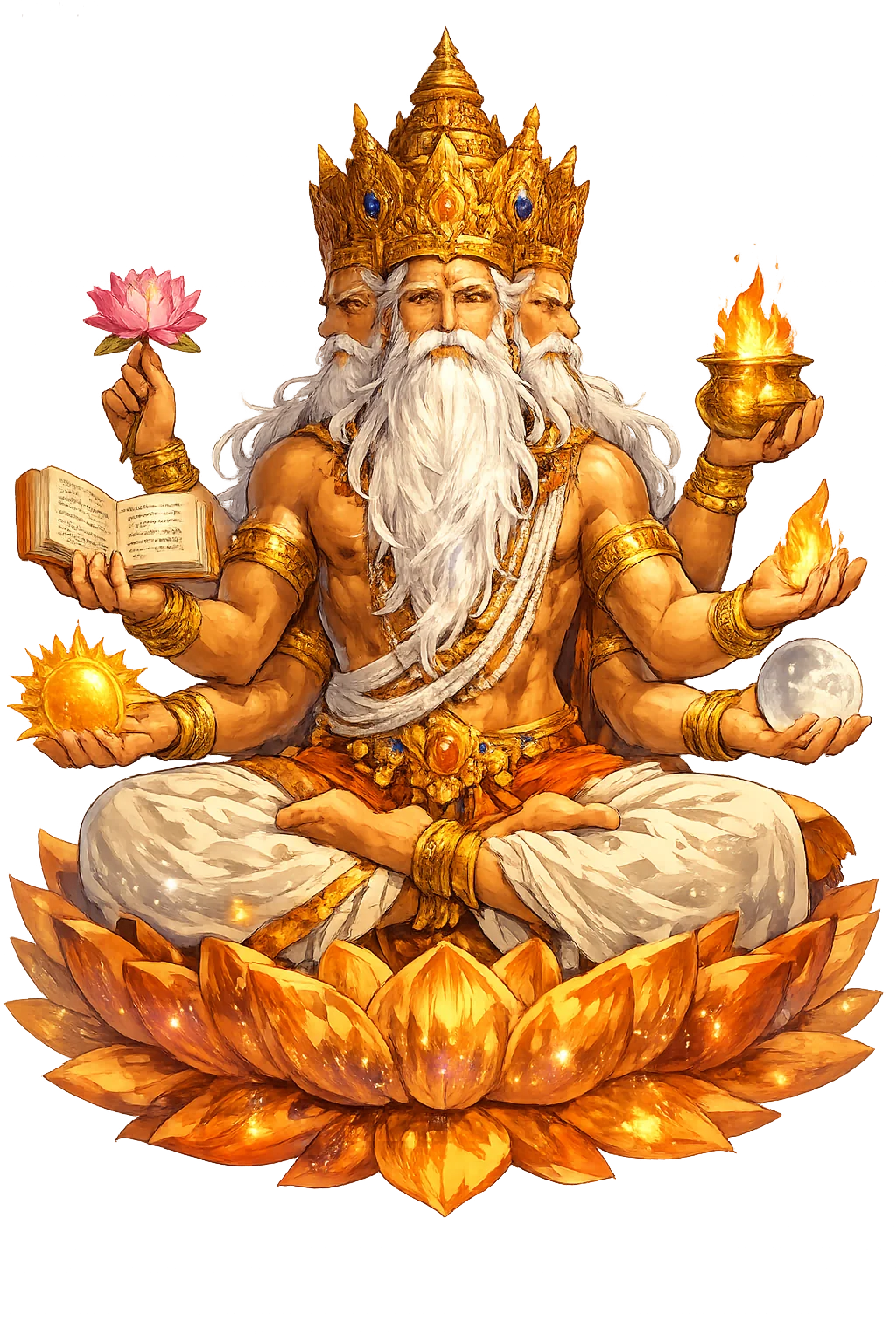
Prajāpati has no independent classical iconography apart from the Puruṣa figure. At Deogarh’s 6th-century Dashavatara temple, the cosmic man is carved in relief, his body aligned with the cardinal directions and the social classes issuing from his limbs. Later Hindu art identifies the creator with Brahmā, giving him four faces, a lotus seat, and the vedas in hand—an iconographic inheritance from Prajāpati but now labeled Brahmā. Medieval manuscripts of the Purāṇas and Ṛgveda repeat the seated creator type. Modern Indian nationalist and calendar art often collapses Prajāpati into Brahmā or the abstract “cosmic man,” while academic diagrams reproduce the Puruṣa mandala as an icon in its own right.

06

Reception & Transformation

The name after its own age — transmission, translation, survival

Afterlives

Prajāpati’s authority was absorbed into the figure of Brahmā during the late Vedic and Epic periods, so that the creator of the Purāṇas is in many ways Prajāpati renamed. The philosophical schools identified him with the absolute brahman, while temple Hinduism redirected creator devotion toward Śiva and Viṣṇu, leaving Prajāpati primarily a textual and ritual category. In medieval India, Purāṇic retellings kept the cosmogonic narratives alive; in the colonial era, European philology made Prajāpati a central exhibit in debates about “Aryan” religion and primitive monotheism. Twentieth-century Indology restored the Vedic context through editions of the Śatapatha Brāhmaṇa and Frits Staal’s Agnicayana films. Today Prajāpati appears mainly in Hindu nationalist appropriations of the Puruṣa Sūkta and in scholarly discussions of Vedic sacrifice, cosmogony, and kingship.

Identifications Across Traditions

Prajāpati is the bridge between Vedic impersonality and Purāṇic theism. His identification with Puruṣa links him to cosmic-sacrifice theology; his absorption into Brahmā links him to the later Trimūrti. The Atharvaveda already calls him the first physician, connecting creation with healing. In some strands of Vedānta, Prajāpati becomes a name for the personal god who presides over the lower Brahman, while the higher Brahman remains unnamed. His absence of cultic statues in the Vedic period makes him a pure concept: the generative ground before the gods take shape.

Modern Legacy

Prajāpati never became a popular devotional deity with mass temples, but his influence is foundational. The Puruṣa Sūkta remains one of the most recited hymns in Hindu ritual, used in weddings, housewarmings, and temple consecrations. The varṇa imagery derived from the cosmic body has shaped Indian social theory for millennia — debated, resisted, and reinterpreted, but never ignored. In modern India, 'Prajāpati' is a common surname and a title of honor. The idea that creation is a sacrifice rather than a manufacture continues to inform Hindu ecological and ritual thinking: the world is not raw material but a living body.

07

The Meditation

What Prajāpati means — beyond the dictionary

Before there was a world, there was only the will to become. That is Prajāpati. Not a craftsman standing outside his work, but the work itself in the moment before it knows it is a work. His tapas is the concentrated energy that precedes all making — the silence so full it must become sound, the darkness so dense it must become light. Every creative act repeats his gesture: the painter before the canvas, the writer before the blank page, the parent before the child. To create is to risk dismemberment, to give pieces of oneself so that something else can live.

Prajāpati teaches that creation is not a one-time event. It is continuous, renewed at every sacrifice, every dawn, every breath. The cosmos is not a machine set running; it is a fire that must be fed. To remember his name is to remember that we too are made of sacrifice — and one day must become his body.

08

Frequently Asked Questions

Common questions about Prajāpati, Lord of Creatures, and Unicode restoration

01How do you pronounce Prajāpati?

In reconstructed pronunciation, Prajāpati is /prɐ.dʑaː.pɐ.ti/ — approximately 'pruh-JAH-puh-tee' — the second syllable is long and bright; the j is soft, like the 'j' in 'judge' but lighter.

02What does Prajāpati mean?

Prajāpati means 'Lord of Creatures' — the creator and progenitor ranked above or among the Vedic gods in the sanskrit tradition.

03What are the symbols of Prajāpati?

Prajāpati is associated with Egg (aṇḍa) (The golden egg from which Prajāpati hatches; the universe in embryonic form.), Fire altar (The Vedic ritual ground laid out as his body; sacrifice as cosmic engineering.), Year (Prajāpati is identified with the year; his joints are the seasons.), Puruṣa (The Cosmic Man whose sacrifice generates the varṇas, heavens, and earth.), Swan or goose (haṃsa) (In Purāṇic iconography, his mount; the bird that separates milk from water, essence from accretion.).

04Why restore Prajāpati in Unicode?

Plain ASCII prajapati strips the stress, length, and script that make the name specific. Unicode restoration returns the name to its original written dignity.

05What is the most important myth about Prajāpati?

“From Tapas to Cosmic Egg” — the Creation story that anchors the mythology of Prajāpati, told in full on the lore page.

09

Scholarly Sources

The philological foundations of this restoration

Every claim on this page is grounded in established scholarship. The orthographic restorations follow disciplinary convention. The etymological chain follows the best available reference works. This is not invention — it is resurrection through scholarship.

◈

Lexicography & Philology

  • MW
  • RV
◎

Primary Texts

  • Ṛgveda 10.90, Puruṣa Sūkta
  • Ṛgveda 10.121, Hiraṇyagarbha Sūkta
  • Śatapatha Brāhmaṇa 1.7.2–4 (Death; the father and the daughter)
  • Atharvaveda 19.53 (Prajāpati as first physician)
  • Chāndogya Upaniṣad 8.13–15
◉

Archaeology & Art History

  • Material evidence — iconography, inscriptions, and temple archaeology — for Prajāpati and related cults.
✦

Religious Studies

  • Monier-Williams Sanskrit Dictionary, s.v. prajāpati
Return

The Surface Awaits

You have traced the name from its earliest attestation to its Unicode restoration. Now return to the myth. The story is where the name lives.

Back to Lore
Prajāpati mascot