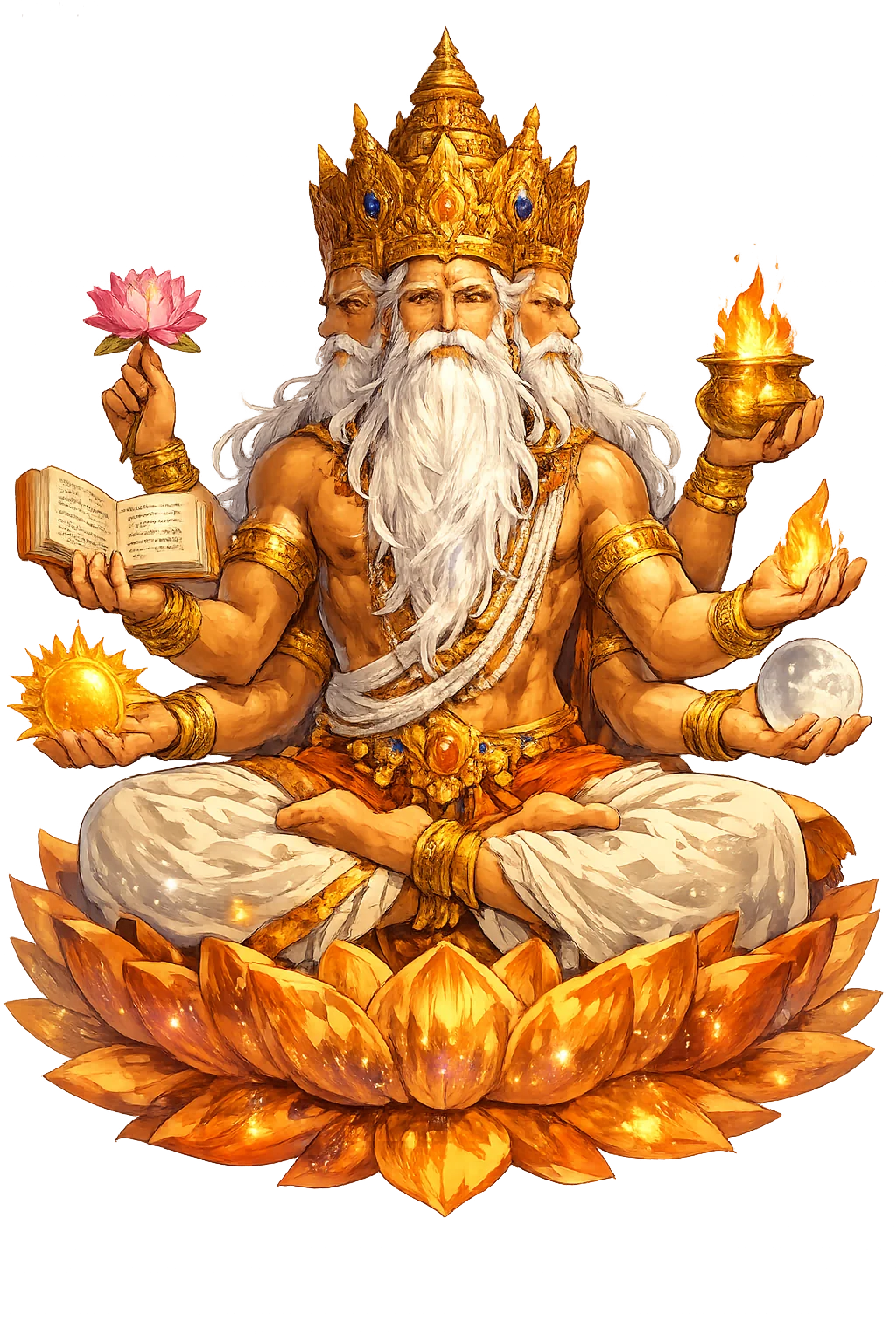
Stories of Prajāpati
Prajāpati's mythology is cosmogonic speculation cast as narrative: he is the One who becomes many, the undifferentiated whole who divides himself so that time, space, and species can exist. The Brāhmaṇas do not flatter their creator — they wound him, dismember him, and bind him back together with ritual.
In the Śatapatha Brāhmaṇa, Prajāpati exists first as the nonmanifest unity-totality. Desire (kāma) moves him to reproduce, so he heats himself by ascetic ardor (tapas) until he creates the triple Veda, then the Waters, and finally enters them. An egg develops on the waters; in the later Purāṇic telling he splits it, and the shell, membrane, and yolk become sky, mountains, and sun. He is born from it as the year, the sacrifice, and the ordered cosmos. Exhausted and disjointed by creation, he must be restored through ritual — which is why every sacrifice is said to be Prajāpati. The myth turns cosmogony into a physiology: the world is not manufactured but gestated, born, and then nursed back to health by the liturgy that remembers its body.
Ṛgveda 10.90 hymns the Puruṣa, the Cosmic Man whose body is the whole universe: a thousand heads, a thousand eyes, a thousand feet, covering the earth on every side (10.90.1). The gods sacrifice him, and from his parts arise the four varṇas — the Brāhmaṇa from his mouth, the Rājanya from his arms, the Vaiśya from his thighs, the Śūdra from his feet — while the moon is born from his mind, the sun from his eye, Indra and Agni from his mouth, the wind from his breath, and the earth from his feet (10.90.12–14). In the Brāhmaṇas this Puruṣa is identified with Prajāpati outright: 'Puruṣa is Prajāpati; Puruṣa is the Year.' Creation is therefore not manufacture but self-sacrifice — the deity giving himself to become the world, so that every later offering reenacts the primordial one. It is the Vedic answer to the question every cosmogony must face: if nothing existed, what did the maker use for material? The only available thing — himself.
The Brāhmaṇas do not spare their creator. In Śatapatha Brāhmaṇa 1.7.4, Prajāpati conceives desire for his own daughter — called Uṣas in some recensions, Rohiṇī in others — pursues her, and is pierced by an arrow of Rudra, whom the gods had charged to punish a deed 'that is not done.' The wounded father's seed falls and gathers into a lake, from which the gods fashion new life, while the ritual must labor to rejoin the dismembered creator — every sacrifice thereafter 'heals' Prajāpati. The neighboring passage (1.7.2) tells how he first created Death (Mṛtyu) to devour his creatures, and wept when they fled it. Creation, the Brāhmaṇas insist, is not innocent: the Lord of Creatures pays for generation with a wound, and the cosmos is splinted together by ritual.
As Vedic speculation gives way to theistic Purāṇic narrative, the abstract creator becomes the four-faced god Brahmā. Prajāpati's functions — creation, Vedic knowledge, sovereignty over creatures — are inherited by Brahmā, who is often called Prajāpati Brahmā, and the older name survives as a title borne by the ten mind-born sages of Manusmṛti 1.34 and by hosts of lesser progenitors. The name also migrated inward: in the Upaniṣads, Prajāpati becomes the teacher of the gods and demons about the Self (Chāndogya 8), and in some Vedāntic strands a name for the personal god of the lower Brahman. The trajectory is the reverse of most deities': not a god who grew from cult, but a concept that slowly put on a face — and then, in popular Hinduism, quietly lost it again to Śiva and Viṣṇu.
Lord of Creatures
Prajāpati is not a god of thunder or war. He is the slow, patient power of generation itself — the one who broods over the waters, performs tapas (ascetic heat), and brings forth creatures by sacrifice. In the Brāhmaṇas he becomes the supreme creator; in the Purāṇas, he passes his crown to Brahmā.
He heats himself by ascetic ardor until the cosmos condenses from his sweat and seminal emission.
The ritual fire altar is his body; every sacrifice reconstructs the world from his dismembered form.
He produces the triple Veda from himself so that gods and humans may speak the language of order.
From the waters an egg develops; its shell becomes earth, its inner fire becomes sun and life.
From the original script to the living URL
प्रजापति
The name in its original Sanskrit form. Prajāpati (प्रजापति) is attested in the source tradition — “'Lord of Creatures' — the creator and progenitor ranked above or among the Vedic gods”. Its macron-length vowels carry the full phonetic and orthographic weight of the source tradition.
prajapati
Reduced to plain prajapati, the name loses everything that made it specific: macron-length vowels. What remains is an ASCII string that machines can parse but that no longer speaks with its original voice.
Prajāpati
The Unicode restoration recovers what ASCII flattened. Prajāpati restores macron-length vowels, returning the name to its original written dignity. The domain encodes to Punycode, but the browser displays the truth.
Prajāpati.com → xn--prajpati-k7a.com
The non-ASCII characters in Prajāpati are encoded while the ASCII remains visible. To the DNS, it is Punycode. To humanity, it is Prajāpati.
Owned, ideal, and ASCII forms of Prajāpati
Prajāpati
Restores प्रजापति. The live temple domain — prajāpati.com.
prajapati
Flattens प्रजापति. The plain ASCII fallback — what DNS and legacy systems see.
How Prajāpati was spoken
How Prajāpati travels from ancient script to the modern URL
Sanskrit Prajāpati; from prajā “creature, offspring" + pati “lord"; the Vedic lord of creatures.
Lord of Creatures
The IAST form Prajāpati uses registrable Latin diacritics; the Devanagari form is not supported in .com.
The lore you have read is the living myth. Extended Lore opens the scholarly vault beneath it: the cult and its material remains, a history of the image, the name after antiquity, a meditation on what the name still means, and the full scholarly apparatus — etymology, orthography, sources.
Enter Extended Lore