PuniCodex

Extended Lore

Phánēs — The Deeper Record

Etymology · Orthography · Cult · Iconography · Reception · Sources

Preserves stress & vowel length Phánēs.com
Phánēs — Procreation, Light
01

At a Glance

Phánēs — every fact links to its home

PantheonGreek
DomainProcreation, Light
Attestedc. 340 BCE
Original ScriptΦάνης →
Primary Sources2 cited →
02

Etymology & Word Family

From original script to Unicode restoration — the full etymology page →

Original Script Φάνης Phánēs — "Bringer of light"
Unicode Restoration Phánēs Restored stress, length, and script
Modern ASCII phanes Plain-ASCII fallback

The name Phánēs carries the orthographic signature of the greek tradition: Φάνης. Unicode restoration recovers what ASCII flattens.

03

Unicode Character Breakdown

Character-by-character philological analysis

CharacterUnicodeNameBlockPhonetic Role
PU+0050Latin Capital Letter PBasic LatinP uppercase
hU+0068Latin Small Letter HBasic Latinh same
áU+00E1Latin Small Letter A with AcuteLatin-1 SupplementAcute on a
nU+006ELatin Small Letter NBasic Latinn same
ēU+0113Latin Small Letter E with MacronLatin Extended-AMacron: long vowel
sU+0073Latin Small Letter SBasic Latins same

The restoration of Phánēs preserves what it can of the original phonology — stress and vowel length for Greek names, distinctive letters and diacritics for every other tradition.

04

Cult & Worship

How the sacred was kept — rites, sanctuaries, remains

The Cult

Phánēs was worshipped the way his tradition worked — in the dark, by initiates, with books. No public temple, priesthood, or civic festival to him is attested anywhere; Orphic religion ran on initiation and rite-texts, not sanctuaries. What survives is practice glimpsed at its edges: Orphic Hymn 6 is a working invocation of Prōtógonos, sung with aromatics before the statue of a god; the gold tablets buried with the dead at Thessaly, Crete, and South Italy put his cosmology into the initiate's mouth at the grave; the Derveni papyrus shows his verses expounded in a funerary context in the fourth century BCE. Late-antique Neoplatonists wrote about him constantly and sacrificed, if they sacrificed, to other gods. Modern 'Orphic' revivals are new compositions — the ancient rite left no script to copy.

In the Earth

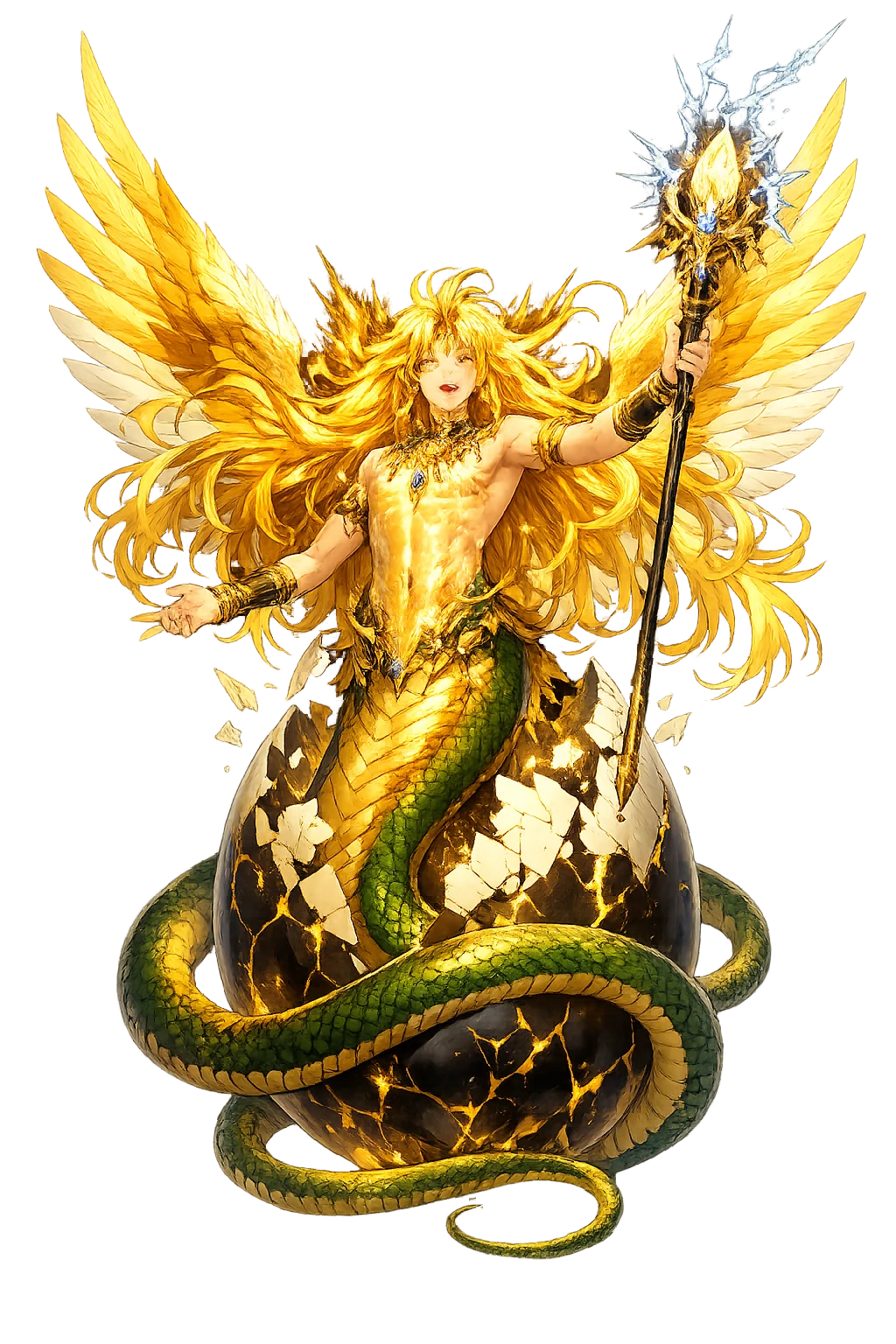
Phánēs left no temples — Orphic cult was initiatory and book-based — but two extraordinary documents survive: the Derveni papyrus (Archaeological Museum of Thessaloniki), carbonized c. 340 BCE and quoting the theogony, and the Orphic gold tablets from graves in Thessaly, Crete, and South Italy, whose instructions to the dead ('I am a child of Earth and starry Heaven') breathe the same cosmology. The Modena relief of a winged, egg-born deity with a serpent (2nd century CE) is often, cautiously, associated with his iconography; otherwise his image is carried by the hymns and the fragments alone.

05

Iconography

How Phánēs was imaged across the ages

The Image

One image carries the whole dossier. The Modena relief (second century CE, Galleria Estense) shows a winged youth emerging from a split egg, a serpent coiled at his feet — hatched in stone — and scholars have cautiously read it as Phánēs ever since. Otherwise the first-shining one was seen with the mind's eye. Orphic verse supplies the portrait: golden wings, four eyes facing every way, the serpent of Time wound round the egg, the key of mind. Roman gems of the same theurgic idiom show winged, serpent-entwined first gods as echoes. No cult statue, no pediment, no canonical vase type exists. A god without a temple kept, fittingly, almost no face; the egg, the wings, and the snake were image enough.

06

Reception & Transformation

The name after its own age — transmission, translation, survival

Afterlives

The Rhapsodies died as books but survived as quotations. Plato absorbed the egg-born pattern; Aristotle doubted Orpheus had ever lived; the Derveni commentator allegorized the verses in the fourth century BCE; Proclus made Phánēs a fixed station between the One and the intellectual gods, and Damascius mapped the whole Orphic succession. Christian apologists quoted the theogonies to mock them — and then could not stop quoting. The medieval west lost the poems entirely; what returned in the Renaissance were the hymns — Ficino translated the Orphic Hymns in 1462 for the Florentine circle, and 'Orpheus the theologian' re-entered European thought as philosophy, not cult. The nineteenth century rebuilt the text: Thomas Taylor's translations, from 1787 onward, carried Orphic cosmology to the English Romantics, and Lobeck's Aglaophamus (1829) founded its modern study. Kern's Orphicorum Fragmenta (1922) gathered the shards; the Derveni papyrus, found in 1962 and officially published in 2006, proved the theogony ancient and made Orphism a field. A god of no temples, whose whole afterlife is a bibliography.

Identifications Across Traditions

The Greeks equated him with Erōs — the oldest god in Hesiod's alternative genealogy — with Mētis, and with Dionysos in his first, pre-Zagreus form; Orphic theology is deliberately fluid, one first principle wearing many names. Scholars since the nineteenth century have set him beside the Mithraic lion-headed Aion wrapped in his serpent, and the Orphic egg beside Egyptian and Vedic world-eggs — the 'first-shining' is one of humanity's recurring answers to the question of beginnings, and the Orphics gave it their most ornate Greek form. Plato absorbed the pattern into the Timaeus; the Neoplatonists made Phánēs a fixed metaphysical grade between the One and the intellectual gods, and Proclus cites him constantly. Through that lineage the egg-born light passes into Gnostic and Hermetic speculation, where the first revealer is similarly swallowed by a father-god to become the world.

Modern Legacy

The word he gives us is as large as his myth: 'phenomenon' — that which shines forth — 'epiphany,' 'fancy' and 'fantasy,' all descend from φαίνω through Latin and French. Modern depth psychology's 'primordial light' and physics' casual metaphor of the cosmic egg both reach him, by way of Alexandria and Byzantium, from the Orphic hatching; the very first line of the Timaeus' reception history is already about him. In art he is rare but unmistakable where he appears — the Modena relief of a winged, egg-born deity, the serpent at his feet — and in scholarship he anchors the study of Greek esotericism: the Derveni papyrus and the gold tablets made 'Orphism' a field instead of a rumor. A god of no temples, he survives in the vocabulary of everything that appears.

07

The Original Script Note

What the written record preserves — and what it does not

Original Script

The name is written in Greek as Φάνης, from φαίνω, 'to bring to light, reveal' — the Revealer, an exact name for the first god of the Orphic theogonies. Phánēs belongs to the other Greece: not Homer but the hexameter theogonies sung by initiates, where he springs from the world-egg, androgynous, serpent-legged, primordial. The Derveni papyrus, our oldest Orphic commentary (late fifth century BCE), seems to know the equivalent figure under the name Prōtogónos, 'Firstborn'; the Rhapsodies and the later Neoplatonists call him Phánēs. The acute falls on the penult; the final -ης is long. The canonical form Phánēs carries both.

08

The Meditation

What Phánēs means — beyond the dictionary

Phánēs is the god of first versions — the shining draft that must be swallowed and rewritten before the world can be published. Every creator knows him: the first form of anything true is radiant, total, and unusable, and only its sacrifice makes the durable cosmos. He asks a hard question: what are you willing to swallow of your first light so that something greater can be born?

The Orphic initiates buried with their gold tablets understood him as instruction, not cosmology: remember that you are hatched from light, and the dark of the grave is only the egg's second shell. That is why his cult left no temples and few images — the first-shining one is not worshipped but recognized, in every first draft, every first light, every beginning that must be swallowed before the real world can begin.

09

Frequently Asked Questions

Deep-dives into the cult, attestation, reception, and sources of Phánēs

01How do we know how Phánēs was worshipped?

Phánēs left no temples — Orphic cult was initiatory and book-based — but two extraordinary documents survive: the Derveni papyrus (Archaeological Museum of Thessaloniki), carbonized c. The full cult record →

02Where do the earliest attestations of Phánēs come from?

The record rests on Orphic Rhapsodies, fr. 71–86, 167–168 Kern (OF 121–168 Bernabé), Orphic Hymn 6 (to Protogonos), Derveni Papyrus, cols. IX–XVI, among 6 cited works. The full source apparatus →

03How did later traditions reinterpret Phánēs?

The Rhapsodies died as books but survived as quotations. Reception & transformation →

04What do the surviving images of Phánēs actually show?

One image carries the whole dossier. The iconography →

05What does the written record of Phánēs actually preserve?

The name is written in Greek as Φάνης, from φαίνω, 'to bring to light, reveal' — the Revealer, an exact name for the first god of the Orphic theogonies. The Original Script note →

10

Scholarly Sources

The philological foundations of this restoration

Every claim on this page is grounded in established scholarship. The orthographic restorations follow disciplinary convention. The etymological chain follows the best available reference works. This is not invention — it is resurrection through scholarship.

◈

Lexicography & Philology

  • Orphic
  • West, M. L. Indo-European Poetry and Myth. Oxford: Oxford University Press, 2007.
◎

Primary Texts

  • Orphic Hymn 6 (to Protogonos)
  • Proclus, In Platonis Timaeum
◉

Archaeology & Art History

  • Boardman, J. Greek Sculpture: The Classical Period; Carpenter, T. H. Art and Myth in Ancient Greece.
✦

Religious Studies

  • Orphic Rhapsodies, fr. 71–86, 167–168 Kern (OF 121–168 Bernabé)
  • Derveni Papyrus, cols. IX–XVI
  • Damascius, De principiis (On the First Principles)
  • West, The Orphic Poems
Return

The Surface Awaits

You have traced the name from its earliest attestation to its Unicode restoration. Now return to the myth. The story is where the name lives.

Back to Lore
Phánēs mascot