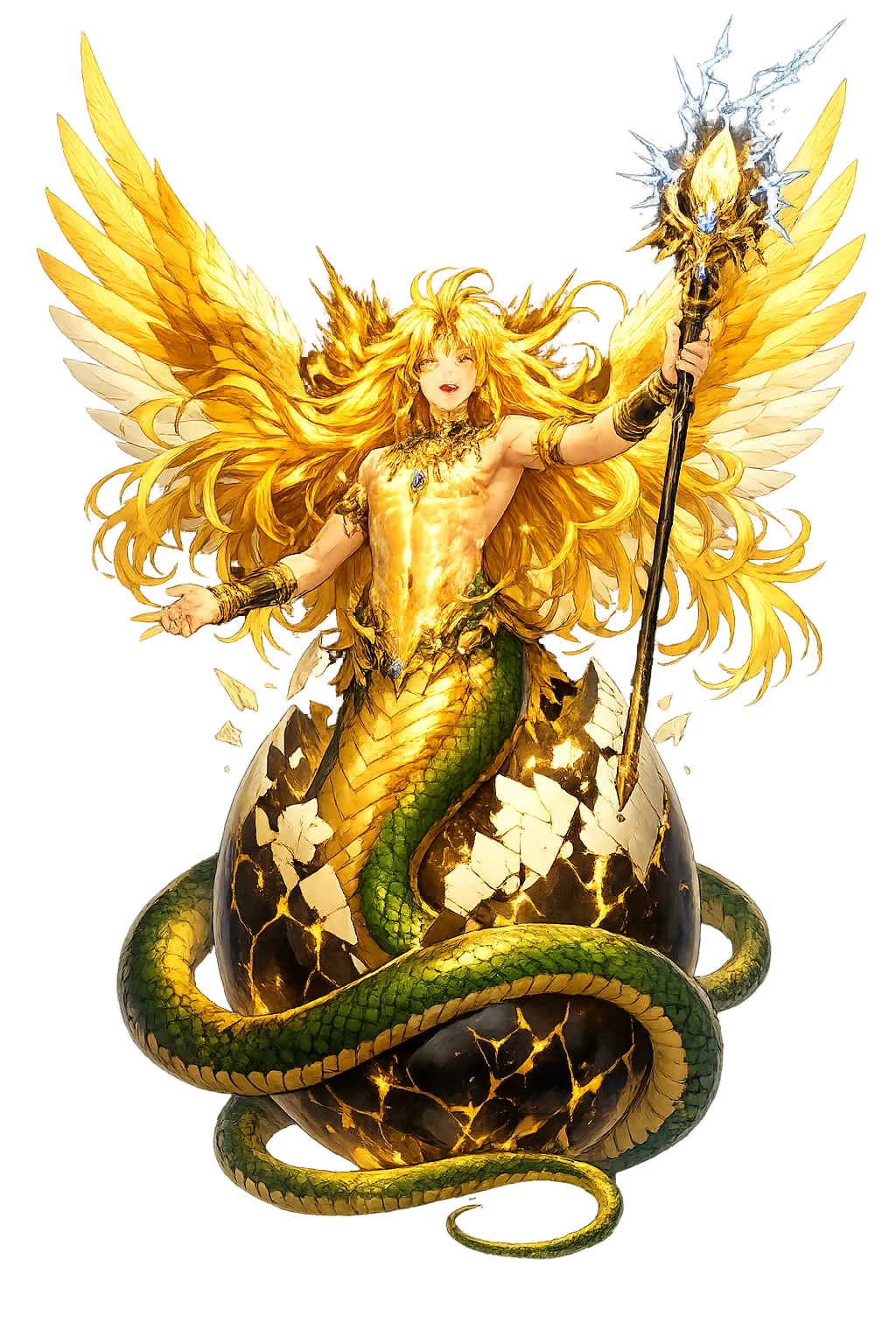
Stories of Phánēs
Phánēs belongs to the other Greece — the Orphic theogonies sung by initiates, where the cosmos begins not with Chaos' yawn but with an egg, and the first god is light itself given a name. Our knowledge of him comes from fragments, a burnt papyrus, and the gold leaves buried with the dead.
In the Orphic Rhapsodies, the beginning is not Hesiod's yawning Chaos but a craftsman: Chronos, Time unaging, fashions an egg in the luminous aithēr, and winds the serpent of necessity around it. The egg splits — and Phánēs comes forth, 'the first-born, the revealer': golden-winged, four-eyed, two-faced, bearing both sexes, carrying the seeds of all gods and all things (Orphicorum fragmenta 79–86 Kern; OF 121–131 Bernabé). His other names are a catalogue of what he is: Prōtógonos, 'first-born'; Eríkepaios, a name even the ancients left unexplained; Mētis, 'counsel'; and Erōs, for he is also desire. From him the gods receive light, the cosmos its first visible form, and the initiate the pattern of every soul's journey — hatched into light out of a shell of darkness, as the world itself was hatched.
The Orphic succession differs from Hesiod's at the very start. In the Rhapsodies, Phánēs holds the sceptre first of all — the first king of the gods — and the rule passes from him to Night, from Night to Ouranos, and thence to Kronos and Zeús, ending with Dionysos; Proclus reports the scheme as received theology, not invention (in Timaeum; Damascius, De principiis). During his reign the hymns say the cosmos was still 'all in one,' undivided; he created sun and moon, founded the first Olympus, and gave birth to the race of the immortals and the blessed. Against the Homeric background the doctrine is startling: kingship among the gods did not begin with Zeús but with a light older than the sky itself, and every later throne — Olympian included — was borrowed from the shining one's first rule, and finally returned to it in the body of the king who swallowed him.
The supreme Orphic mystery is a swallowing. Zeús, forewarned that he would be unseated as he had unseated Kronos, went to the source instead: he begged or seized Phánēs himself — the fragments say he 'swallowed the great strength of the revered Protogonos' — so that with the first god he swallowed all that the first god had made (OF 167–168 Bernabé). The preserved verses marvel at the result: 'thus all things within Zeús were made anew — the shining height of the aithēr, the sky, the sea, the earth, and the blessed gods themselves.' Creation is therefore not once but twice: first revealed in Phánēs, then reabsorbed and reborn in Zeús, so that the present cosmos is simultaneously the first god's body and the king's mind. It is the only Greek theogony in which the god who makes the world also consumes it — total incorporation as the last word of theology, and the pattern the gold tablets will copy at the scale of a single soul.
That this theology was already ancient by classical times is proven not by a temple — Orphism built none — but by a funeral fire. The Derveni papyrus, carbonized around 340 BCE in a Macedonian pyre and laboriously unrolled in the twentieth century, quotes the very poem of the swallowing and glosses it line by line: the anonymous commentator reads Zeús as Mind (Nous) ruling all that exists, and explains the verses allegorically for a circle of initiates. It is among the oldest surviving books in Europe, and it is an Orphic commentary — proof that the Phánēs theology circulated in written, taught, ritual form before Plato was born. When Plato complains of unnamed 'theologians' or Socrates cites 'Orpheus' on the body's prison, this is the company he is arguing with, and the Derveni columns are that company's earliest surviving classroom.
The religion Phánēs presided over left no temples but left instructions. The Orphic gold tablets — fingernail-thin leaves buried with initiates from Thessaly to South Italy, from the fifth century BCE onward — coach the dead: you will come to a spring; do not drink from the water of Forgetfulness but from the Lake of Memory; say to its guardians, 'I am a child of Earth and starry Heaven, but my race is of Heaven alone' (OF 474–493 Bernabé). The tablets never name Phánēs, but their cosmology is his: the soul, like the first-shining one, is a creature of light hatched out of darkness, and the journey of the dead replays the hatching of the world at a smaller scale. The egg's two halves are the two realms — the initiate who remembers which water to drink passes through the shell of death as Phánēs passed through the shell of the cosmos, into the same light.
The Orphic Egg, First Light, and the Swallowed Cosmos
Phánēs is the hidden first god of the Orphic theogonies: hatched from the silver egg of Time, winged and shining, the first form in which the universe could see itself. Zeús himself will swallow him — and in swallowing, become everything.
Formed by Chronos in the aithēr; from it the shining one hatches with golden wings.
'First-born' — his other name; also Eríkepaios, Mētis, and bright-winged Erōs.
Zeús devours Phánēs and with him all that is: sky, earth, sea, and the blessed gods.
Orphic verse calls him 'the key of the mind' — the first intelligence to shine in darkness.
From the original script to the living URL
Φάνης
The name in its original Greek form. Phánēs (Φάνης) is attested in the source tradition — “Bringer of light”. Its long vowels and acute accents carry the full phonetic and orthographic weight of the source tradition.
phanes
Reduced to plain phanes, the name loses everything that made it specific: long vowels and acute accents. What remains is an ASCII string that machines can parse but that no longer speaks with its original voice.
Phánēs
The Unicode restoration recovers what ASCII flattened. Phánēs restores long vowels and acute accents, returning the name to its original written dignity. The domain encodes to Punycode, but the browser displays the truth.
Phánēs.com → xn--phns-6na51a.com
The non-ASCII characters in Phánēs are encoded while the ASCII remains visible. To the DNS, it is Punycode. To humanity, it is Phánēs.
Owned, ideal, and ASCII forms of Phánēs
Phánēs
Restores Φάνης. The live temple domain — phánēs.com.
phanes
Flattens Φάνης. The plain ASCII fallback — what DNS and legacy systems see.
How Phánēs was spoken
How Phánēs is preserved in writing
A bespoke provenance study for Phánēs is being prepared by the PUNICODEX scholarly team.
Contribute scholarly provenance →The lore you have read is the living myth. Extended Lore opens the scholarly vault beneath it: the cult and its material remains, a history of the image, the name after antiquity, a meditation on what the name still means, and the full scholarly apparatus — etymology, orthography, sources.
Enter Extended Lore