
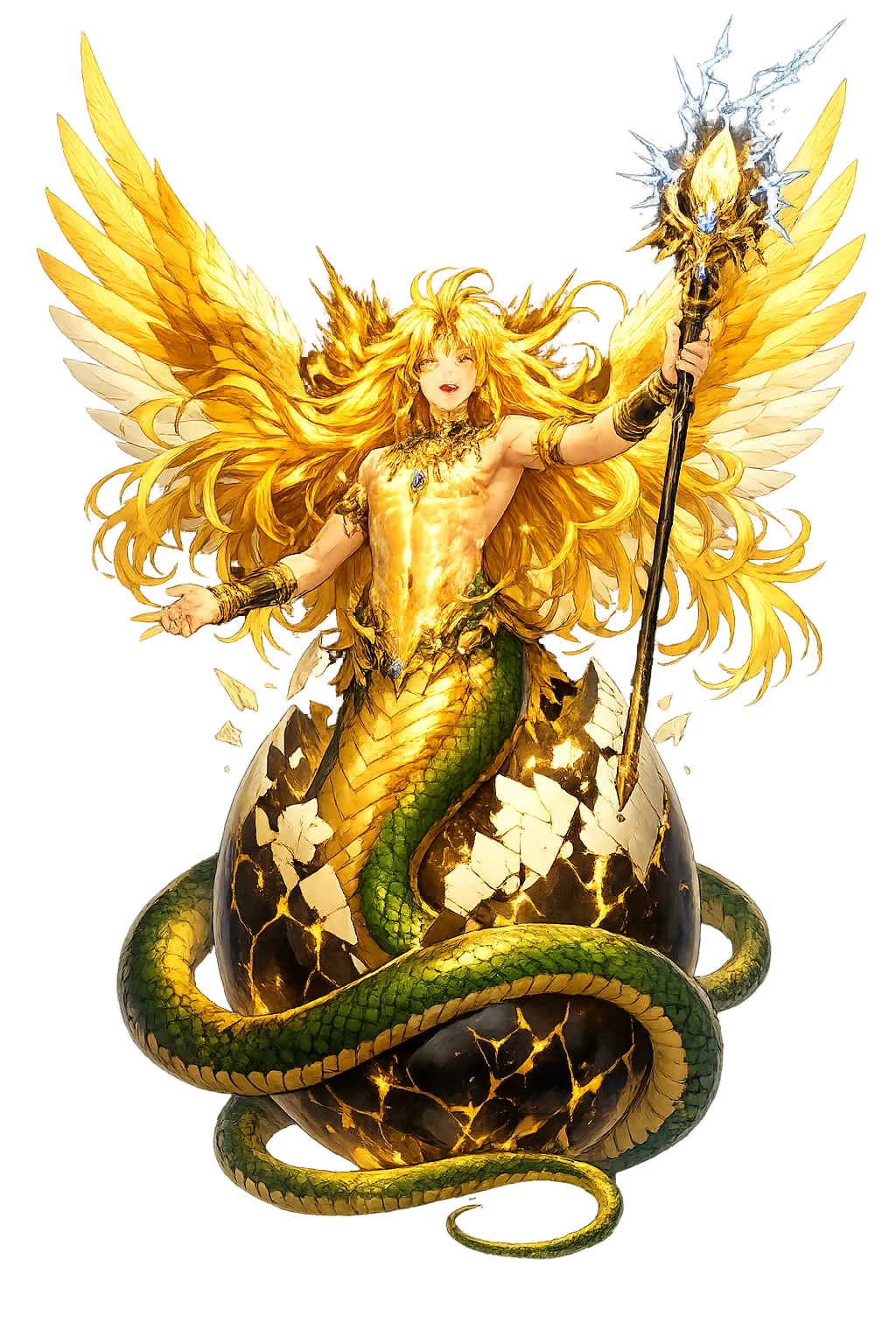
How Phánēs was rebuilt, mark by mark
Bench notes, Phánēs: what we found, what we rejected, and what we finally set down. Kept in the open, because a restoration you cannot audit is just a spelling with confidence.
What We Found
The attestation, in the attestation Orphic Rhapsodies, fr. 71–86, 167–168 Kern (OF 121–168 Bernabé) and Orphic Hymn 6 (to Protogonos) give us: Φάνης. Meaning: "Bringer of light".
The figure behind the name: Phánēs belongs to the other Greece — the Orphic theogonies sung by initiates, where the cosmos begins not with Chaos' yawn but with an egg, and the first god is light itself given a name.
What the Name Carried In
Born of the Egg. In the Orphic Rhapsodies, the beginning is not Hesiod's yawning Chaos but a craftsman: Chronos, Time unaging, fashions an egg in the luminous aithēr, and winds the serpent of necessity around it. The egg splits — and Phánēs comes forth, 'the first-born, the revealer': golden-winged, four-eyed, two-faced, bearing both sexes, carrying the seeds of all gods and all things (Orphicorum fragmenta 79–86 Kern; OF 121–131 Bernabé).
First King of the Gods. The Orphic succession differs from Hesiod's at the very start. In the Rhapsodies, Phánēs holds the sceptre first of all — the first king of the gods — and the rule passes from him to Night, from Night to Ouranos, and thence to Kronos and Zeús, ending with Dionysos; Proclus reports the scheme as received theology, not invention (in Timaeum; Damascius, De principiis).
A spelling that has to carry stories like these is not a label. It is equipment.
Where It Stood Before Us
Phánēs left no temples — Orphic cult was initiatory and book-based — but two extraordinary documents survive: the Derveni papyrus (Archaeological Museum of Thessaloniki), carbonized c. 340 BCE and quoting the theogony, and the Orphic gold tablets from graves in Thessaly, Crete, and South Italy, whose instructions to the dead ('I am a child of Earth and starry Heaven') breathe the same cosmology. The Modena relief of a winged, egg-born deity with a serpent (2nd century CE) is often, cautiously, associated with his iconography; otherwise his image is carried by the hymns and the fragments alone. The bench inherits all of it — the web temple is the newest site, not the first.
What We Kept
The evidence, mark by mark — 2 features the keyboard form phanes cannot hold:
- a → á — Acute on a. Kept.
- e → ē — Macron: long vowel. Kept.
What We Rejected
Any form invented for availability. The rule on the bench: if the evidence does not carry it, the domain does not get it — whatever the registrar has in stock.
What We Set Down
Phánēs — Tier-1 is not a compliment; it is a measurement. This restoration keeps something the ASCII form provably loses, and the measurement is repeatable.
For the voice: fAH-nace, stress on the first syllable with a long ē.
The temple stands at /phanes/ — the notes above are public in its Scholarly Edition, sources and all.
At a Glance
- Restored name: Phánēs
- ASCII form: phanes
- Meaning: "Bringer of light"
- Domain of influence: Procreation, Light
- Pantheon: Greek
- Classification: Tier 1
- Original script: Φάνης
- Series: The Restoration Files, No. 390 of 546
The File Continues
The temple's founding dispatch tells the name's story; its Resonance File reads the myths into the industries; the blog index holds the whole archive.
Continue the series — previous file: Perun (read it here) · next file: Phoíbē (read it here).
The Restoration Files are written from the same canonical record as the temples themselves: the lexicon, the lore catalog, the pattern atlas, and the cited scholarly sources. If a file ever disagrees with its temple, the temple is right — tell us, and the file will be corrected.