PuniCodex

Extended Lore

Persephonē — The Deeper Record

Etymology · Orthography · Cult · Iconography · Reception · Sources

Preserves vowel length Persephonē.com
Persephonē — Spring, Underworld, Vegetation
01

At a Glance

Persephonē — every fact links to its home

PantheonGreek
DomainSpring, Underworld, Vegetation
Original ScriptΠερσεφόνη →
Primary Sources4 cited →
02

Etymology & Word Family

From original script to Unicode restoration — the full etymology page →

Proto-indo-european *per-ʰseh₂- to emerge, to destroy
Original Script Περσεφόνη Persephonē — "She who destroys the light (possibly)"
Unicode Restoration Persephonē Restored stress, length, and script
Modern ASCII persephone Plain-ASCII fallback

Possibly from πέρθω "to destroy" + φόνος "murder", or pre-Greek. Queen of the Underworld.

03

Unicode Character Breakdown

Character-by-character philological analysis

CharacterUnicodeNameBlockPhonetic Role
PU+0050Latin Capital Letter PBasic LatinPi
eU+0065Latin Small Letter EBasic LatinShort epsilon
rU+0072Latin Small Letter RBasic LatinRho
sU+0073Latin Small Letter SBasic LatinSigma
eU+0065Latin Small Letter EBasic LatinShort epsilon
pU+0070Latin Small Letter PBasic LatinPi
hU+0068Latin Small Letter HBasic LatinPhi
oU+006FLatin Small Letter OBasic LatinShort omicron
nU+006ELatin Small Letter NBasic LatinNu
ēU+0113Latin Small Letter E with MacronLatin Extended-AEta: long epsilon

More than one historically valid Unicode spelling of Persephonē exists — each variant is a real, attested restoration, and the owned forms live as temples.

04

Cult & Worship

How the sacred was kept — rites, sanctuaries, remains

The Cult

Persephone was worshipped chiefly in her mother's company, and nowhere more mysteriously than at Eleusis. There the Great Mysteries of Boedromion drew initiates from the whole Greek world along the Sacred Way from Athens into the Telesterion, where the hierophant showed whatever was shown — no ancient author dares say. Her myth was the sanctuary's foundation charter: the Homeric Hymn to Demeter makes Eleusis the place of reunion. At Locri Epizephyrii in Magna Graecia she received her own passionate cult, its thousands of pinakes — terracotta plaques — praising marriage, abduction, and the queen below. Sicilian Enna and Syracuse claimed the scene of the rape. Athenian women kept her rites too at the women's Thesmophoria. She had priests and priestesses but no separate Olympian temple-cult: her sanctuaries were mysteries, groves, and graves.

In the Earth

Eleusis houses the Telesterion and the Mirthless Rock where Persephone was seated in Demeter's sorrow. The sanctuary of Persephone at Locri Epizephyrii has yielded thousands of pinakes (clay plaques) showing the goddess with worshippers, wedding, and abduction scenes. Sicily's Lake Pergusa and the sanctuary at Enna were identified with the rape of Persephone; the goddess's image appears on Syracusan coinage and in terracotta votives.

05

Iconography

How Persephonē was imaged across the ages

The Image

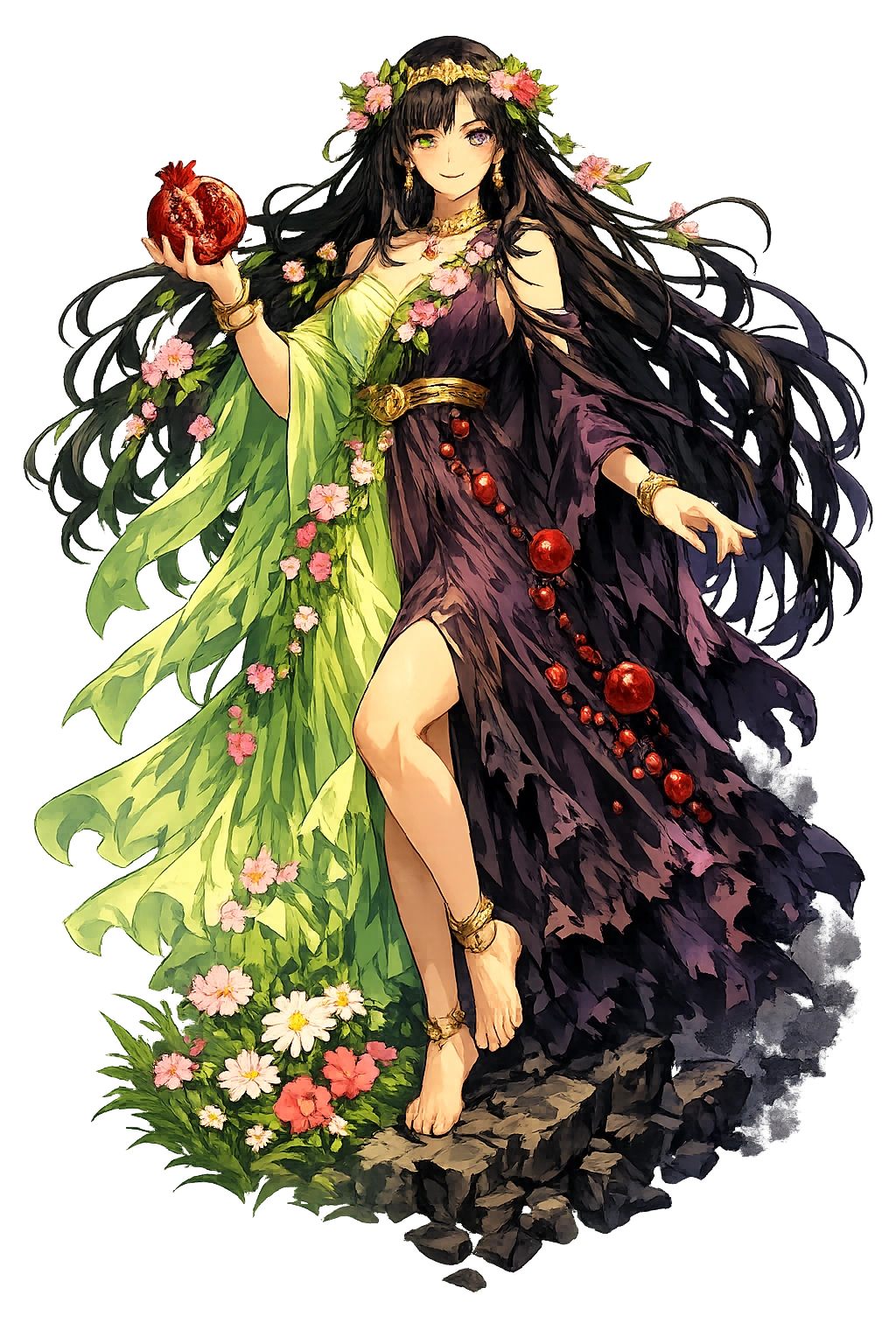
Persephone's image is built from the torch and the ear of grain. Archaic and early Classical vases show her carried off in Hades' chariot; by the mid-fifth century the anodos type shows her rising, twin-torched, from the earth between Demeter and Triptolemus. The Great Eleusinian Relief (National Archaeological Museum, Athens, c. 440 BCE) fixes the Eleusinian triad in marble — Demeter seated, Kore rising with torches, Triptolemus in the winged car. At Locri the pinakes picture her enthroned beside Hades as bride and judge, holding torch and pomegranate; at Syracuse her head with barley wreath crowns the coinage of the greatest Sicilian mint. The Hellenistic age adds the melancholy queen, most fully in the Rape wall-painting of the royal tomb at Vergina (c. 336 BCE), where the terrified maiden still struggles in the god's arms.

06

Reception & Transformation

The name after its own age — transmission, translation, survival

Afterlives

The Eleusinian Mysteries carried Persephone's name across the Mediterranean for a thousand years, down to the sanctuary's end in the fourth century CE — late-antique writers say Alaric's Goths spared the initiates in 396. Thereafter her story traveled only in books: Ovid's Metamorphoses 5 and Claudian's De raptu Proserpinae, copied through the Middle Ages, were the vehicles, and Dante plants Proserpina's flowers in the Earthly Paradise (Purgatorio 28) on that authority. The site itself slept under a village until the Archaeological Society of Athens, from Phintikles in 1882 and Kourouniotes in the twentieth century, cleared the Telesterion and its precinct — one of the great rediscoveries of Greek archaeology. Nineteenth-century scholarship created her modern study: Lobeck's Aglaophamus (1829) assembled the mystery evidence, Rohde's Psyche (1894) traced her chthonian logic, and the Orphic gold leaves from Thurii, excavated in 1879, gave her initiates back their own voices.

Identifications Across Traditions

The Romans identified Persephonē with Proserpina, a goddess whose name may derive from the Latin proserpere, 'to emerge.' The Proserpina myth preserved the same seasonal structure. In later antiquity she was syncretized with Egyptian Isis as a savior goddess and with the moon, whose monthly disappearance and return mirrored her own. The Eleusinian cult spread across the Roman Empire, and emperors including Hadrian were initiated. Christian writers from Clement of Alexandria to Augustine attacked the mysteries, but they also borrowed their themes of death and rebirth.

Modern Legacy

Persephonē is the archetype of the dying-and-rising goddess, the divine figure whose descent makes spring possible. Her myth influenced the mystery religions of the Roman Empire and, through them, Christian iconography of resurrection. In literature, she appears from Milton's Paradise Lost to modern novels and films as the queen of the underworld. Psychologically, she has become a symbol of feminine individuation: the daughter who must separate from her mother, enter darkness, and return transformed. Restoring Persephonē restores the name of the goddess who makes death temporary.

08

The Original Script Note

What the written record preserves — and what it does not

Original Script

The Greek is Περσεφόνη, acute on the penult and a long closing η. Homer prefers the epic by-form Περσεφόνεια, lengthened for the metre; the Homeric Hymn to Demeter makes her its heroine, daughter of Demeter and queen of the dead. The etymology is disputed — ancient speakers heard 'she who destroys the light', connecting πέρθω, 'destroy', with φόνος — but Beekes regards the name as probably Pre-Greek. PUNICODEX writes Persephonē, marking the long vowels per the macron convention; the ideal Persephónē restores the acute as well.

09

The Meditation

What Persephonē means — beyond the dictionary

Persephonē is the only Greek god who must live in two places. She is not half-dead; she is fully alive in both realms. That is the terror and the promise of her myth: death is not a wall but a season. The grain goes under the earth and comes back; the girl goes under the earth and comes back. The pattern is the same.

Modernity has largely lost this cyclical imagination. We treat death as an ending and grief as a pathology. Persephonē offers a different grammar: descent is part of the year. The restoration of her name is a small act of faith that what disappears may also return.

10

Screen & Culture

Where Persephonē echoes through film, television, and games — and how

11

Frequently Asked Questions

Deep-dives into the cult, attestation, reception, and sources of Persephonē

01How do we know how Persephonē was worshipped?

Eleusis houses the Telesterion and the Mirthless Rock where Persephone was seated in Demeter's sorrow. The full cult record →

02Where do the earliest attestations of Persephonē come from?

The record rests on Homeric Hymn to Demeter, Hesiod, Theogony, Ovid, Metamorphoses 5.341–661, among 6 cited works. The full source apparatus →

03How did later traditions reinterpret Persephonē?

The Eleusinian Mysteries carried Persephone's name across the Mediterranean for a thousand years, down to the sanctuary's end in the fourth century CE — late-antique writers say Alaric's Goths spared the initiates in 396. Reception & transformation →

04What do the surviving images of Persephonē actually show?

Persephone's image is built from the torch and the ear of grain. The iconography →

05What does the written record of Persephonē actually preserve?

The Greek is Περσεφόνη, acute on the penult and a long closing η. The Original Script note →

12

Scholarly Sources

The philological foundations of this restoration

Every claim on this page is grounded in established scholarship. The orthographic restorations follow disciplinary convention. The etymological chain follows the best available reference works. This is not invention — it is resurrection through scholarship.

◈

Lexicography & Philology

  • Liddell, H. G., Scott, R., & Jones, H. S. A Greek-English Lexicon. Oxford: Clarendon Press, 9th ed. 1996.
  • Pape, W., & Benseler, G. E. Wörterbuch der griechischen Eigennamen. Braunschweig: Vieweg, 1884.
  • Beekes, R. S. P. Etymological Dictionary of Greek. Leiden: Brill, 2010.
◎

Primary Texts

  • Homeric Hymn to Demeter
  • Hesiod, Theogony
  • Ovid, Metamorphoses 5.341–661
  • Pausanias, Description of Greece
◉

Archaeology & Art History

  • Boardman, J. Greek Sculpture: The Classical Period; Carpenter, T. H. Art and Myth in Ancient Greece.
✦

Religious Studies

  • Clinton, Myth and Cult
  • Orphic gold leaves
Return

The Surface Awaits

You have traced the name from its earliest attestation to its Unicode restoration. Now return to the myth. The story is where the name lives.

Back to Lore
Persephonē mascot