PuniCodex

Extended Lore

Περσεφόνη Persephonē

Etymology · Orthography · Cultural Legacy · Reception · Primary Sources

Tier 1 Persephonē.com
Persephonē — Spring, Underworld, Vegetation
01

Quick Facts

Essential information about Persephonē, Spring, Underworld, Vegetation

Original ScriptΠερσεφόνη
Unicode RestorationPersephonē
Reconstructed Pronunciation/per.se.pʰó.nɛː/
PantheonGreek
DomainSpring, Underworld, Vegetation
MeaningShe who destroys the light (possibly)
ClassificationTier 1
Primary DomainPersephonē.com
Sacred SymbolsPomegranate, Narcissus, Torch, Crown or diadem, Sheaf of wheat
02

Etymology & Word Family

From original script to Unicode restoration

Proto-indo-european *per-ʰseh₂- to emerge, to destroy
Original Script Περσεφόνη Persephonē — "She who destroys the light (possibly)"
Unicode Restoration Persephonē Restored stress, length, and script
Modern ASCII persephone Plain-ASCII fallback

Possibly from πέρθω "to destroy" + φόνος "murder", or pre-Greek. Queen of the Underworld.

03

Unicode Character Breakdown

Character-by-character philological analysis

CharacterUnicodeNameBlockPhonetic Role
PU+0050Latin Capital Letter PBasic LatinPi
eU+0065Latin Small Letter EBasic LatinShort epsilon
rU+0072Latin Small Letter RBasic LatinRho
sU+0073Latin Small Letter SBasic LatinSigma
eU+0065Latin Small Letter EBasic LatinShort epsilon
pU+0070Latin Small Letter PBasic LatinPi
hU+0068Latin Small Letter HBasic LatinPhi
oU+006FLatin Small Letter OBasic LatinShort omicron
nU+006ELatin Small Letter NBasic LatinNu
ēU+0113Latin Small Letter E with MacronLatin Extended-AEta: long epsilon

The Tier 1 classification reflects how much of the original phonology this restoration preserves — stress and vowel length for Greek names, distinctive letters and diacritics for every other tradition.

04

Cultural Significance

From ancient cult to modern memory

Persephonē in Later Traditions

The Romans identified Persephonē with Proserpina, a goddess whose name may derive from the Latin proserpere, 'to emerge.' The Proserpina myth preserved the same seasonal structure. In later antiquity she was syncretized with Egyptian Isis as a savior goddess and with the moon, whose monthly disappearance and return mirrored her own. The Eleusinian cult spread across the Roman Empire, and emperors including Hadrian were initiated. Christian writers from Clement of Alexandria to Augustine attacked the mysteries, but they also borrowed their themes of death and rebirth.

Modern Legacy

Persephonē is the archetype of the dying-and-rising goddess, the divine figure whose descent makes spring possible. Her myth influenced the mystery religions of the Roman Empire and, through them, Christian iconography of resurrection. In literature, she appears from Milton's Paradise Lost to modern novels and films as the queen of the underworld. Psychologically, she has become a symbol of feminine individuation: the daughter who must separate from her mother, enter darkness, and return transformed. Restoring Persephonē restores the name of the goddess who makes death temporary.

In the Earth

Eleusis houses the Telesterion and the Mirthless Rock where Persephone was seated in Demeter's sorrow. The sanctuary of Persephone at Locri Epizephyrii has yielded thousands of pinakes (clay plaques) showing the goddess with worshippers, wedding, and abduction scenes. Sicily's Lake Pergusa and the sanctuary at Enna were identified with the rape of Persephone; the goddess's image appears on Syracusan coinage and in terracotta votives.

05

The Meditation

What Persephonē means — beyond the dictionary

Persephonē is the only Greek god who must live in two places. She is not half-dead; she is fully alive in both realms. That is the terror and the promise of her myth: death is not a wall but a season. The grain goes under the earth and comes back; the girl goes under the earth and comes back. The pattern is the same.

Modernity has largely lost this cyclical imagination. We treat death as an ending and grief as a pathology. Persephonē offers a different grammar: descent is part of the year. The restoration of her name is a small act of faith that what disappears may also return.

06

Screen & Culture

Where Persephonē echoes through film, television, and games — and how

07

Frequently Asked Questions

Common questions about Persephonē, Spring, Underworld, Vegetation, and Unicode restoration

01How do you pronounce Persephonē?

In reconstructed pronunciation, Persephonē is /per.se.pʰó.nɛː/ — approximately 'per-seh-FOH-nay' — the third syllable carries the pitch, and the final 'nay' is long and solemn.

02What does Persephonē mean?

Persephonē means She who destroys the light (possibly) in the greek tradition.

03What are the symbols of Persephonē?

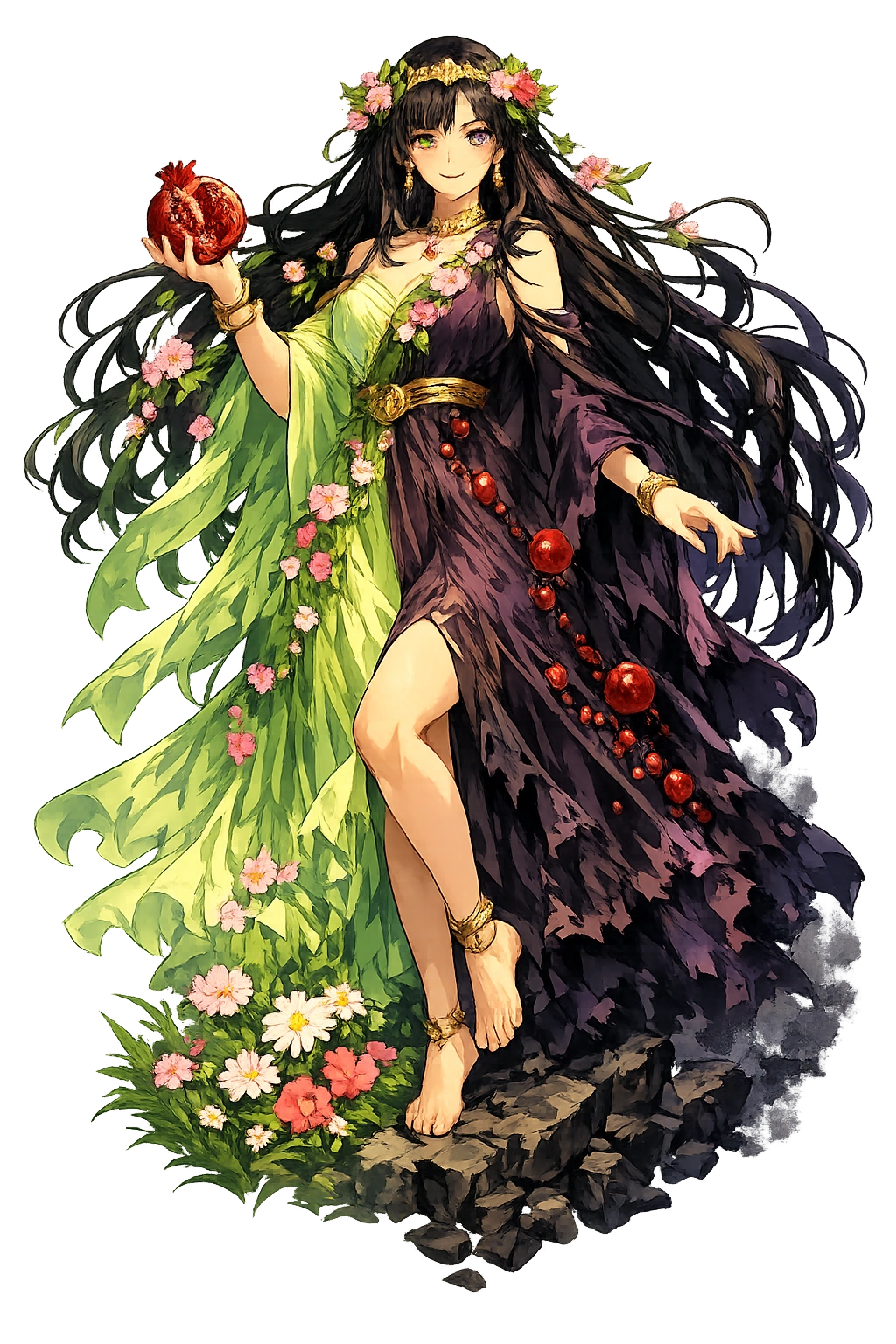
Persephonē is associated with Pomegranate (The seed that bound her to the underworld), Narcissus (The flower whose beauty lured her to the abduction), Torch (Her mother's search and her own queenly authority), Crown or diadem (Queen of the dead), Sheaf of wheat (The grain that dies and rises).

04Why are there different spellings of Persephonē?

Each form is a historically attested restoration rather than a mistake: Persephónē is the ideal form (Acute on the stressed short vowel, matching Greek Περσεφόνη; preserves stress where the canonical macron-only form records length only.). PUNICODEX registers the full set so the tradition is preserved under every defensible spelling.

05Why restore Persephonē in Unicode?

Plain ASCII persephone strips the stress, length, and script that make the name specific. Unicode restoration returns the name to its original written dignity.

06What is the most important myth about Persephonē?

“The Narcissus and the Void” — Persephonē's mythology is the Homeric Hymn to Demeter. Every later retelling is a variation on that poem's architecture of loss, grief, negotiation, and return. The full telling lives on the lore page.

08

Scholarly Sources

The philological foundations of this restoration

Every claim on this page is grounded in established scholarship. The orthographic restorations follow disciplinary convention. The etymological chain follows the best available reference works. This is not invention — it is resurrection through scholarship.

Lexicography & Philology

  • Liddell, H. G., Scott, R., & Jones, H. S. A Greek-English Lexicon. Oxford: Clarendon Press, 9th ed. 1996.
  • Pape, W., & Benseler, G. E. Wörterbuch der griechischen Eigennamen. Braunschweig: Vieweg, 1884.
  • Beekes, R. S. P. Etymological Dictionary of Greek. Leiden: Brill, 2010.

Primary Texts

Archaeology & Art History

  • Material evidence — iconography, inscriptions, and temple archaeology — for Persephonē and related cults.

Religious Studies

  • Clinton, Myth and Cult
  • Orphic gold leaves
Return

The Surface Awaits

You have traced the name from its earliest attestation to its Unicode restoration. Now return to the myth. The story is where the name lives.

Back to Lore
Persephonē mascot