The Living Myth
Mountains, Fertility, Devotion · The Daughter of the Mountain
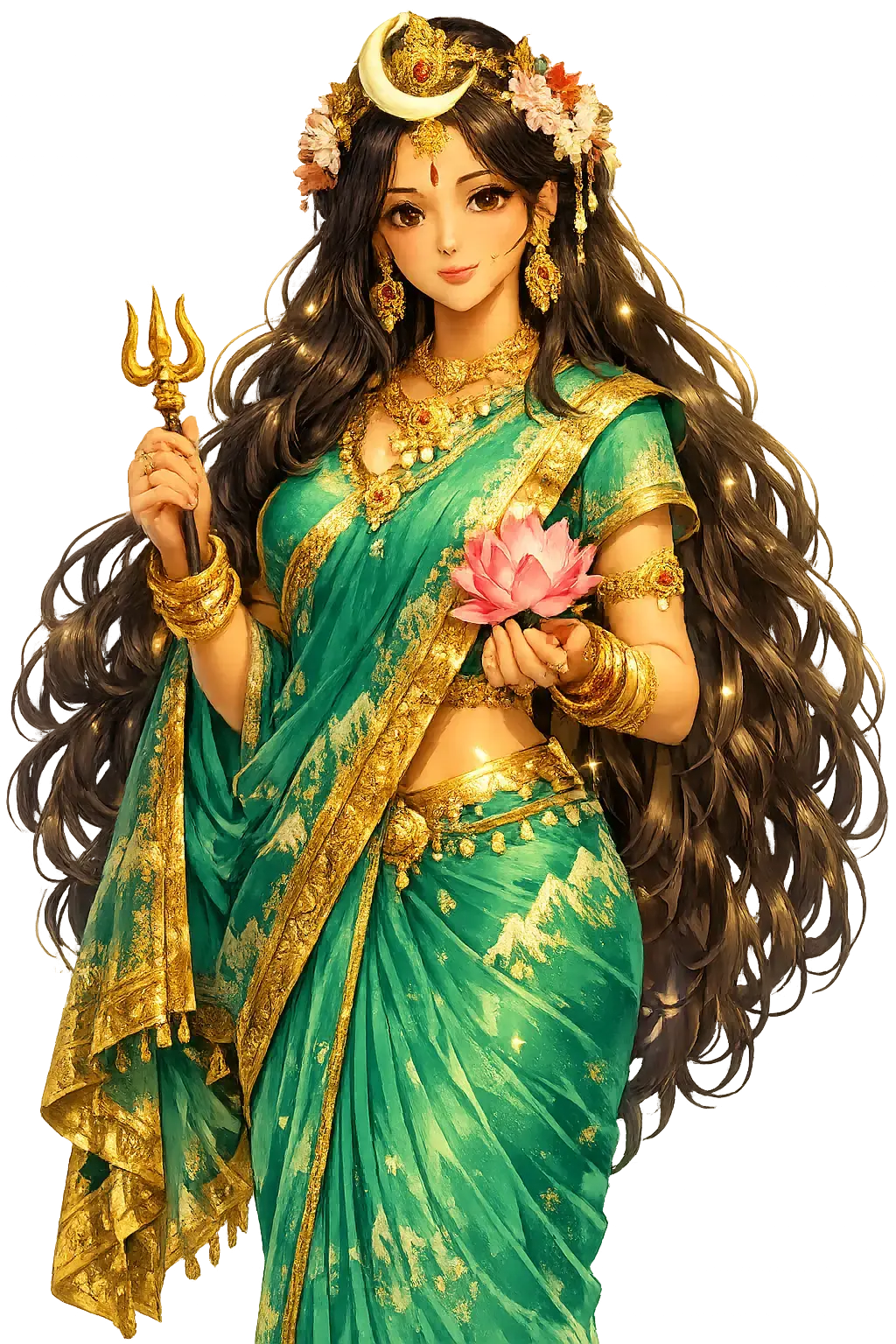
Stories of Pārvatī
Pārvatī's mythology is the story of a love that refuses to fail. From Satī's death by fire to the reborn goddess's discipline in the snow, her narratives ask how devotion can soften the remotest ascetic — and answer that it does so not by pleading but by becoming equally still, equally burning.
At the great sacrifice of King Dakṣa, the father of the bride made sure that no portion, no honor, was offered to his son-in-law Śiva — the wild, ash-smeared god who had carried off his daughter Satī. Satī argued with her father, and when he would not yield she declared that since the body he had given her had become the instrument of his insult, it could no longer be her dwelling; she entered the sacrificial fire (Śiva Purāṇa, Satī-khaṇḍa; Devībhāgavata Purāṇa 7; the episode is told across many Purāṇas with differing details). Śiva, insane with grief, arrived with his gaṇas, shattered the sacrifice, and began the dance of destruction that could unmake the worlds. Out of Satī's death two things were born: the Śakti Pīṭhas, the seats of the goddess where her body fell, and the resolve of the gods that she must be reborn — as Pārvatī. The myth insists that the goddess does not tolerate being dishonored, even through her own body, and that her death is always strategic, never final.
Reborn as the daughter of Himavat, the mountain king, and his queen Menā, the goddess grew up beneath the peaks she had once been. From childhood she was drawn to the meditating Śiva — remote, ash-clad, unmoved — and when her parents despaired, she did what no one expected of a princess: she became an ascetic. In the forests of the Himālaya she performed tapas so severe that the gods began to sweat, and Indra sent the love-god Kāma to interrupt her; Śiva opened his third eye and burned Kāma to ash (Kālidāsa, Kumārasambhava 3–5; Śiva Purāṇa, Pārvatī-khaṇḍa; Matsya Purāṇa 154). Pārvatī did not break her vow; she intensified it, living on air, standing in icy water, until the balance of the universe itself demanded that Śiva notice her. The courting of Śiva is the tradition's answer to a hard question — how does one win the undivided? Not by seduction but by becoming equally undivided: her penance is her proposal.
The earliest appearance of the mountain's daughter in Sanskrit literature is not as a wife but as a teacher. In the Kena Upaniṣad (3.1–4.1), the gods — fresh from a victory they believe is theirs — are humbled by a spirit who defeats their enemies where they themselves could not. Indra alone goes to question it, and beside that radiant being stands a woman: 'Umā, daughter of the Himalaya.' It is she who explains the mystery: the spirit is Brahman, the ground of all victory, and the gods prevailed only by its power. Humility, not conquest, is the beginning of knowledge. Set beside the Purāṇic romances, the little Upaniṣadic scene is striking: Pārvatī's first role is metaphysician — the gentle mountain girl before whom even Indra must sit as a student. Her mythology begins not with marriage but with wisdom, and the texts never forgot it: in every later age, when the gods are confused, it is the goddess who explains the absolute.
Śiva tested the goddess who had burned through her austerities to reach him. Appearing at her parents' court as a wandering ascetic, he argued with ferocious logic against his own worthiness: the god of cremation grounds, he said, is no fit husband for a mountain princess. In Kālidāsa's telling it is Pārvatī herself who answers — eyes lowered, argument flawless — refuting the case against Śiva point by point; in the Purāṇic versions she replies through her friend after her scandalized mother sends her from the hall (Kumārasambhava 5; Śiva Purāṇa). Devotion, she argues, is not deceived by appearances, and the wise judge what is, not what looks proper. Śiva shed his disguise; the wedding was celebrated with the whole cosmos in attendance, the rivers rising in spate, the gods raining flowers (Kumārasambhava 7). From this marriage the gods receive what they had prayed for — Skanda, the war-god. The myth's grace note is that Śiva chose to be won in his own idiom: the goddess passes his test not by pleading her case but by out-thinking his disguise.
While Pārvatī bathed, she shaped a boy from the unguents and turmeric rubbed from her own body and breathed life into him, charging him to let no one pass her door. Śiva returned, was stopped by an unknown child, and in a fury struck off his head. When Pārvatī emerged and saw what had been done to the son she had made alone, her grief threatened the three worlds; she summoned her fierce powers and demanded his life back (Śiva Purāṇa, Rudrasaṃhitā 2.13–18; the story is retold with variations across the Purāṇas). Śiva sent his gaṇas to bring the head of the first creature found facing north — they returned with an elephant's head — and restored the boy, naming him Gaṇeśa, lord of the hosts, and granting him precedence at every beginning. The household myth holds the theology of the household: the child a mother makes from her own substance is greater than any stranger's claim, and Śiva's violence is healed only by becoming a father. Pārvatī's door, guarded wrong and righted wrong, becomes the threshold-god of all Hindu life.
Mountains, Fertility, Devotion, and Sacred Marriage
Pārvatī is the mountain goddess whose devotion transforms the absolute into a husband. Born of Himavat, the personified Himālaya, she is Satī reborn — destined to wed Śiva and bridge his fierce asceticism and the needs of the world. She is the śakti without whom the great yogin never turns toward creation: through her, the renouncer becomes a householder and the snow-peak a bridal chamber.
She wins Śiva not by beauty alone but by the heat of her own ascetic discipline, matching his severity with hers.
As mother of Gaṇeśa and Skanda/Kārttikeya, she grounds the divine family in domestic love and protective power.
She is the active energy that complements Śiva's stillness; without her, he cannot move toward the world.
Her Himalayan birth links her to snow, purity, and the life-giving rivers that descend from the heights.
From the original script to the living URL
पार्वती
The name in its original Sanskrit form. Pārvatī (पार्वती) is attested in the source tradition — “'Daughter of the Mountain' — consort of Śiva, daughter of Himavat, mother of Gaṇeśa and Kārttikeya”. Its macron-length vowels carry the full phonetic and orthographic weight of the source tradition.
parvati
Reduced to plain parvati, the name loses everything that made it specific: macron-length vowels. What remains is an ASCII string that machines can parse but that no longer speaks with its original voice.
Pārvatī
The Unicode restoration recovers what ASCII flattened. Pārvatī restores macron-length vowels, returning the name to its original written dignity. The domain encodes to Punycode, but the browser displays the truth.
Pārvatī.com → xn--prvat-fwa21a.com
The non-ASCII characters in Pārvatī are encoded while the ASCII remains visible. To the DNS, it is Punycode. To humanity, it is Pārvatī.
Owned, ideal, and ASCII forms of Pārvatī
Pārvatī
Restores पार्वती. The live temple domain — pārvatī.com.
parvati
Flattens पार्वती. The plain ASCII fallback — what DNS and legacy systems see.
How Pārvatī was spoken
How Pārvatī travels from ancient script to the modern URL
Sanskrit Pārvatī; from parvata “mountain"; the daughter of the mountain and consort of Śiva.
Mountains, Fertility, Devotion
The IAST form Pārvatī uses registrable Latin diacritics; the Devanagari form is not supported in .com.
The lore you have read is the living myth. Extended Lore opens the scholarly vault beneath it: the cult and its material remains, a history of the image, the name after antiquity, a meditation on what the name still means, and the full scholarly apparatus — etymology, orthography, sources.
Enter Extended Lore