
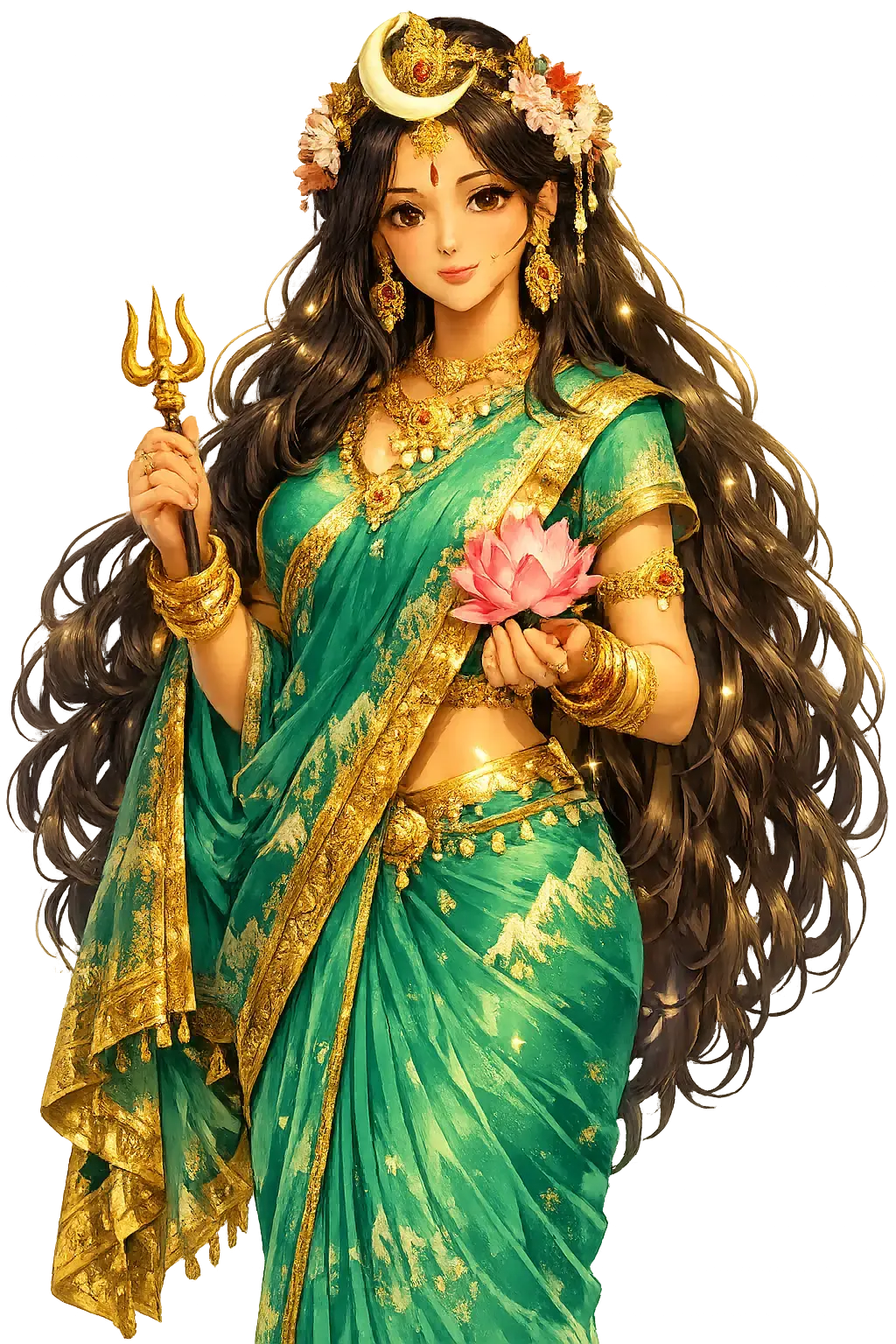
From Devanagari to Unicode: the journey of Pārvatī
Long before it was a domain, this name traveled through scripts. Pārvatī begins in Devanagari, passes through scholarly transliteration, and ends — for now — inside the punycode machinery of the global DNS. Each stage of that journey preserves some information and loses some, and the craft of restoration is knowing exactly which marks matter. This post follows the name stage by stage: the original script, the reconstructed pronunciation, the mythological record, the material evidence, and finally the Unicode form that carries all of it into the address bar. Think of it as a biography of a name, told through its spelling.
At a Glance
- Restored name: Pārvatī
- ASCII form: parvati
- Meaning: "'Daughter of the Mountain' — consort of Śiva, daughter of Himavat, mother of Gaṇeśa and Kārttikeya"
- Domain of influence: Mountains, Fertility, Devotion
- Pantheon: Sanskrit
- Restoration: Preserves vowel length
- Original script: पार्वती (Devanagari)
- Live domain: pārvatī.com
Overview
Pārvatī (parvati) — Mountains, Fertility, Devotion · the Daughter of the Mountain — consort of Śiva, daughter of Himavat, mother of Gaṇeśa and Kārttikeya — belongs to the Sanskrit tradition, where it is catalogued under the domain "Mountains, Fertility, Devotion". The name means "she of the mountains" — the feminine derivative of parvata, "mountain": the daughter of Himavat, the king of the snows, born to become the wife of Śiva.
Pārvatī is the mountain goddess whose devotion transforms the absolute into a husband. Born as the daughter of Himavat, the personified Himalaya, she is Satī reborn, destined to marry Śiva and bridge the abyss between his fierce asceticism and the needs of the world. She is gentle, patient, and resolute — the feminine power (śakti) without whom the great yogin remains withdrawn from creation.
Her domain is the sacred marriage itself: the union of opposites that makes the cosmos fertile. Through her, the renouncer becomes householder, the destroyer becomes father, and the snow-capped peak becomes a bridal chamber.
PuniCodex restores the name as Pārvatī and serves its temple at pārvatī.com. The original carries both stress and vowel length, and exactly one historically valid Unicode restoration exists. The plain ASCII form parvati survives as a modern convenience imposed by the early domain-name system; the restoration, not the fallback, is the form the project defends as philologically complete.
The Name
The name is attested in Devanagari as पार्वती. It is the feminine derivative of parvata, "mountain" — "she of the mountains": Monier-Williams defines pārvatī as the wife of Śiva and daughter of Himavat, king of the snowy mountains, citing her from the Upaniṣads through the Mahābhārata and the kāvya literature.
The ASCII form parvati survives only because the early domain-name system could not carry diacritics; it is a technological compromise, not an ancient spelling. The Unicode restoration Pārvatī recovers the vowel length of the original directly in the address bar. The original carries both stress and vowel length, and exactly one historically valid Unicode restoration exists.
The letter-by-letter transformation runs:
- p → P — Same
- a → ā — Macron: long a
- r → r — Same
- v → v — Same
- a → a — Same
- t → t — Same
- i → ī — Macron: long i
The project holds the domain pārvatī.com (xn--prvat-fwa21a.com) as the canonical home of this name.
The Original Script
The name is preserved in Devanagari as पार्वती — Brahmic abugida, attested Vedic – present, c. 1500 BCE –, in South Asia. The script is written left-to-right.
The scholarly transliteration is Pārvatī (IAST), giving the normalized reading /ˈpaːr.ʋə.tiː/.
The rendering proceeds step by step:
- Sanskrit Pārvatī is written पार्वती in Devanagari.
- Each aksara combines a consonant with an inherent or explicit vowel.
- IAST diacritics preserve length, retroflexion, and aspiration lost in plain ASCII.
- The Devanagari form is not used as the primary domain because Indic scripts are not in the .com IDN table.
Pronunciation
The reconstructed pronunciation of the name is /ˈpaːr.ʋə.tiː/ — Sanskrit Reconstruction.
Phoneme by phoneme:
- Pār- — Voiceless bilabial stop [p] plus long open [aː], followed by voiced labiodental approximant [ʋ] — softer than English 'v'
- -va- — Short open [a], the second syllable is light and unstressed
- -tī — Voiceless alveolar stop [t] plus long close front [iː]; the macron marks length, giving fully restored status
For the modern speaker, the closest approximation is: 'PAHR-vuh-tee' — hold the first 'pahr' and final 'tee' long; the 'v' is light, almost like a 'w'.
Kindred and historical forms of the name:
- Sanskrit — पार्वती (pārvatī), 'she who is from the mountain (parvata)', daughter of Himavat
- Earlier names — Satī, the first wife of Śiva who immolated herself and was reborn as Pārvatī
- Tamil — பார்வதி (Pārvati), the goddess of the Tamil Śaiva devotional tradition
Pārvatī preserves both features because both the initial ā and final ī are long. The name is a transparent feminine derivative of parvata, 'mountain,' specifically the Himalaya.
Mythology
Pārvatī's mythology is the story of a love that refuses to fail. From Satī's tragic death to Pārvatī's disciplined courtship, her narratives explore how devotion can soften even the most remote ascetic and how the feminine divine restores the world when the masculine principle withdraws too far.
The Birth and Penance of Pārvatī (Śiva Purāṇa)
After Satī immolated herself in protest against her father Dakṣa's insult to Śiva, the goddess was reborn as Pārvatī, daughter of the mountain king Himavat. From childhood she was drawn to Śiva, who sat motionless in meditation, clad in ash and serpents. While her parents worried, Pārvatī undertook severe tapas in the snowy forests, repeating his name until the earth trembled. Her ascetic power grew so great that the gods themselves grew alarmed and urged Śiva to accept her.
The Marriage of Śiva and Pārvatī (Kumārasambhava)
Kālidāsa's Kumārasambhava tells the courtship in exquisite verse. Śiva tests Pārvatī by appearing as a wandering ascetic who speaks against his own worth. Pārvatī's calm defense of the god reveals the depth of her understanding, and Śiva reveals himself. Their marriage is celebrated by the whole cosmos, and from their union is born Skanda, the commander of the gods' armies.
The Birth of Gaṇeśa (Skanda Purāṇa)
In one widely told story, Pārvatī creates Gaṇeśa from the turmeric paste of her own body to guard her door while she bathes. When Śiva returns and is stopped by the boy, he strikes off his head in anger. Stricken with remorse, Śiva restores the boy to life with the head of an elephant, and Gaṇeśa becomes the beloved son of Pārvatī and the remover of obstacles.
The Bride Who Chose the Fire (Satī)
At the great sacrifice of King Dakṣa, the father of the bride made sure that no portion, no honor, was offered to his son-in-law Śiva — the wild, ash-smeared god who had carried off his daughter Satī. Satī argued with her father, and when he would not yield she declared that since the body he had given her had become the instrument of his insult, it could no longer be her dwelling; she entered the sacrificial fire (Śiva Purāṇa, Satī-khaṇḍa; Devībhāgavata Purāṇa 7; the episode is told across many Purāṇas with differing details). Śiva, insane with grief, arrived with his gaṇas, shattered the sacrifice, and began the dance of destruction that could unmake the worlds. Out of Satī's death two things were born: the Śakti Pīṭhas, the seats of the goddess where her body fell, and the resolve of the gods that she must be reborn — as Pārvatī. The myth insists that the goddess does not tolerate being dishonored, even through her own body, and that her death is always strategic, never final.
The Penance in the Snow (Tapas)
Reborn as the daughter of Himavat, the mountain king, and his queen Menā, the goddess grew up beneath the peaks she had once been. From childhood she was drawn to the meditating Śiva — remote, ash-clad, unmoved — and when her parents despaired, she did what no one expected of a princess: she became an ascetic. In the forests of the Himālaya she performed tapas so severe that the gods began to sweat, and Indra sent the love-god Kāma to interrupt her; Śiva opened his third eye and burned Kāma to ash (Kālidāsa, Kumārasambhava 3–5; Śiva Purāṇa, Pārvatī-khaṇḍa; Matsya Purāṇa 154). Pārvatī did not break her vow; she intensified it, living on air, standing in icy water, until the balance of the universe itself demanded that Śiva notice her. The courting of Śiva is the tradition's answer to a hard question — how does one win the undivided? Not by seduction but by becoming equally undivided: her penance is her proposal.
Umā Haimavatī, Who Taught the Gods (Kena Upaniṣad)
The earliest appearance of the mountain's daughter in Sanskrit literature is not as a wife but as a teacher. In the Kena Upaniṣad (3.1–4.1), the gods — fresh from a victory they believe is theirs — are humbled by a spirit who defeats their enemies where they themselves could not. Indra alone goes to question it, and beside that radiant being stands a woman: 'Umā, daughter of the Himalaya.' It is she who explains the mystery: the spirit is Brahman, the ground of all victory, and the gods prevailed only by its power. Humility, not conquest, is the beginning of knowledge. Set beside the Purāṇic romances, the little Upaniṣadic scene is striking: Pārvatī's first role is metaphysician — the gentle mountain girl before whom even Indra must sit as a student. Her mythology begins not with marriage but with wisdom, and the texts never forgot it: in every later age, when the gods are confused, it is the goddess who explains the absolute.
Symbols & Iconography
Pārvatī's iconography splits along the line of her two natures — the gentle wife of the mountain and the sovereign warrior she can become:
- Blue lotus (nīlotpala) — Her constant attribute in benign images: purity and the unfolding of devotion.
- The mirror and bridal ornaments — In Umāmaheśvara groups she appears as the adorned bride beside the ash-smeared ascetic, the visual grammar of the sacred marriage.
- Lion or tiger — The vehicle she shares with her warrior forms Durgā and Caṇḍī; the benign Umā of the early images has no mount of her own, and the lion arrives with her fierce aspect.
- Two-armed and four-armed forms — From the modest wife of domestic shrines to the cosmic Devī of Śākta worship.
- The Himalaya itself — Her father and birthplace: the snow-peaks and the rivers descending from them are her oldest landscape, older than any temple image.
Archaeology & Evidence
The goddess enters the material record beside her husband: the Umāmaheśvara motif — Śiva seated in intimate embrace with Umā — appears in Mathurā sculpture by the Kuṣāṇa period and multiplies under the Guptas, when the divine couple becomes a fixed subject of temple art. The great cave temples monumentalize her mythology: Elephanta devotes whole panels to the marriage of Śiva and Pārvatī (Kalyāṇasundara) and to Rāvaṇa shaking Mount Kailāsa beneath their feet, while Ellora and Badami carry major groups of the couple. Medieval temples across the subcontinent give her independent shrines as Gaurī, Umā, or Bhavānī, and the living cult keeps its own calendar — the Gaurī festivals of Maharashtra and the Hartālikā Teej of Rajasthan and the Himalayan regions, in which women celebrate her marriage and her disciplined power.
Realm & Domain
Pārvatī is the mountain goddess whose devotion transforms the absolute into a husband. Born as the daughter of Himavat, the personified Himalaya, she is Satī reborn, destined to marry Śiva and bridge the abyss between his fierce asceticism and the needs of the world. She is gentle, patient, and resolute — the feminine power (śakti) without whom the great yogin remains withdrawn from creation.
Her domain is the sacred marriage itself: the union of opposites that makes the cosmos fertile. Through her, the renouncer becomes householder, the destroyer becomes father, and the snow-capped peak becomes a bridal chamber.
Tapas and Devotion
She wins Śiva not by beauty alone but by the heat of her own ascetic discipline, matching his severity with hers.
Divine Mother
As mother of Gaṇeśa and Skanda/Kārttikeya, she grounds the divine family in domestic love and protective power.
Śakti of Śiva
She is the active energy that complements Śiva's stillness; without her, he cannot move toward the world.
Mountain and Fertility
Her Himalayan birth links her to snow, purity, and the life-giving rivers that descend from the heights.
Across Cultures
Pārvatī is inseparable from the broader network of Śiva's consorts and energies. She is Satī reborn, Umā in the Vedas, Gaurī the fair one, and Caṇḍī or Durgā when wrathful. In South India she merges with the Tamil goddess Taṇṇammai; in Bengal and Assam she is identified with the mother goddess. Tantric traditions further multiply her forms, seeing her as the gentle face of the supreme śakti whose fierce aspect is Kālī. The mountain-goddess type has Indo-European echoes — the goddess born from or dwelling on the high peaks — but Pārvatī's specific identity as Śiva's wife and the mother of Gaṇeśa is distinctively Hindu.
Kindred figures in the PuniCodex cross-tradition index include Ọbalúayé, Bꜣstt, Cōātlīcue, Dāgan, Dēmētēr, and Gaîa, each linked through earth / mother / fertility.
Cultural Legacy
Pārvatī remains a model of the devoted wife, the disciplined yoginī, and the protective mother in Hindu culture. Her marriage to Śiva is re-enacted in countless festivals, dance dramas, and domestic rituals; images of the divine couple (umāmaheśvara) grace temples and home shrines from Nepal to Tamil Nadu. In classical dance, especially Bharatanatyam and Odissi, her narratives are central. Feminist scholars have reclaimed her tapas as an assertion of female spiritual agency, while popular film and television continue to tell her stories to mass audiences. The name Pārvatī is also widely chosen for girls, embodying the ideal of strength cloaked in gentleness.
The Scholarly Record
The account of Pārvatī given in this edition rests on the witnesses and reference works listed below. Lexica and etymological dictionaries secure the form and meaning of the name; the literary and religious texts supply the narrative evidence.
- Śiva Purāṇa, Satī Khaṇḍa and Pārvatī Khaṇḍa.
- Kālidāsa, Kumārasambhava.
- Skanda Purāṇa (birth of Gaṇeśa).
- Devībhāgavata Purāṇa.
- Monier-Williams, Sanskrit-English Dictionary (pārvatī).
- Kinsley, Hindu Goddesses: Visions of the Divine Feminine.
- Handelman and Shulman, Śiva in the Forest of Pines.
The list spans the entry's two source-worlds: the Purāṇas and Kālidāsa's kāvya supply the continuous narrative from Satī to Pārvatī, while Kinsley maps her place among the Hindu goddesses and Handelman–Shulman model the close reading of Śaiva myth around the divine couple.
A Meditation
Pārvatī teaches that love can be a form of asceticism. She does not pursue Śiva through seduction or demand; she becomes so still, so focused, so burning with intention that the universe rearranges itself to bring them together. Her devotion is not submission but a discipline of matching power.
In a world that often pits independence against intimacy, Pārvatī offers a third path: the one who is fully herself and fully given. She is the mountain — immovable, clear, life-giving — and she is the river that descends from it, reaching everywhere. To remember her is to remember that the greatest strength can wear the gentlest face.
The Unicode Restoration
Pārvatī preserves vowel length. The ASCII fallback parvati still resolves everywhere, but it is the restored form that carries the name's full information. Across the 7 characters of the name, the restoration adjusts 2: 2 marks of length (ā, ī). That is the whole thesis of this temple: the marks are the message.
The Domain Name
The restored name is live as a working domain: pārvatī.com, which the DNS carries in punycode form as xn--prvat-fwa21a.com — an ASCII-compatible encoding that lets a non-ASCII name travel the global network without breaking older infrastructure. The visitor sees Pārvatī; the machines see the encoding. That duality is the engineering compromise on which the entire restoration rests, and it is why a name written the way its own tradition wrote it in Devanagari can now be typed into any browser on earth.
Why This Restoration Matters
Every stage of the journey from Devanagari to Unicode was an act of care: the scribe who first wrote the name, the lexicographer who glossed it, the engineer who taught the DNS to carry it. The PuniCodex restoration is the latest stage, not the last word — the Scholarly Edition is revised as the evidence improves. What does not change is the principle: a name deserves to be written the way its own tradition wrote it. Pārvatī in the address bar is that principle, made routable.
Explore Further
This post is one doorway into the temple. The home page carries the full character breakdown and the ambient canvas; the lore page tells the myths in long form; the Scholarly Edition preserves the sources, pronunciation data, and revision history; and the patron wall supports the restoration directly. For the wider map, browse the Lexicon, explore the Pantheon, or return to the PuniCodex blog.
Related Names
Sources
The full scholarly apparatus — every citation, revision, and review — lives in the Scholarly Edition. Key references for this post:
- Śiva Purāṇa, Satī Khaṇḍa and Pārvatī Khaṇḍa.
- Kālidāsa, Kumārasambhava.
- Skanda Purāṇa (birth of Gaṇeśa).
- Monier-Williams, Sanskrit-English Dictionary (pārvatī; from parvata, "mountain").
- Lexicon authorities for this entry: MW, KEWA.