PuniCodex

Extended Lore

盤古 Pángǔ

Etymology · Orthography · Cult · Iconography · Reception · Sources

Tier 1 Pángǔ.com
Pángǔ — Creation, Separation, Foundation
01

Quick Facts

Essential information about Pángǔ, Creation, Separation, Foundation

Original Script盤古
Unicode RestorationPángǔ
Reconstructed Pronunciation/pʰa˧˥ ku˨˩˦/
PantheonChinese
DomainCreation, Separation, Foundation
Meaning'Coiled antiquity' (盤古), the giant who split heaven from earth
ClassificationTier 1
Primary DomainPángǔ.com
Sacred SymbolsThe egg, The horns, The pillars of his limbs
02

Etymology & Word Family

From original script to Unicode restoration

Original Script 盤古 Pángǔ — "'Coiled antiquity' (盤古), the giant who split heaven from earth"
Unicode Restoration Pángǔ Restored stress, length, and script
Modern ASCII pangu Plain-ASCII fallback

The name Pángǔ carries the orthographic signature of the chinese tradition: 盤古. Unicode restoration recovers what ASCII flattens.

03

Unicode Character Breakdown

Character-by-character philological analysis

CharacterUnicodeNameBlockPhonetic Role
PU+0050Latin Capital Letter PBasic LatinSame letter
áU+00E1Latin Small Letter A with AcuteLatin-1 SupplementStress mark (acute/tone)
nU+006ELatin Small Letter NBasic LatinSame letter
gU+0067Latin Small Letter GBasic LatinSame letter
ǔU+01D4Latin Small Letter U with CaronLatin Extended-BPreserves the base letter

The Tier 1 classification reflects how much of the original phonology this restoration preserves — stress and vowel length for Greek names, distinctive letters and diacritics for every other tradition.

04

Cult & Worship

How the sacred was kept — rites, sanctuaries, remains

The Cult

Pángǔ's worship is among the youngest in this catalogue, and it knows it. No shrine of his predates the myth's third-century literary birth; what exists now grew up in late imperial times and lives in two registers. The first is regional: temple complexes at Tóngbái in Henan — which claims his birthplace — and shrines across Guǎngdōng and Guǎngxī, where his 'birthday' fills the tenth lunar month with incense, opera, and communal feasts, their foundations recorded in local gazetteers. The second is liturgical: Daoism, always hungry for deep antiquity, enrolled the primordial giant in its celestial bureaucracy, and Daoist priests now officiate at his altars as they would for any high god. The rites themselves are the standard Chinese temple grammar — offering tables, incense, firecrackers, divination blocks — addressed to a god whose biography every worshipper first met as a children's story.

In the Earth

No cult-temple of Pángǔ predates the myth's literary arrival, but his material afterlife is real: the Pángǔ temples of Tóngbái (Henan) and the southern shrines of Guǎngdōng and Guǎngxī mark the festival of his 'birth' in the tenth lunar month, and the Shùyì jì's report of a Pángǔ country in the southern sea whose people carried his name as a surname shows the cult travelling on genealogies as much as on festivals. The textual archaeology is exact — Xú Zhěng's Sānwǔ lìjì and the Wǔyùn lìnián jì (both 3rd century, preserved in encyclopedias) are the two struts of the whole tradition, and the history of their quotation is the history of the myth itself.

05

Iconography

How Pángǔ was imaged across the ages

The Image

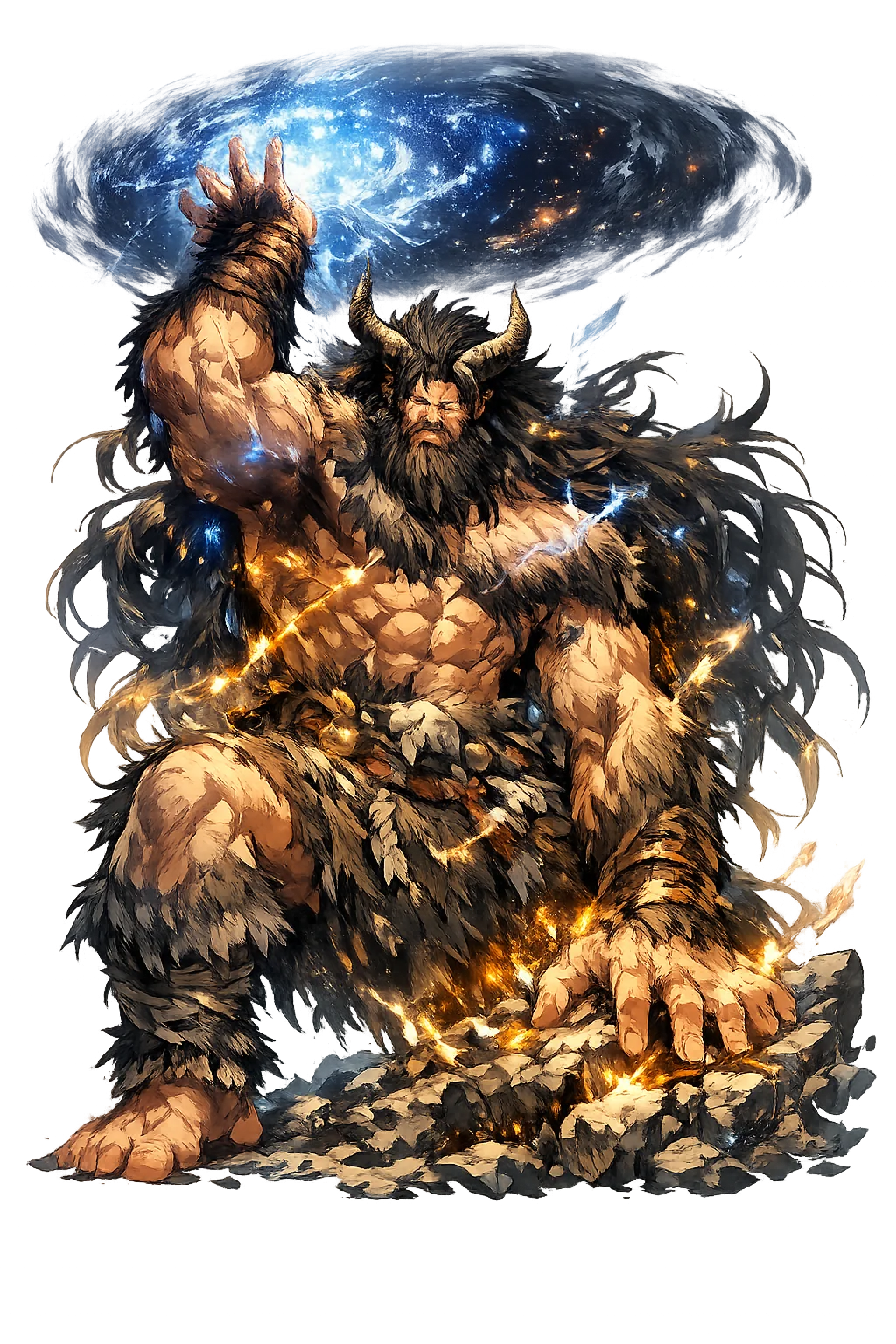
Pángǔ's body is prescribed by the texts, and the texts are wonderfully specific: the Wǔyùn lìnián jì gives him a dragon's head and serpent's body; the Sānwǔ lìjì sends his breath out as wind and thunder, his eyes up as sun and moon, his four limbs out as the four pillars of the world. Art followed. By late imperial times the standard image had set: a horned giant in leaf or bearskin garments, shouldering the risen sky, an enormous axe — or chisel and mallet — in his hands, the sun and moon sometimes set in his staring eyes, and, at the beginning of things, the whole figure still coiled inside the cracked cosmic egg. Temple murals of the south and Ming-Qing woodblock compendia repeat the type almost unchanged. Then the modern age gave it gigantism: monumental stone Pángǔs now stand over Tóngbái and a dozen county towns, axe raised, in concrete. An iconography that froze early and grew enormous — the oldest god with the youngest statues.

06

Reception & Transformation

The name after its own age — transmission, translation, survival

Afterlives

Pángǔ's survival is a tour of the Chinese book world. The third-century texts that invented him were lost early and live as quotations — quoted into the seventh-century Yìwén lèijù and the tenth-century Tàipíng yùlàn, the two great encyclopedias that carried his name through every later library. Tang writers made him literature: Li Róng's Dúyì zhì retells the creation, adding the brother-and-sister marriage of the survivors after his death. Daoism canonized him; Qing evidential scholarship then tried to unmask him — Cui Shù's Kǎoxìn lù, that great engine of historical skepticism, read the Pángǔ story as a late fabrication, and on the dating he was right. The twentieth century restored him as mythology: Yuán Kē's standard synthesis opened the history of Chinese myth with the giant, and schoolrooms took him up as the nation's creation story. A creator whose entire ancient career is footnotes — and whose modern career needs none.

Identifications Across Traditions

The Pángǔ–Pán Hù debate is one of Chinese mythology's famous problems: the southern dog-ancestor of the Yao and She peoples and the cosmic giant share a syllable and a region, and scholars from the Republican era onward have argued transmission in both directions. Comparative mythology places him with the dismembered primordial beings — Vedic Púruṣa, Norse Ymir — whose bodies become worlds: China's version is distinctive for making the giant's death not a murder but a completion.

Modern Legacy

"Since Pángǔ separated heaven and earth" is the standard Chinese formula for "since the beginning of time," and his myth opens every children's account of Chinese prehistory. The transformation — body to landscape — gave Chinese poetry one of its deepest image-families, the mountain-as-body. UNESCO-listed school textbooks, animated films, and the giant's statues across southern China (Henan's Tongbai county claims his birthplace) keep the youngest creator as the most familiar.

07

The Meditation

What Pángǔ means — beyond the dictionary

Pángǔ is the god of the long work: eighteen thousand years of pushing, unnoticed, until the sky stayed up on its own. He never saw the world he made — he became it. He asks of everyone engaged in slow, unglamorous creation: what are you growing between the heaven and the earth of your time — and will it stand when you are done?

The flea-born people of the oldest version keep the myth honest: humanity is not the giant's masterpiece but his smallest parasite, quickened by the wind. It is the humblest creation-line in world mythology — and somehow the most accurate: we are the detail, not the design, and the world was not made for us but of something that once stood up and held it apart.

08

Frequently Asked Questions

Common questions about Pángǔ, Creation, Separation, Foundation, and Unicode restoration

01How do you pronounce Pángǔ?

In reconstructed pronunciation, Pángǔ is /pʰa˧˥ ku˨˩˦/ — approximately pahng-goo, rising tone on Pang, low-dipping on Gu.

02What does Pángǔ mean?

Pángǔ means 'Coiled antiquity' (盤古), the giant who split heaven from earth in the chinese tradition.

03What are the symbols of Pángǔ?

Pángǔ is associated with The egg (Chaos as potential — the undivided whole that must crack to become a world), The horns (His folk-iconography — the shaggy, horned giant of the first morning), The pillars of his limbs (The four limbs as the four sacred mountains — the body as geography).

04Why restore Pángǔ in Unicode?

Plain ASCII pangu strips the stress, length, and script that make the name specific. Unicode restoration returns the name to its original written dignity.

05What is the most important myth about Pángǔ?

“Three-Five Calendar Record” — the The Egg story that anchors the mythology of Pángǔ, told in full on the lore page.

09

Scholarly Sources

The philological foundations of this restoration

Every claim on this page is grounded in established scholarship. The orthographic restorations follow disciplinary convention. The etymological chain follows the best available reference works. This is not invention — it is resurrection through scholarship.

◈

Lexicography & Philology

  • Sanguozhi
  • Xu Zheng
  • Birrell
◎

Primary Texts

  • Primary sources in the chinese tradition for Pángǔ.
◉

Archaeology & Art History

  • Material evidence — iconography, inscriptions, and temple archaeology — for Pángǔ and related cults.
✦

Religious Studies

  • Xú Zhěng 徐整 (3rd c. CE), Sānwǔ lìjì 三五歷記 — the cosmic egg and the body-transformation; preserved in Tàipíng yùlàn 2 and Yìwén lèijù 1
  • Xú Zhěng, Wǔyùn lìnián jì 五運歷年紀 — the horned, serpent-bodied stratum of the legend
  • Rèn Fáng 任昉 (d. 508), Shùyì jì 述異記 — the folk variants and the Pángǔ country of the southern sea
  • Birrell, Anne, Chinese Mythology: An Introduction (Johns Hopkins, 1993), ch. 2
  • Yuán Kē 袁珂, Zhōngguó gǔdài shénhuà 中國古代神話 (rev. edn.) — the standard modern synthesis
  • Shan Hǎi Jīng 山海經 — the pre-Han cosmography whose silence on Pángǔ dates him
Return

The Surface Awaits

You have traced the name from its earliest attestation to its Unicode restoration. Now return to the myth. The story is where the name lives.

Back to Lore
Pángǔ mascot