Stories of Pángǔ
Pángǔ's myth exists in two sentences of immense consequence, recorded by Xú Zhěng in the 3rd century CE — and expanded by a civilization into its canonical account of how the world began.
Xú Zhěng's Sānwǔ lìjì (3rd century CE, preserved in later encyclopedias) gives the founding text: 'Heaven and earth were chaos like a hen's egg, and Pángǔ was born within it. After eighteen thousand years, heaven and earth opened: the bright, light qì rose to become heaven; the dark, heavy qì sank to become earth. Pángǔ stood between them, changing nine times daily — heaven rising ten feet a day, earth thickening ten feet, and Pángǔ growing ten feet — for eighteen thousand years more, until heaven stood ninety thousand li above the earth.' The arithmetic is the myth's own poetry: the world is not spoken into being but pushed apart by increments, against a measurable resistance — creation as the first and longest labor, and the giant as the one who never stops growing because his work is never done.
When the separation was fixed, Pángǔ died — and the transformation began, in the same text's most famous lines: his breath became wind and cloud, his voice thunder, his left eye the sun and his right the moon, his four limbs the four sacred mountains, his blood the rivers, his veins the roads, his flesh the soil, his hair the stars, his skin and body-hair grass and trees, his sweat the rain — and, in the most anthropologically piquant line, the fleas and lice of his body, quickened by the wind, became the black-haired people. Nothing in the list is wasted and nothing is decorative: the myth insists that geography is biography — that every mountain is a limb and every river a vein — so that to wound the landscape is to wound the body one lives inside. It is the world's most complete statement of the sacredness of place.
The myth's strangest fact is its date: no pre-Han text mentions Pángǔ, and the Sānwǔ lìjì itself has to be reconstructed from quotations in medieval encyclopedias, for the original is lost. Scholars trace his entry through southern traditions — the Yao and Miao genealogies of the dog-ancestor Pán Hù, phonetically adjacent, from the very region the later sources call Pángǔ country — absorbed and cosmicized in the Wei-Jin centuries, when the north's older creation-by-culture-hero had left a vacancy at the very beginning. China's canonical creation is thus a relative newcomer, adopted so completely that every schoolchild now learns it as the oldest story — a case of a myth winning by arriving last, exactly when the civilization needed a single name to put at the head of time.
By the sixth century the giant had accumulated regional tellings, and Rèn Fáng's Shùyì jì ('Records of Strange Matters', c. 500 CE) preserves the collated harvest. The folk versions map his body onto the sacred mountains with cheerful disagreement: in one, his head became the Eastern Marchmount, his belly the Central, his limbs the Southern and Northern, his feet the Western; in another, his tears became the rivers, his breath the wind, his voice thunder, his pupils lightning — and his moods the weather, his gladness clearing the sky and his anger clouding it (Shùyì jì, quoting what it calls Qín-Hàn popular sayings). The most remarkable entry records that in the southern sea there was a Pángǔ country whose people bore Pángǔ as their surname — a whole people claiming descent from the giant. And in the Wú-Chǔ region south of the Yangtze, the tellers made him a married pair: Pángǔ and his wife, 'the beginning of yin and yang.' The creator was still growing new versions four centuries after his first written breath — evidence that China never finished deciding what its youngest god meant.
The Egg, the Eighteen Thousand Years, and the Body of the World
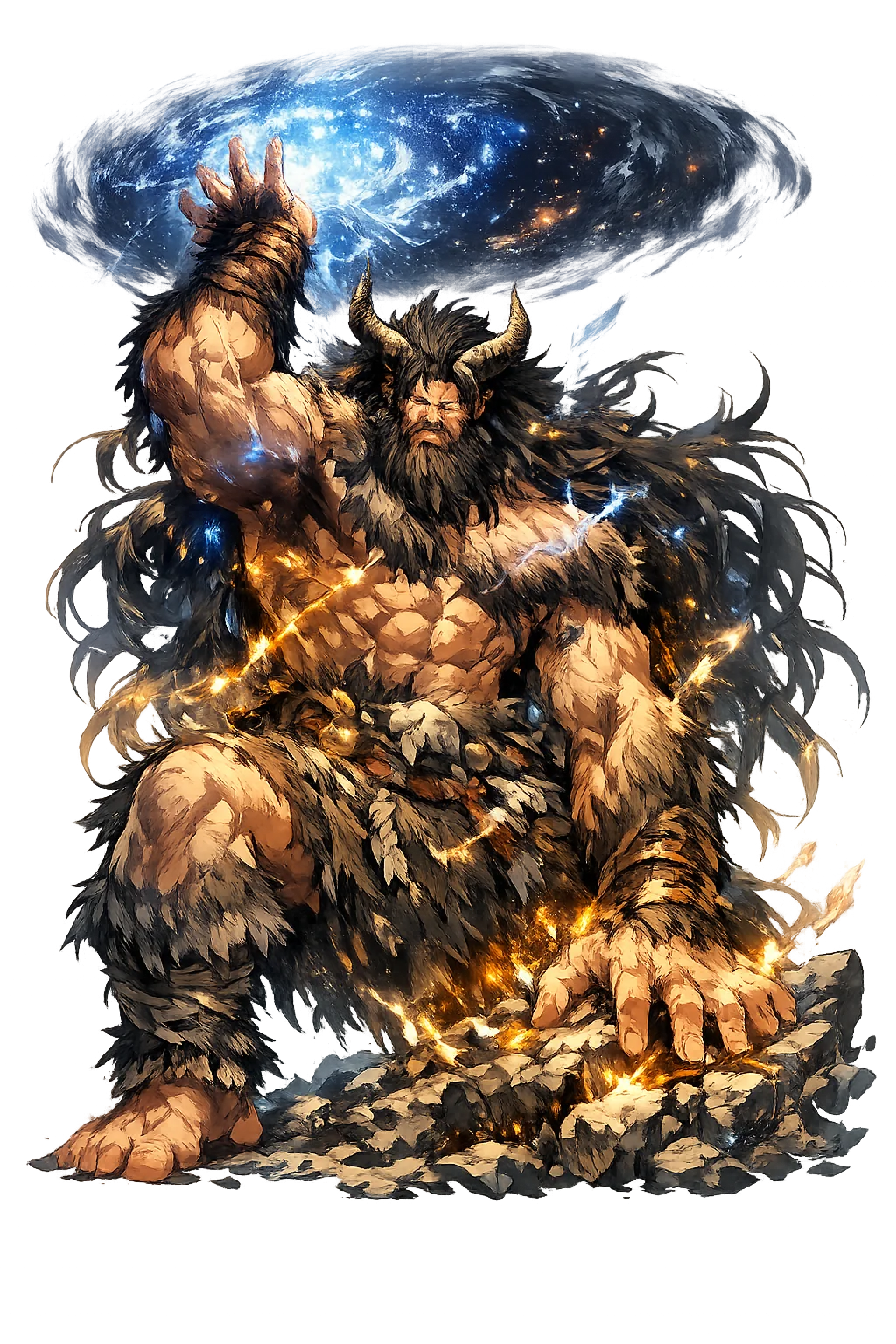
Pángǔ is China's creation made flesh: the giant who grew for eighteen thousand years inside the cosmic egg, pushed heaven and earth apart with his own body, and — dying at last — became the world itself: his eyes the sun and moon, his breath the wind, his voice the thunder.
Chaos like a hen's egg — and Pángǔ born within it, the first form in the formless.
Heaven rose ten feet daily, earth thickened ten feet, and he grew between them — 18,000 years of pushing.
His body becomes the world: eyes to sun and moon, limbs to mountains, blood to rivers.
Folk art arms him with the tools of separation — the first worker, carving sky from stone.
From the original script to the living URL
盤古
The name in its original Chinese form. Pángǔ (盤古) is attested in the source tradition — “'Coiled antiquity' (盤古), the giant who split heaven from earth”. Its acute stress marks carry the full phonetic and orthographic weight of the source tradition.
pangu
Reduced to plain pangu, the name loses everything that made it specific: acute stress marks. What remains is an ASCII string that machines can parse but that no longer speaks with its original voice.
Pángǔ
The Unicode restoration recovers what ASCII flattened. Pángǔ restores acute stress marks, returning the name to its original written dignity. The domain encodes to Punycode, but the browser displays the truth.
Pángǔ.com → xn--png-ela13j.com
The non-ASCII characters in Pángǔ are encoded while the ASCII remains visible. To the DNS, it is Punycode. To humanity, it is Pángǔ.
Owned, ideal, and ASCII forms of Pángǔ
Pángǔ
Restores 盤古. The live temple domain — pángǔ.com.
pangu
Flattens 盤古. The plain ASCII fallback — what DNS and legacy systems see.
How Pángǔ was spoken
How Pángǔ is preserved in writing
A bespoke provenance study for Pángǔ is being prepared by the PUNICODEX scholarly team.
Contribute scholarly provenance →The lore you have read is the living myth. Extended Lore opens the scholarly vault beneath it: the cult and its material remains, a history of the image, the name after antiquity, a meditation on what the name still means, and the full scholarly apparatus — etymology, orthography, sources.
Enter Extended Lore