PuniCodex

Extended Lore

पद्मसम्भव Padmasambhava

Etymology · Orthography · Cult · Iconography · Reception · Sources

Tier 2 Padmasambhava
Padmasambhava — Lotus-Born, Vajrayana, Tibet
01

Quick Facts

Essential information about Padmasambhava, Lotus-Born, Vajrayana, Tibet

Original Scriptपद्मसम्भव
Unicode RestorationPadmasambhava
Reconstructed Pronunciation/ˈpɐd̪.mɐ.sɐm.bʱɐ.ʋɐ/
PantheonBuddhist
DomainLotus-Born, Vajrayana, Tibet
Meaning'Lotus-born' (padma 'lotus' + sambhava 'born, arisen'), 'Guru Rinpoche', the tantric master revered as the founder-figure of Tibetan Buddhism.
ClassificationTier 2
Primary DomainPadmasambhava
Sacred SymbolsThe lotus of his birth, The vajra, The khaṭvāṅga staff, The pregnant tigress, Zangdok Palri
02

Etymology & Word Family

From original script to Unicode restoration

Original Script पद्मसम्भव Padmasambhava — "'Lotus-born' (padma 'lotus' + sambhava 'born, arisen'), 'Guru Rinpoche', the tantric master revered as the founder-figure of Tibetan Buddhism."
Unicode Restoration Padmasambhava Canonical scholarly spelling — ASCII-identical
Modern ASCII padmasambhava Plain-ASCII fallback

The name Padmasambhava reaches the modern world through scholarly transliteration of the buddhist tradition. Because the conventional spelling uses only Latin letters, its Unicode and ASCII forms coincide — the tradition it carries is in the name itself, not in diacritics.

03

Unicode Character Breakdown

Character-by-character philological analysis

CharacterUnicodeNameBlockPhonetic Role
PU+0050Latin Capital Letter PBasic LatinSame, capitalized
aU+0061Latin Small Letter ABasic LatinSame
dU+0064Latin Small Letter DBasic LatinSame
mU+006DLatin Small Letter MBasic LatinSame
aU+0061Latin Small Letter ABasic LatinSame
sU+0073Latin Small Letter SBasic LatinSame
aU+0061Latin Small Letter ABasic LatinSame
mU+006DLatin Small Letter MBasic LatinSame
bU+0062Latin Small Letter BBasic LatinSame
hU+0068Latin Small Letter HBasic LatinSame
aU+0061Latin Small Letter ABasic LatinSame
vU+0076Latin Small Letter VBasic LatinSame
aU+0061Latin Small Letter ABasic LatinSame

The Tier 2 classification here reflects fidelity to the attested tradition, not recovered diacritics: every character of Padmasambhava already survives in ASCII. What the restoration preserves is the canonical spelling itself — the form scholarship standardised.

04

Cult & Worship

How the sacred was kept — rites, sanctuaries, remains

The Cult

Padmasambhava is worshipped as the second Buddha, and his cult is a guru cult. Nyingma practice takes refuge in the lama before Buddha, Dharma, and Sangha; his portrait hangs above every altar, and the daily engine of devotion is guru-yoga — the Guru visualized above the crown of the head, blessing descending as light. The calendar's great date is the tenth day of the lunar month, kept across the Tibetan world with masked cham dances and communal feasts; the tenth of the monkey month, his birth-moment, draws the largest crowds. Temples enshrine him in eight manifestations — Guru Tshen Gye — surrounding the central lotus-born form, and his consort Yeshe Tsogyal, who attained realization through him, is invoked beside him. At Tso Pema in India, where he is said to have hidden from the king of Zahor, an annual festival still carries his statue around the lake.

In the Earth

The historical Padmasambhava leaves no contemporary trace — the earliest sources are three to five centuries later — and the archaeology of his legend is the archaeology of Samye itself: excavations at Dranang have confirmed an 8th-century mandala-planned monastery with central Wutse and four temples matching the chronicles, and Dunhuang manuscripts (closed c. 1000) already circulate his name. His landscape, though, is thoroughly mapped: the Tiger's Nest (Taktsang) above the Paro valley, the cave-temples of Nepal's upper valleys where he meditated en route, the statue at Tso Pema (Rewalsar) where he hid from the king of Zahor — every site an enacted chapter. Uḍḍiyāna, his birthplace, is fixed by the Swat valley's ruins and inscriptions. The figure is a study in how a people builds monuments to a man the record cannot see — and calls the monuments evidence.

05

Iconography

How Padmasambhava was imaged across the ages

The Image

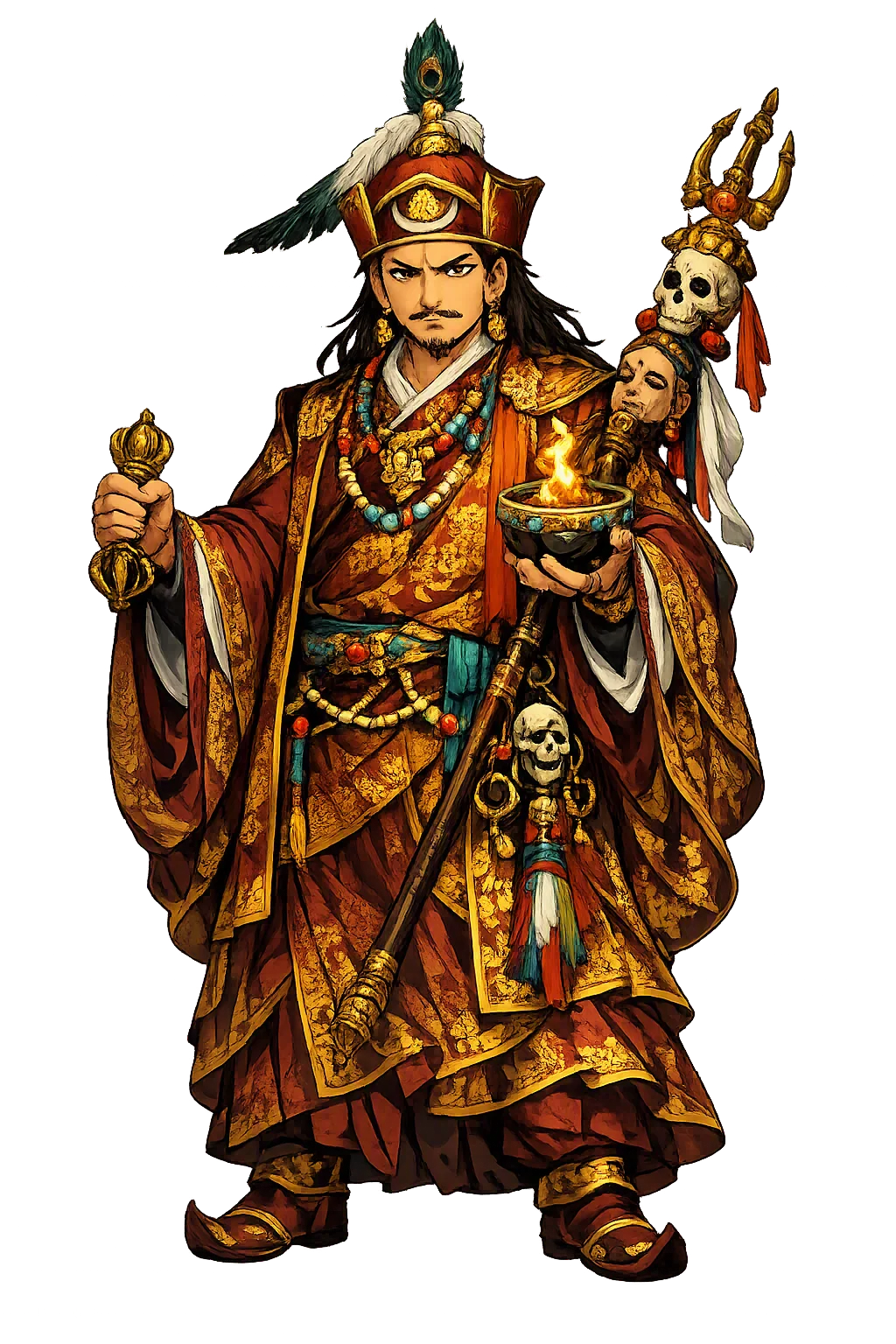
Padmasambhava is recognized at a glance, and every attribute is a sermon. The right hand brandishes a golden vajra; the left cradles a skull-cup brimming with the vase of immortal life, while under the left arm rests the khatvanga, a trident-staff hung with skulls, ribbons, and a small drum; on his head sits the upturned-brimmed lotus hat with its vulture feather; he sits in royal ease on a lotus and sun-disc, usually flanked by his consorts Mandarava and Yeshe Tsogyal. When wrathful he is Dorje Drolo, astride a pregnant tigress. The earliest images ride the Dunhuang cache (closed c. 1000), where manuscripts and a portrait of him already travel together; the great mural cycles of western Tibet fixed the type by the fifteenth century, and sets of the Eight Manifestations became a genre of their own, painted from Ladakh to Bhutan.

06

Reception & Transformation

The name after its own age — transmission, translation, survival

Afterlives

Padmasambhava's transmission began as an act of hiding. After the imperial collapse his memory survived in fragments — the Dunhuang papers, a few clan histories — until the twelfth century, when the first treasure-biographies appeared: Nyangral Nyima Özer's Zanglingma, then the fourteenth-century Padma bKa' thang of Orgyen Lingpa, which built the life every later image follows. Tradition credits him with more than his own biography: the Bardo Thödol, the 'Liberation Through Hearing,' was rediscovered as a terma by Karma Lingpa, and Walter Evans-Wentz's 1927 edition — with Jung's commentary — made the Lotus-Born the Western world's back-door introduction to Tibetan religion. The Schlagintweit brothers had carried his name into European scholarship with Buddhism in Tibet (1863); Tucci's Tibetan Painted Scrolls (1949) gave his iconography an archive; Demiéville's Le Concile de Lhasa (1952) went hunting the man beneath the legend. After 1959 the diaspora made him global, and the academic field he founded as myth now studies as history.

Identifications Across Traditions

Padmasambhava is syncretism's master key. In Tibet he absorbed the thunderbolt of the vajra and the oath-bound demons of the old religion, so that every mountain god of the plateau became a dharmapāla with a Buddhist name. Bon, Tibet's indigenous tradition, answered in kind: its later texts speak of the Guru as bound and outwitted, a rival's way of admitting his power. In the Himalayas his cult merged with local spirit-lords — he is the guru of Nepal's caves as much as Tibet's — and in Sikkim and Bhutan he is a national ancestor, his flight-route on the tigress mapped as pilgrimage. The 19th-century nonsectarian Rimé movement made him the shared treasure of all schools, and the modern global spread of Dzogchen and Vajrayāna rides on his name: where Tibetan Buddhism goes, Guru Rinpoche has already flown.

Modern Legacy

Every Nyingma monastery is his house twice over: Samye, Tibet's first, was raised on his taming; and in Bhutan, the cliff-hanging Tiger's Nest (Taktsang) marks the cave where he is said to have meditated on the tigress's back — the kingdom's defining image. The annual 10th-day rituals across the Tibetan world re-enact his arrival; the Seven Line Prayer — "I pray to the Lotus-Born of Uḍḍiyāna..." — is the most recited invocation in Tibetan Buddhism. In the 20th century his treasure-doctrine proved its worth: as Tibet's texts scattered, the terma logic rediscovered them — libraries sealed by exile, waiting in Dharamsala and Kathmandu to be read again. The Lotus-Born, who hid the teaching against the dark age, became the patron saint of a tradition that had to bury itself to survive — and then, as promised, was found.

07

The Meditation

What Padmasambhava means — beyond the dictionary

Padmasambhava is the founder who refuses to be historical — and that refusal is his deepest teaching. The tradition does not ask you to believe a man was born on a lotus; it asks you to notice what the image does: a teacher with no parents, no caste, no homeland, arriving from the pure lake the way insight arrives from nowhere. The 14th century wrote his 8th-century life, and no one calls it fraud, because the figure was designed for exactly this — a founder whose biography is a treasure-text, to be discovered, not verified.

His practical legacy is the taming: Buddhism did not conquer Tibet by argument alone but by converting the landscape — the old gods stayed, renamed and re-employed. It is the most successful model of cultural transmission ever devised: nothing destroyed, everything bound to the vow. And his final act — burying the teaching — is the strangest bequest in religious history: a gift addressed to the future, with the Guru's certainty that the future would deserve it and would know where to dig. Every crisis of Tibetan Buddhism since has proven him right.

08

Frequently Asked Questions

Common questions about Padmasambhava, Lotus-Born, Vajrayana, Tibet, and Unicode restoration

01How do you pronounce Padmasambhava?

In reconstructed pronunciation, Padmasambhava is /ˈpɐd̪.mɐ.sɐm.bʱɐ.ʋɐ/ — approximately 'PUD-muh-sum-BHUH-vuh' — even syllables, the stress spread; the bh is a voiced breath, not an English 'v'.

02What does Padmasambhava mean?

Padmasambhava means 'Lotus-born' (padma 'lotus' + sambhava 'born, arisen'), 'Guru Rinpoche', the tantric master revered as the founder-figure of Tibetan Buddhism. in the buddhist tradition.

03What are the symbols of Padmasambhava?

Padmasambhava is associated with The lotus of his birth (The eight-petaled bloom on Lake Dhanakośa that bore him — purity without parentage; the name and the origin are the same word), The vajra (The thunderbolt-scepter of tantric power — with which he struck the spirits of Tibet into oath-bound protectors, converting the landscape itself), The khaṭvāṅga staff (The trident-staff crowned with skulls and ribbons — tantric mastery over death, carried by the Guru in his wandering iconography), The pregnant tigress (His steed out of Tibet — flying from the Gungthang pass to the Copper-Colored Mountain, wrath and compassion yoked together), Zangdok Palri (The Copper-Colored Mountain of Glory, his paradise in the southwest — every Nyingma altar's painted destination).

04Why restore Padmasambhava in Unicode?

Padmasambhava is written entirely in ASCII letters, so its restoration is about canonical fidelity rather than recovered diacritics: the temple fixes the name in its scholarly standard spelling, attested in the source tradition, instead of leaving it to drift.

05What is the most important myth about Padmasambhava?

“Found on a Lotus in the Lake” — the The Birth story that anchors the mythology of Padmasambhava, told in full on the lore page.

09

Scholarly Sources

The philological foundations of this restoration

Every claim on this page is grounded in established scholarship. The orthographic restorations follow disciplinary convention. The etymological chain follows the best available reference works. This is not invention — it is resurrection through scholarship.

◈

Lexicography & Philology

  • Vajrayana texts
  • Tantric texts
◎

Primary Texts

  • The Larger Sukhāvatī-vyūha Sūtra; the Smaller Sukhāvatī-vyūha Sūtra; the Amitāyurdhyāna Sūtra; the Lotus Sūtra.
◉

Archaeology & Art History

  • Material evidence — iconography, inscriptions, and temple archaeology — for Padmasambhava and related cults.
✦

Religious Studies

  • Padma bKa' thang (Padma Kathang), terma of Orgyen Lingpa (14th c.)
  • Basm yas Debate records
  • Demiéville, Le Concile de Lhasa (1952)
  • Tucci, Tibetan Painted Scrolls (1949)
  • Buswell & Lopez, The Princeton Dictionary of Buddhism (2014)
Return

The Surface Awaits

You have traced the name from its earliest attestation to its Unicode restoration. Now return to the myth. The story is where the name lives.

Back to Lore
Padmasambhava mascot