
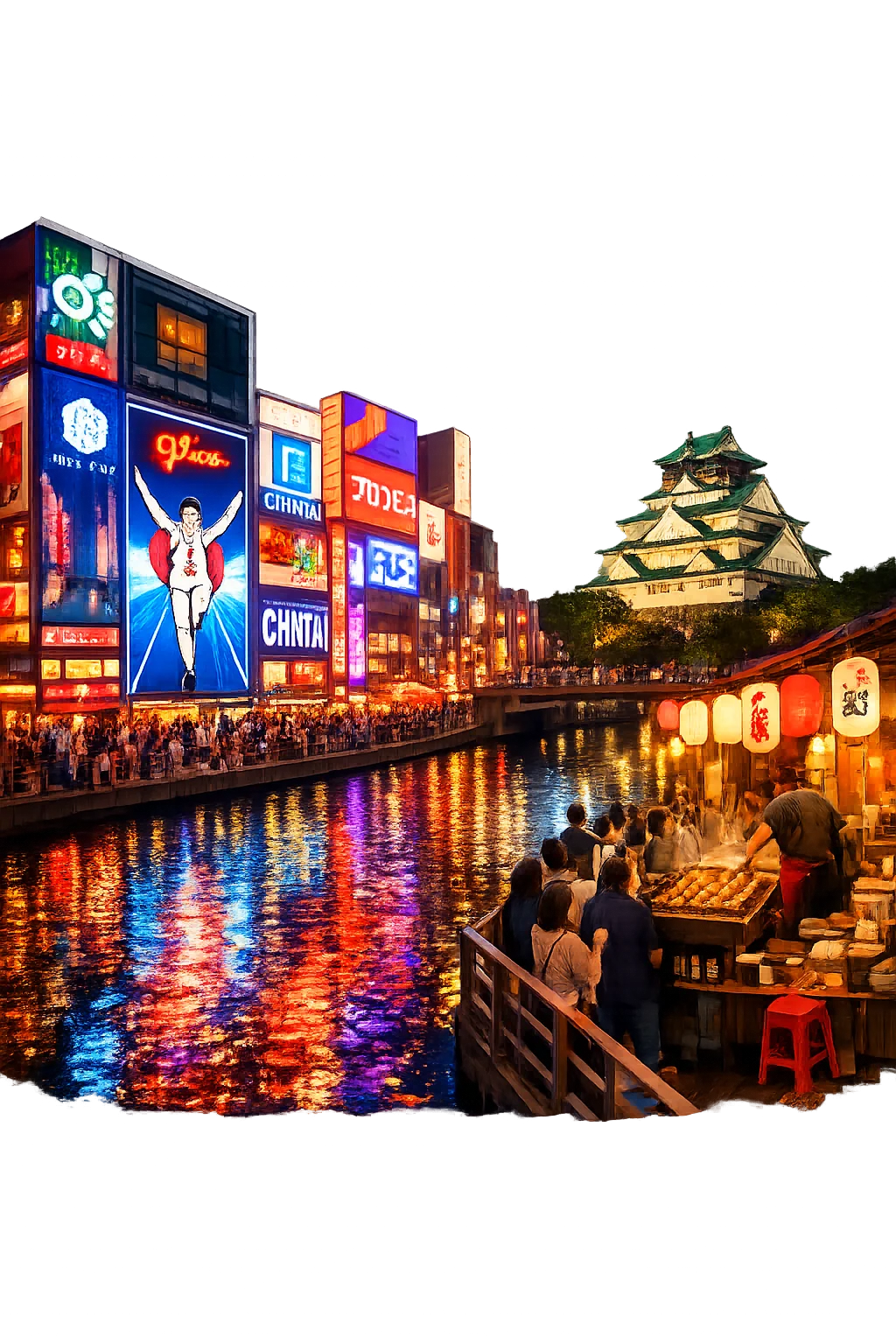
How Ōsaka was rebuilt, mark by mark
Bench notes, Ōsaka: what we found, what we rejected, and what we finally set down. Kept in the open, because a restoration you cannot audit is just a spelling with confidence.
What We Found
The attestation, as Nihon Shoki (Chronicles of Japan) and Kojiki (Records of Ancient Matters, 712 CE) preserve it: 大阪. Meaning: "Large hill or slope".
The figure behind the name: Ōsaka began as the ancient port of Naniwa, gateway to the Asian continent and briefly an imperial capital.
What the Name Carried In
Naniwa, the First Imperial Port. Long before it was called Ōsaka, the delta at the mouth of the Yodo River was Naniwa — 難波, 'the rapids'. The Man'yōshū ('Collection of Ten Thousand Leaves', c.
Shitennō-ji and Prince Shōtoku. In 593, tradition says, Prince Shōtoku founded Shitennō-ji, 'Temple of the Four Heavenly Kings', on Naniwa's ground, making Ōsaka one of the first places in Japan where Buddhism put down institutional roots. The temple was a political theology built in wood: the Four Kings were guardians of the state, and their temple announced that the new faith would defend the realm — a diplomatic as much as a devotional statement, aimed at the continental powers whose models Japan was adopting.
A spelling that has to carry stories like these is not a label. It is equipment.
Where It Stood Before Us
Naniwa Palace Ruins Park preserves the Daigokuden audience hall, warehouse complexes, and wharf remains of Emperor Kōtoku's capital. The Mozu-Furuichi Kofun Group, including the Daisenryō Kofun attributed to Emperor Nintoku, dominates the southern plain. Excavated Toyotomi stone walls, granite ramparts, and the reconstructed donjon of Ōsaka Castle document the city's transformation from port to mortuary landscape to fortress. The bench inherits all of it — the web temple is the newest site, not the first.
What We Kept
The evidence, mark by mark — 1 feature the keyboard form osaka cannot hold:
- o → Ō — Macron: long vowel. Kept.
What We Rejected
Any form invented for availability. The rule on the bench: if the evidence does not carry it, the domain does not get it — whatever the registrar has in stock.
What We Set Down
Ōsaka — Tier-1 is not a compliment; it is a measurement. This restoration keeps something the ASCII form provably loses, and the measurement is repeatable.
For the voice: 'OH-sah-kah' — the first vowel is long; the following syllables are short and level in pitch.
The temple stands at /osaka/ — the notes above are public in its Scholarly Edition, sources and all.
At a Glance
- Restored name: Ōsaka
- ASCII form: osaka
- Meaning: "Large hill or slope"
- Domain of influence: Merchant City, Kansai
- Pantheon: Japanese
- Classification: Tier 1
- Original script: 大阪
- Series: The Restoration Files, No. 369 of 546
The File Continues
The temple's founding dispatch tells the name's story; its Resonance File reads the myths into the industries; the blog index holds the whole archive.
Continue the series — previous file: Ọrúnmìlà (read it here) · next file: Ọṣun (read it here).
The Restoration Files are written from the same canonical record as the temples themselves: the lexicon, the lore catalog, the pattern atlas, and the cited scholarly sources. If a file ever disagrees with its temple, the temple is right — tell us, and the file will be corrected.