Stories of Ọrun
Ọrun's myths are the architecture of Yoruba cosmology: how heaven was connected to earth, how every soul is commissioned before birth, and how the traffic between the two realms has never once stopped.
In the beginning there was only sky. Below Ọrun lay the primeval waters, and on the water floated nothing but the command of Olódùmarè. The creation account recorded across Yorubaland — set down by the Rev. Samuel Johnson in the early twentieth century and analyzed by Bolaji Idowu — tells how Olódùmarè sent the orisha down a golden chain from heaven with a hen, a chameleon, and a handful of sand. Where the sand fell and the hen scratched, a mound rose from the flood: Ilé-Ifẹ̀, 'the house that spreads', the navel of the earth. The chain did not come back up; it anchored heaven to the new ground, and orisha, ancestors, and newborn souls have traveled it in both directions ever since. The myth means that Yoruba cosmology is a story of migration. Every birth repeats the first descent, and the road between Ọrun and ayé has never once been closed.
Before a child is born, the Ifá corpus teaches, its soul kneels in Ọrun at the workshop of Ajala, the celestial potter, to choose its orí — the inner head that is its personal destiny. The odu narratives (see Abimbola, Ifá: An Exposition of Ifá Literary Corpus, and Bascom, Ifá Divination) tell of souls who chose carelessly, who bargained, or who arrived too late and had to take whatever heads remained. The choice is then sealed and the memory wiped: the child is born carrying an unread contract, and life is the slow reading of it. This is why Yoruba religion lavishes its attention on the head itself — offerings are made to the orí, the physical crown of the body, the one shrine every person carries everywhere. The myth means that destiny is chosen, not imposed — but chosen by a self you no longer remember being.
The Yoruba cosmos runs on commuting. Orisha descend to mount their priests in trance; ancestors return as Egúngún masquerades; the dead are reborn, and the abíkú — 'born to die' — are the children who keep commuting, slipping back to Ọrun young and being sent down again until their earthly parents find a charm to bind them to stay. The Ifá verses speak of these journeys as ordinary travel — dangerous, expensive, but routine — along the same chain-road the first orisha descended (Abimbola; Bascom; Drewal). The dead do not leave the world; they change direction. The myth means that Ọrun is not a distant heaven but an adjacent one — the next town, not the next world — and the border is crossed so often that every lineage keeps stories of the crossing.
The most dramatic proof that the dead commute is the Egúngún: the masked, robed masqueraders who appear at the great festivals and are understood — not metaphorically but literally — as ancestors returned from Ọrun for a visit. The cloth-wrapped figure may never be touched or unmasked, for the cloth is both its embassy and its disguise; its voice is disguised, its blessing is sought by the whole lineage, and its displeasure is feared more than any chief's (Drewal, Pemberton and Abiodun, Yoruba: Nine Centuries of African Art and Thought, 1989). The Egúngún societies keep the costumes as lineage treasures handed down the generations, and the appearance of the ancestors is the high point of the ritual year. The institution means that heaven maintains a postal service: the dead can still speak, still bless, still scold — they simply cannot stay, and the message always comes wrapped in cloth.
Sky, Destiny, and the Realm of Olódùmarè
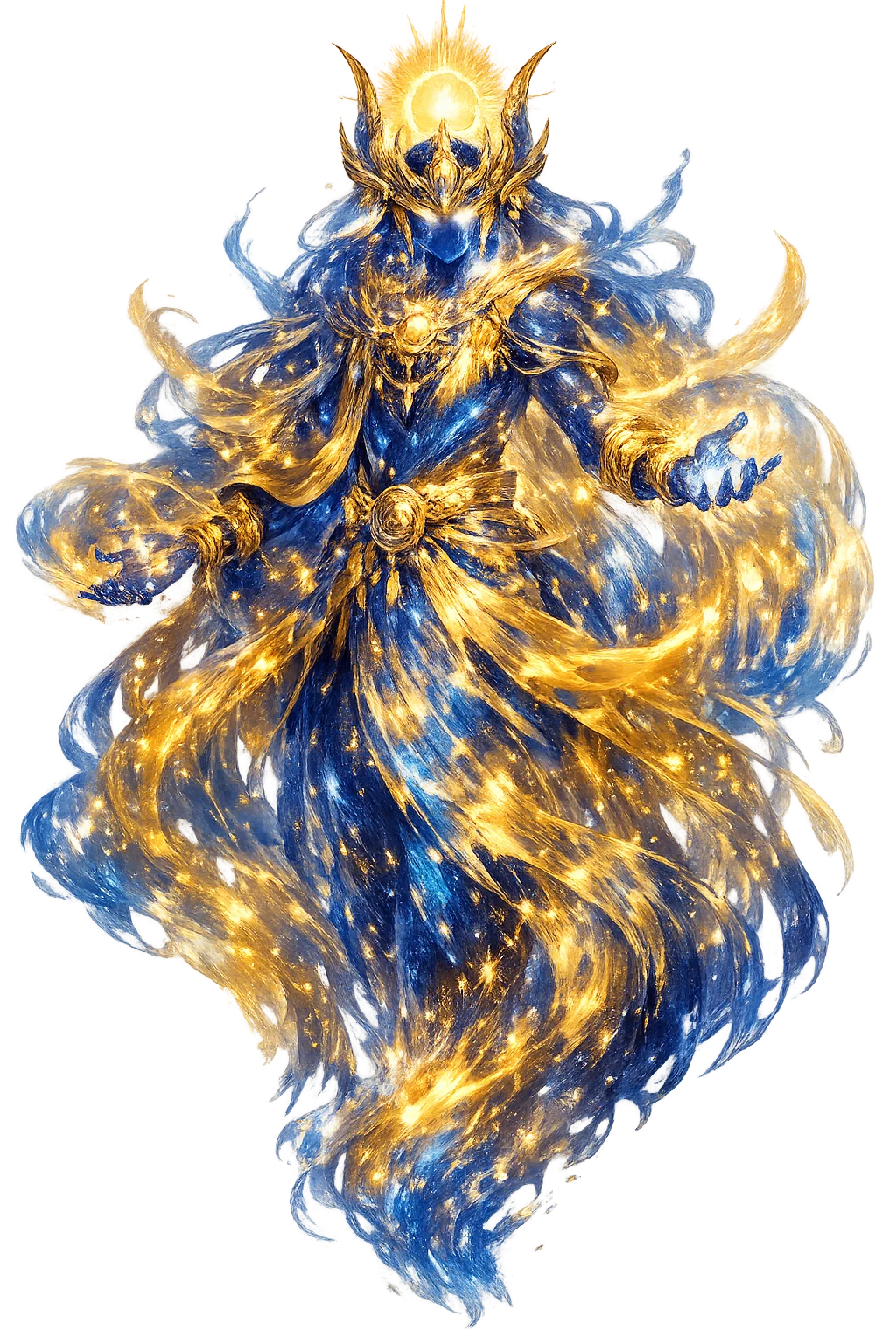
Ọrun is the Yoruba name of heaven itself: the sky-realm where Olódùmarè and the orisha dwell, from which every soul descends to earth (ayé) — and to which every destiny (orí) is assigned before birth. It is not a god but the address of the gods.
Heaven and earth: the two halves of reality, with the soul commuting between them.
The inner head — the personal destiny each soul chooses (or receives) in Ọrun before birth.
The Owner of Heaven — the supreme being whose realm Ọrun is.
Every birth is an emigration from heaven; every death, the return journey.
From the original script to the living URL
Ọrun
The name survives only in scholarly transliteration. Ọrun is the standard Yoruba romanisation, documented in academic sources — “"Heaven" — the sky-realm of the orisha, the divine order above the world”. Its original diacritics and script distinctions preserve distinctions lost in plain ASCII.
No indigenous writing system is securely attested for individual yoruba names. The form shown is a modern scholarly transliteration.
orun
Reduced to plain orun, the name loses everything that made it specific: original diacritics and script distinctions. What remains is an ASCII string that machines can parse but that no longer speaks with its original voice.
Ọrun
The Unicode restoration recovers what ASCII flattened. Ọrun restores original diacritics and script distinctions, returning the name to its original written dignity. The domain encodes to Punycode, but the browser displays the truth.
Ọrun.com → xn--run-slz.com
The non-ASCII characters in Ọrun are encoded while the ASCII remains visible. To the DNS, it is Punycode. To humanity, it is Ọrun.
Owned, ideal, and ASCII forms of Ọrun
Ọrun
The live temple domain — ọrun.com.
orun
The plain ASCII fallback — what DNS and legacy systems see.
How Ọrun was spoken
How Ọrun is preserved in writing
No indigenous writing system is securely attested for individual yoruba names. The form shown is a modern scholarly transliteration.
Contribute scholarly provenance →The lore you have read is the living myth. Extended Lore opens the scholarly vault beneath it: the cult and its material remains, a history of the image, the name after antiquity, a meditation on what the name still means, and the full scholarly apparatus — etymology, orthography, sources.
Enter Extended Lore