Stories of Ólympos
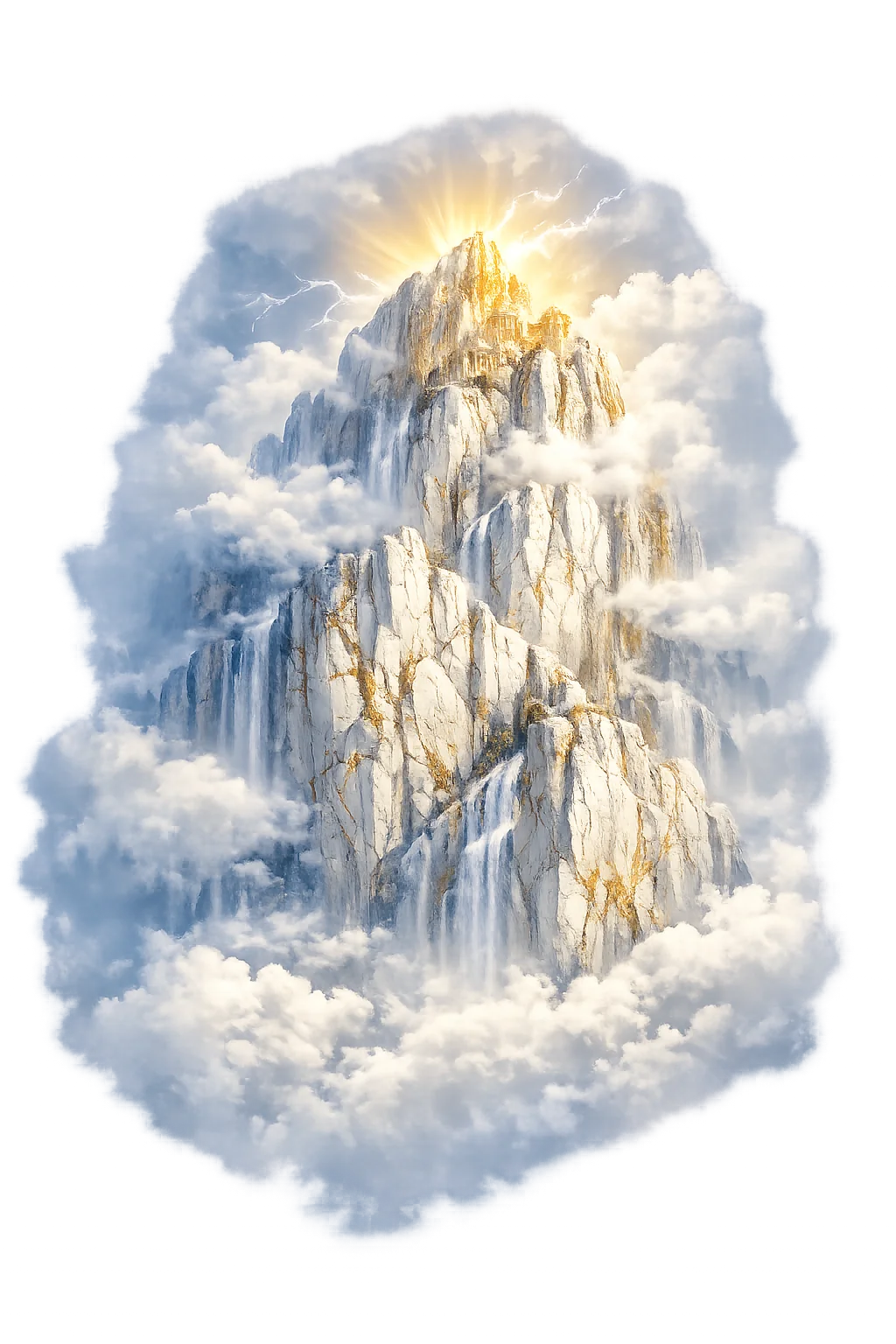
Ólympos is the mountain that became a palace, the palace that became a government, and the government that became a metaphor for supreme authority. Homer places the gods on its cloud-hidden summit, feasting on ambrosia while the Muses sing; Hesiod makes it the muster-ground of the war against the Titans. Ancient Greeks knew several peaks named Ólympos, but the Thessalian mountain — the highest in Greece — became canonical, and its poets set the divine court just above the snowline: a real place, and never quite reachable.
Homer's Olympus is not merely a high mountain in Thessaly but the fixed abode of the Olympian gods, hidden from mortal sight by unbroken clouds. There Zeus has his bronze-floored hall, Hera her golden throne, and Hephaestus his forges. The gods gather in council on its summit, debate the fates of cities, and receive the prayers of mortals through rising sacrificial smoke.
The mountain is therefore both a real place and a cosmic location. Pilgrims might look toward the actual Mount Olympus from the plains of Thessaly, but poets located the divine court just above its peak, in a realm where snow never melts and the light is always clear. This double existence made Olympus the perfect symbol of transcendent power rooted in recognizable geography.
After Zeus and his siblings defeated the Titans, Olympus became the seat of the new regime. The defeated Titans were cast into Tartarus, while the victorious gods divided the cosmos by lot: Zeus received sky and Olympus, Poseidon the sea, and Hades the underworld. The mountain thus marks the boundary between the ordered present and the defeated chaos of the older gods.
Hesiod describes Olympus as the place from which the Olympians marched to war and to which they returned in triumph. Its gates are guarded by the Horai, and its heights are inaccessible to those who have not sworn allegiance to Zeus. To dwell on Olympus is to belong to the victorious order.
Olympus is also the scene of divine discord. In the Iliad, Hera quarrels with Zeus and is hung from the sky by golden fetters; Ares, wounded by Diomedes, howls and flees back to Olympus; and Hephaestus, cast down from heaven by Zeus for defending Hera, falls for a day and lands on Lemnos, crippling him forever. These stories show that Olympus is a court as well as a sanctuary, subject to the same passions and rivalries that trouble mortal houses.
Yet the gods always return to Olympus. Even when they intervene in human wars or descend to the underworld, the mountain remains their home and the seat of their immortality. It is the fixed point around which the changing world turns.
Twins once tried to climb into Olympus. Otus and Ephialtes, the Aloadae — boys of nine who grew nine cubits across and nine fathoms tall, 'the tallest and most beautiful mortals after Orion' — threatened the gods themselves: they would pile Ossa on Olympus and Pelion on Ossa, so that the mountains would touch the starry sky, then rule the sea by cutting a canal through it and the land by force, 'without the leave of the gods' (Homer, Odyssey 11.305–320; cf. Apollodorus, Bibliotheca 1.7.4). Artemis destroyed them on Naxos by a ruse — running between them in a deer's shape so that their own spears found each other. The story is the tradition's commentary on its own mountain: Olympus is high not by geology alone but by decree — a wall between mortal and divine that no ambition, however colossal, may legally breach. The twins measured the distance in mountains and came three peaks short.
The domain of Ólympos
Ólympos is the mountain that rules: the highest peak of Greece became, in epic imagination, the bronze-floored palace of the Olympian gods — seat of Zeus's council, storehouse of his thunderbolts, and the fixed point from which the whole cosmos is governed. To call anything 'Olympian' is still to call it supreme.
Zeus's bronze-floored hall, Hera's golden throne, and Hephaestus's forges crown the mountain above the clouds.
The navel stone at Delphi, not Olympus itself, marked the earth's center, but Olympus was its celestial counterpart.
After the Titanomachy, Olympus became the seat of the victorious gods who divided the cosmos by lot.
Poets placed Olympus above storm and cloud, a luminous court accessible only to the deathless gods.
From the original script to the living URL
Ὄλυμπος
The name in its original Greek form. Ólympos (Ὄλυμπος) is attested in the source tradition — “Bright, shining mountain”. Its acute accents carry the full phonetic and orthographic weight of the source tradition.
olympos
Reduced to plain olympos, the name loses everything that made it specific: acute accents. What remains is an ASCII string that machines can parse but that no longer speaks with its original voice.
Ólympos
The Unicode restoration recovers what ASCII flattened. Ólympos restores acute accents, returning the name to its original written dignity. The domain encodes to Punycode, but the browser displays the truth.
Ólympos.com → xn--lympos-9wa.com
The non-ASCII characters in Ólympos are encoded while the ASCII remains visible. To the DNS, it is Punycode. To humanity, it is Ólympos.
Owned, ideal, and ASCII forms of Ólympos
Ólympos
Restores Ὄλυμπος. The live temple domain — ólympos.com.
olympos
Flattens Ὄλυμπος. The plain ASCII fallback — what DNS and legacy systems see.
How Ólympos was spoken
How Ólympos travels from ancient script to the modern URL
Greek Ὄλυμπος; of uncertain etymology, perhaps “bright, shining mountain"; the abode of the gods.
Mountain of the Gods
The Unicode restoration Ólympos preserves Greek stress and length; the ASCII form olympos loses these features.
The lore you have read is the living myth. Extended Lore opens the scholarly vault beneath it: the cult and its material remains, a history of the image, the name after antiquity, a meditation on what the name still means, and the full scholarly apparatus — etymology, orthography, sources.
Enter Extended Lore