
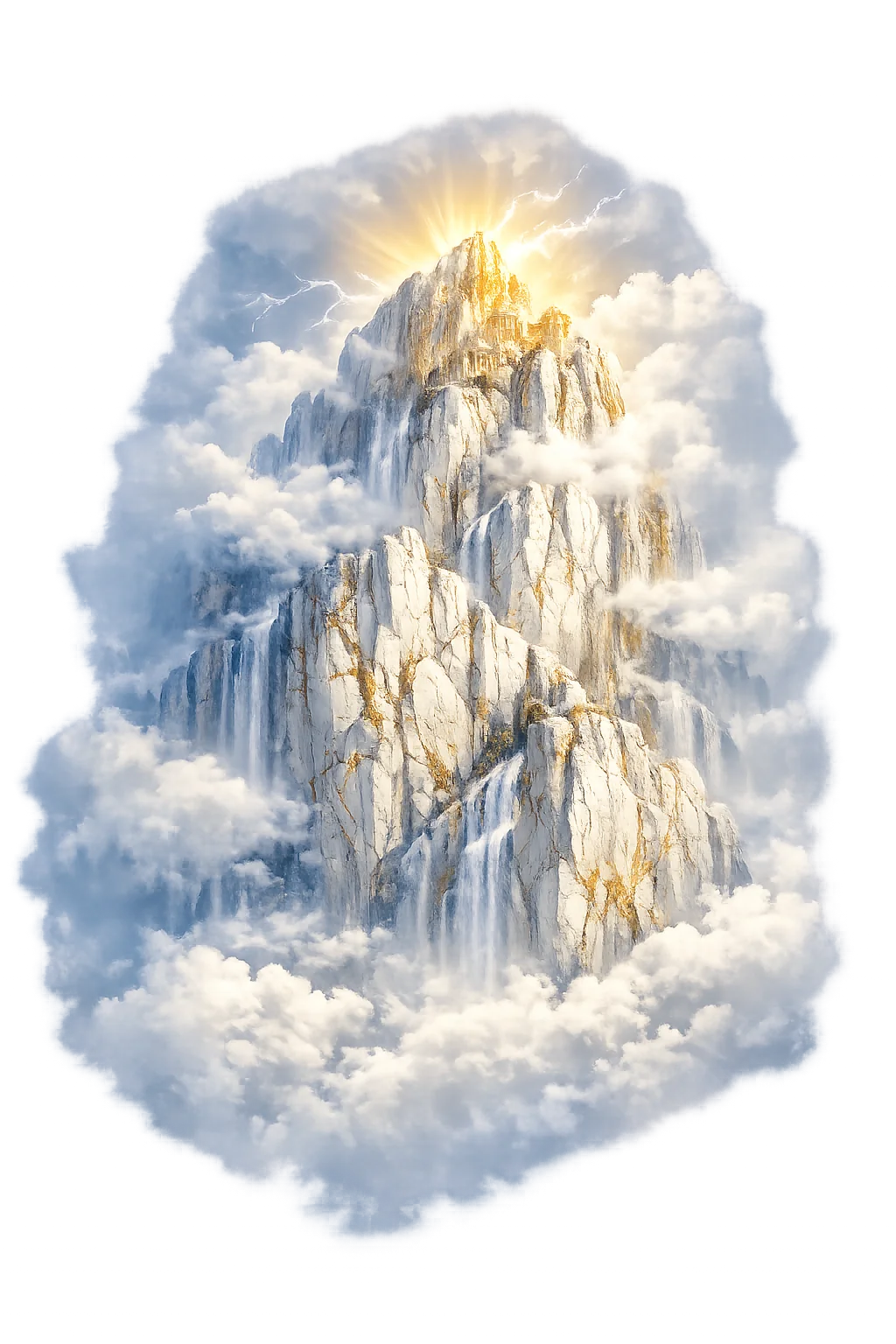
The appointments Ólympos made — and who is keeping them
Take Ólympos's stories in sequence. They are not episodes; they are appointments — and the modern trades are keeping them.
At a Glance
- Temple: Ólympos
- Pantheon: Greek-location
- Domain of influence: Mountain of the Gods
- Pattern seats: 6
- Sectors touched: Culture & Entertainment · Commerce & Governance · Technology & Innovation
- Strongest seat: Travel, Tourism & Place Branding
- Series: The Resonance Files, No. 361 of 546
The Cycle, Read Forward
Travel, Tourism & Place Branding — through The Palace of the Gods
Homer's Olympus is not merely a high mountain in Thessaly but the fixed abode of the Olympian gods, hidden from mortal sight by unbroken clouds. There Zeus has his bronze-floored hall, Hera her golden throne, and Hephaestus his forges.
The atlas states the seat in one line: The mountain of the gods; climbers still ascend it. The story above is the long version of the same sentence. Industries do not invent their archetypes; they inherit them and call them best practice.
Gaming, Fantasy & Entertainment IP — through The Fall of the Titans
After Zeus and his siblings defeated the Titans, Olympus became the seat of the new regime. The defeated Titans were cast into Tartarus, while the victorious gods divided the cosmos by lot: Zeus received sky and Olympus, Poseidon the sea, and Hades the underworld.
The atlas states the seat in one line: The mountain of the gods; the ultimate setting. The story above is the long version of the same sentence. That is the cycle working: story becomes duty, duty becomes trade.
Leadership, Governance & Public Administration — through Hephaestus Thrown from Heaven
Olympus is also the scene of divine discord. In the Iliad, Hera quarrels with Zeus and is hung from the sky by golden fetters; Ares, wounded by Diomedes, howls and flees back to Olympus; and Hephaestus, cast down from heaven by Zeus for defending Hera, falls for a day and lands on Lemnos, crippling him forever.
The atlas states the seat in one line: The mountain that became a palace, the palace a government; the seat of the ruling order. The story above is the long version of the same sentence. The trade thinks it is optimizing a process. It is re-enacting a charter.
Music, Arts & Performance — through Piling Mountains on Mountains
Twins once tried to climb into Olympus. Otus and Ephialtes, the Aloadae — boys of nine who grew nine cubits across and nine fathoms tall, 'the tallest and most beautiful mortals after Orion' — threatened the gods themselves: they would pile Ossa on Olympus and Pelion on Ossa, so that the mountains would touch the starry sky, then rule the sea by cutting a canal through it and the land by force, 'without the leave of the gods' (Homer, Odyssey 11.
The atlas states the seat in one line: The summit where the gods feast to the Muses' song; the name graces musical works still. The story above is the long version of the same sentence. That is the cycle working: story becomes duty, duty becomes trade.
The Theme That Runs the Cycle
Ólympos is the mountain that became a palace, the palace that became a government, and the government that became a metaphor for supreme authority. Homer places the gods on its cloud-hidden summit, feasting on ambrosia while the Muses sing; Hesiod makes it the muster-ground of the war against the Titans. Ancient Greeks knew several peaks named Ólympos, but the Thessalian mountain — the highest in Greece — became canonical, and its poets set the divine court just above the snowline: a real place, and never quite reachable.
The Method, Stated Plainly
None of this is numerology. A seat exists only where the match can be argued from the deity’s documented domains and deeds — weighted, published, and falsifiable. The derivation, the weights, and the challenge process are public on the methodology page. If a seat in this file reads wrong, the atlas itself tells you how to prove it — and the correction becomes part of the record.
For the Ones Who Work There
If you work in travel, tourism & place branding, gaming, fantasy & entertainment ip, or any trade this temple holds a seat in, this is the honest version of what a placement means: your industry beside the story it has been re-telling all along — on the temple floor itself, before an audience that came specifically to read it. The patron tier and the advertising terms describe the mechanics; the resonance above describes the fit.
The File Continues
One of 546 Resonance Files — the series where the pantheon goes to work. Read the founding dispatch for the name, the Restoration File for the spelling, or the whole archive end to end.
Continue the series — previous: Olódùmarè (read it) · next: Oṃ (read it).
The Resonance Files are argued from the same canonical record as the pattern atlas itself: the lexicon, the lore catalog, and the cited sources. Every seat can be challenged at the methodology page — and the challenge is the point.