PuniCodex

Extended Lore

Ὠκεανός Ōkeanós

Etymology · Orthography · Cult · Iconography · Reception · Sources

Tier 1 Ōkeanós.com
Ōkeanós — Ocean, Fresh Water
01

Quick Facts

Essential information about Ōkeanós, Ocean, Fresh Water

Original ScriptὨκεανός
Unicode RestorationŌkeanós
Reconstructed Pronunciation/o.ke.a.nós/
PantheonGreek
DomainOcean, Fresh Water
MeaningThe great river encircling the world
ClassificationTier 1
Primary DomainŌkeanós.com
Sacred SymbolsEncircling river, Bull's horn, Fish, Serpent or dragon, Urn
02

Etymology & Word Family

From original script to Unicode restoration

Original Script Ὠκεανός Ōkeanós — "The great river encircling the world"
Unicode Restoration Ōkeanós Restored stress, length, and script
Modern ASCII okeanos Plain-ASCII fallback

Attested already in Mycenaean Greek (o-ke-a-no) and Homer as the river encircling the world; its ultimate origin is uncertain, with both Indo-European and pre-Greek derivations remaining disputed.

03

Unicode Character Breakdown

Character-by-character philological analysis

CharacterUnicodeNameBlockPhonetic Role
ŌU+014CLatin Capital Letter O with MacronLatin Extended-AMacron: long omega
kU+006BLatin Small Letter KBasic LatinSame
eU+0065Latin Small Letter EBasic LatinSame
aU+0061Latin Small Letter ABasic LatinSame
nU+006ELatin Small Letter NBasic LatinSame
óU+00F3Latin Small Letter O with AcuteLatin-1 SupplementAcute accent
sU+0073Latin Small Letter SBasic LatinSame

The Tier 1 classification reflects how much of the original phonology this restoration preserves — stress and vowel length for Greek names, distinctive letters and diacritics for every other tradition.

04

Cult & Worship

How the sacred was kept — rites, sanctuaries, remains

The Cult

Ōkeanós had virtually no independent cult in the Greek world. As a primordial water-god he belonged to cosmogony rather than to the round of sacrifices and festivals that structured civic religion. A few passages associate the outer Ocean with oaths and with the limits of the world, and Orphic texts gave him a role in theogonic narratives, but there were no major sanctuaries, priesthoods, or processions dedicated to him. His "worship" was largely poetic and philosophical: the poets invoked him as the encircling river, and early natural philosophers speculated on whether the sea and the rivers derived from a single surrounding water.

In the Earth

Roman-era floor mosaics from Antioch-on-the-Orontes, Zeugma, and the Bardo Museum depict Okeanos as a reclining bearded god holding a rudder or sea creature, surrounded by Nereids and ichthyocentaurs. Nilotic mosaics from Pompeii and Roman villas in North Africa extend the iconography of encircling waters. In Greek art, the sixth-century BCE François Vase places Okeanos among the gods at the wedding of Peleus and Thetis.

05

Iconography

How Ōkeanós was imaged across the ages

The Image

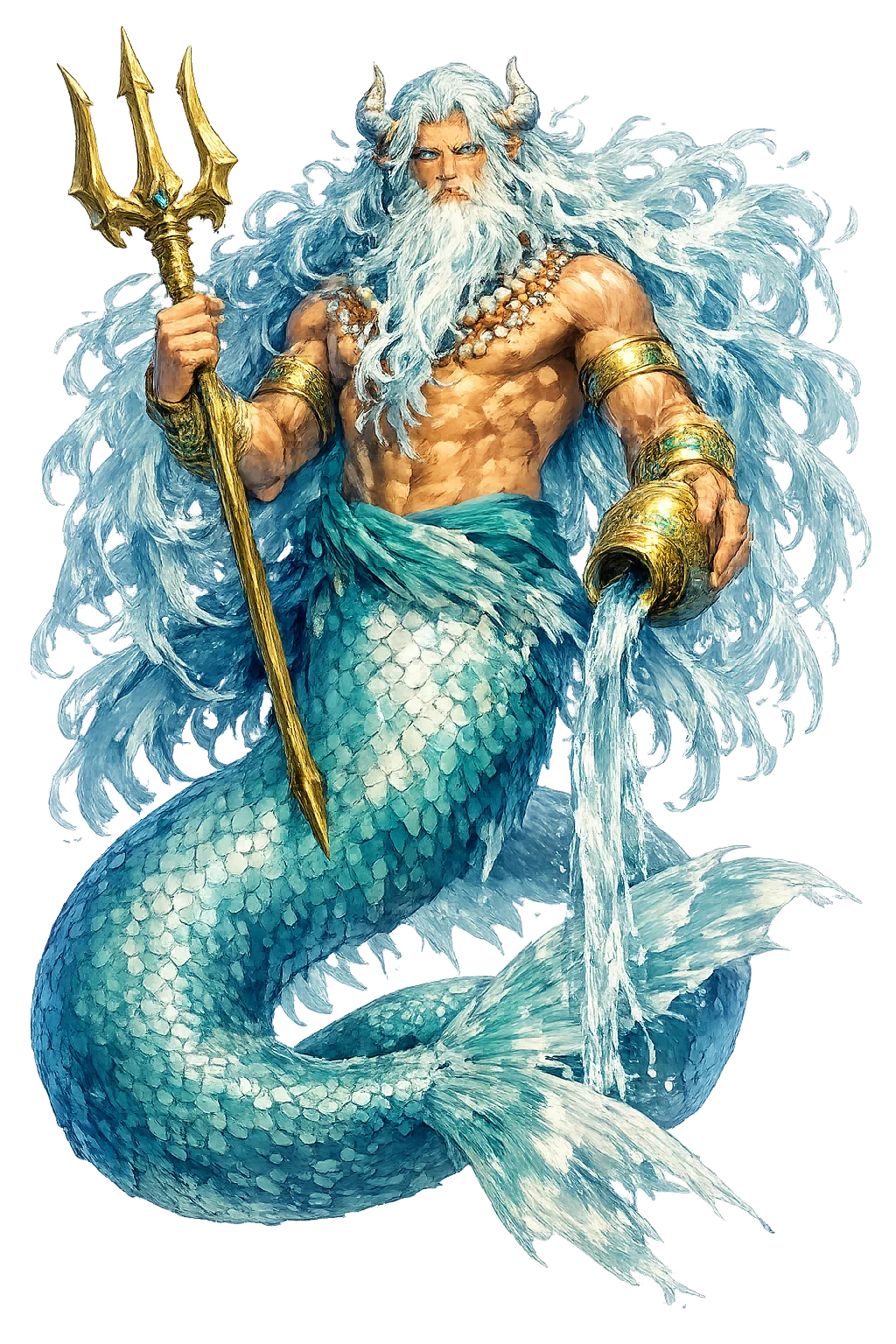
In Greek art Ōkeanós appears chiefly as a bearded, reclining figure surrounded by fish and sea creatures, holding a rudder or a sea-serpent. The François Vase places him among the gods at the wedding of Peleus and Thetis, and Roman floor mosaics from Antioch-on-the-Orontes, Zeugma, and the Bardo Museum elaborate the type into a luxurious marine thiasos of Nereids, Tritons, and ichthyocentaurs. The image of a reclining water-god with a vessel or sea creature became a standard emblem of rivers and oceans across the Roman Empire, adapting the Greek primordial into a decorative personification.

06

Reception & Transformation

The name after its own age — transmission, translation, survival

Afterlives

Ōkeanós became Latin Oceanus and supplied medieval and Renaissance cartography with the image of a river or sea-god enclosing the world. Mappaemundi placed him at the edge of the habitable earth, and manuscript illuminations copied the reclining marine figure from late-antique models. The name survives in modern oceanography and in the European languages that borrowed it for the great ocean. In classical scholarship Ōkeanós has served as a test case for the relationship between myth and early Greek natural philosophy, while in popular usage the word has lost its divine personhood and become simply the sea.

Identifications Across Traditions

The Romans adopted Ōkeanos almost unchanged as Oceanus, bearded and reclining, pouring water from an urn — the standard border-figure of Roman mosaics and the frame of every orbis terrarum. Medieval mappae mundi kept his ring around the three continents, and the encircling Ocean Sea of Columbus's age is the same figure with the rim pushed outward; when the connectedness of all the world's oceans was finally proven, the ancient intuition of a single world-water turned out to be truer than the separate-seas cartography that replaced it. The Moon preserves his name in Oceanus Procellarum, the vast storm-wrack mare; science fiction lends the name to outermost stations and generation ships; and in the word 'ocean' itself — present in nearly every European language — the Titan's name has become the common noun for all his descendants at once.

Modern Legacy

Ōkeanos gave his name to the ocean itself — one of the most universal words on the planet. The idea of a single world-encircling sea, though geographically naive, anticipated the modern understanding of interconnected oceans; climate science now speaks routinely of a single global ocean, and the water that evaporates over the Pacific falls as rain in Athens, exactly as the one-river theology implied. In literature 'Oceanus' still evokes the vast primordial waters beyond the known — Dante's Ocean is the rim of his universe, and Melville's readers could still feel the old ring around the Pequod's world. Restoring Ōkeanos restores the name of the river the Greeks placed at the edge of everything, and whose descendant, the ordinary word 'ocean', we speak every day without remembering it is a god.

07

The Meditation

What Ōkeanós means — beyond the dictionary

Ōkeanos is the water at the edge of the map. For the Greeks, he was both boundary and source: the river you could not cross, yet from which all rivers came. This double nature — limit and origin — makes him one of the most philosophically rich figures in the pantheon.

We now know there is no encircling river, but Ōkeanos was right about the ocean in a deeper sense: all seas are one. The ancient intuition of a single world-water was closer to truth than the fragmented map of separate seas. The restoration of his name honors that insight.

08

Frequently Asked Questions

Common questions about Ōkeanós, Ocean, Fresh Water, and Unicode restoration

01How do you pronounce Ōkeanós?

In reconstructed pronunciation, Ōkeanós is /o.ke.a.nós/ — approximately 'oh-keh-ah-NOSS' — the final syllable carries the pitch, like the river returning to itself.

02What does Ōkeanós mean?

Ōkeanós means The great river encircling the world in the greek tradition.

03What are the symbols of Ōkeanós?

Ōkeanós is associated with Encircling river (The ring of water around the world), Bull's horn (The horn-shaped curve of the river), Fish (The life within his waters), Serpent or dragon (The winding, boundary-guarding form of the river), Urn (The vessel from which rivers pour).

04Why restore Ōkeanós in Unicode?

Plain ASCII okeanos strips the stress, length, and script that make the name specific. Unicode restoration returns the name to its original written dignity.

05What is the most important myth about Ōkeanós?

“Eldest of the Titans” — the The Birth story that anchors the mythology of Ōkeanós, told in full on the lore page.

09

Scholarly Sources

The philological foundations of this restoration

Every claim on this page is grounded in established scholarship. The orthographic restorations follow disciplinary convention. The etymological chain follows the best available reference works. This is not invention — it is resurrection through scholarship.

◈

Lexicography & Philology

  • Liddell, H. G., Scott, R., & Jones, H. S. A Greek-English Lexicon. Oxford: Clarendon Press, 9th ed. 1996.
◎

Primary Texts

  • Hesiod
  • Hesiod, Theogony 133–136, 337–370, 389–401
  • Homer, Iliad 8.485; 14.200–210; 18.395–402
  • Homer, Odyssey 10.504–540; 11.1–24
  • Apollodorus, Library
◉

Archaeology & Art History

  • Material evidence — iconography, inscriptions, and temple archaeology — for Ōkeanós and related cults.
✦

Religious Studies

  • Romm, The Edges of the Earth in Ancient Thought
Return

The Surface Awaits

You have traced the name from its earliest attestation to its Unicode restoration. Now return to the myth. The story is where the name lives.

Back to Lore
Ōkeanós mascot