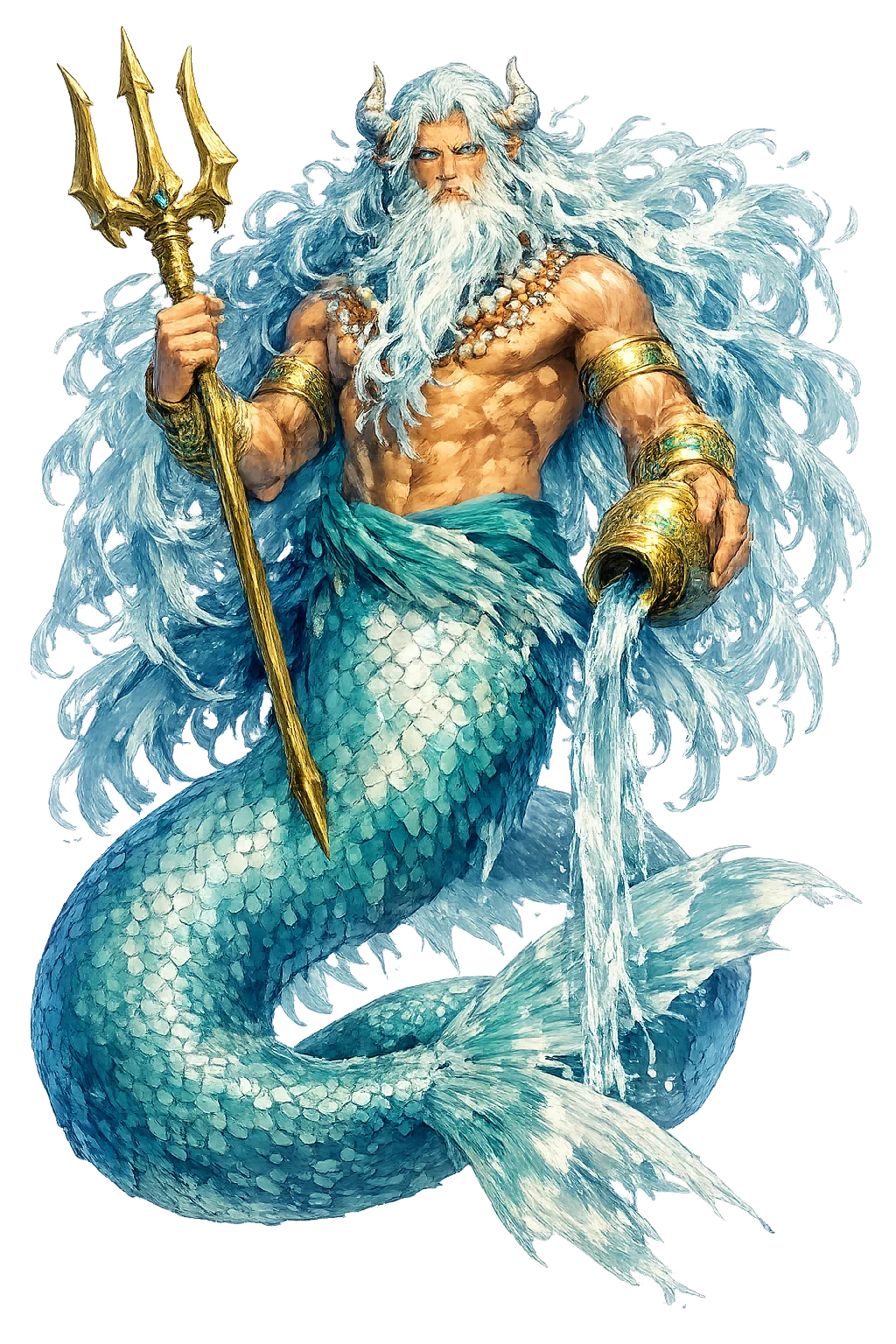
Stories of Ōkeanós
Ōkeanos is a Titan who never fought the Olympians — the tradition nowhere shows him at war. He stays at the rim of the world, neutral and self-contained, the fresh-water source from which all rivers flow and the outer sea that bounds every Homeric voyage.
Hesiod opens the roll of the Titans with a marriage: after Gaia bears the twelve, 'she bore to her firstborn, deep-swirling Ōkeanos, Tethys, the fair-eyed, to be his wife' (Theogony 133–136). He is the eldest child of Ouranos and Gaia — the water that existed before the mountains, before the gods who rule from Olympus. Yet when Kronos rose against his father and the Titanomachy convulsed the cosmos, the tradition is strikingly silent about Ōkeanos: he does not join the war, and he suffers none of its punishments. His household does take sides — his daughter Styx, 'the chiefest of them all,' is the first to bring her children to Zeus's cause (Theogony 389–401), and for that the new king makes her waters the gods' great oath. But Ōkeanos himself simply circles, outside the conflict, older than the order it establishes. The myth makes him the cosmological equivalent of neutrality itself: the river that contains all boundaries cannot be conscripted by any side of one.
In Iliad 14.200–210, Hēra comes to Zeus on Mount Ida with a carefully engineered lie: she is going, she says, to visit 'Ōkeanos, the genesis of the gods, and mother Tethys, who received me from Rhea and reared me kindly in their halls when wide-seeing Zeus cast Kronos down.' The line has startled readers since antiquity — the goddess who reigns on Olympus claims her nurture in a Titan's house, and calls the encircling river 'the source of all the gods.' Whether Homer preserves an older theogony in which the Olympians descend from the waters, or Hēra simply invents the most distant journey imaginable to escape Zeus's bed, the passage fixes Ōkeanos's rank: he is the one power even the gods call ancestor. His stream shelters the outcast as well — Thetis and the Oceanid Eurynome received the crippled Hēphaistos in Ōkeanos's fold and kept him nine years (Iliad 18.395–402). The myth's meaning is consistent in both scenes: the rim of the world is where the mighty go when Olympus itself is not safe.
Hesiod gives Ōkeanos and Tethys the most fecund marriage in the Theogony (337–370): 'three thousand neat-ankled daughters' — the Oceanids, who guard the springs and streams of the world — and 'as many again' sons, the river-gods, 'on whom the god who feeds many, the horned river, rested his prudence.' Every named river of Greek geography is their child: the Neilos of Egypt, the Alpheios of Olympia, the Simois and Skamandros before Troy. Among the daughters the catalogue gathers names that anchor whole dynasties of myth — Metis, the cunning first wife of Zeus; Doris, mother of the Nereids; Perseis, mother of Kirke; the Styx by whom the gods swear. The genealogy is a total hydrology: rain, spring, river, and cloud are all one family, and every fountain in Greece is a granddaughter of the encircling stream. The myth converts geography into kinship — to know where your water comes from is to know whose child you are drinking.
Homeric geography ends where Ōkeanos begins. The sun rises from his stream at dawn and 'sank into Ōkeanos' at dusk (Iliad 8.485) — the day itself is a voyage across the sky and a return through the world-river. Odysseus's road to the dead runs the same way: Kirkē sends him 'to the house of Hades and dread Persephonē' by the deep-flowing Ōkeanos, to the land of the Cimmerians, where night and day lie close together and the sun never looks down (Odyssey 10.504–540; 11.1–24). To sail beyond the streams of Ocean was, for the Greeks, to leave the charted world — past the Pillars of Heraklēs, past every named coast, into the ring that holds everything. Later ages mapped the intuition onto their own expanding maps, and the ring kept receding but never vanished: there is always an edge, and always water beyond it. The myth endures because it is geography become cosmology — the world is an island, and the island is afloat.
The Ocean, Fresh Water, and the Edge of the World
Ōkeanos is the great river that flows around the edge of the world — fresh water, not salt, the source of every river, spring, and cloud. Where Pontos is the sea within the world, Ōkeanos is the water at its rim: eldest of the Titans, husband of Tethys, father of the Oceanids, and the boundary beyond which even the sun must travel to return.
He flows around the flat earth like a ring, beyond the known seas.
All rivers, springs, and rain descend from him; he is the origin of the world's drinkable water.
His three thousand daughters and sons are the springs, rivers, and clouds.
The sun rises from and sets into Ōkeanos; his waters mark the edge of day.
From the original script to the living URL
Ὠκεανός
The name in its original Greek form. Ōkeanós (Ὠκεανός) is attested in the source tradition — “The great river encircling the world”. Its acute accents carry the full phonetic and orthographic weight of the source tradition.
okeanos
Reduced to plain okeanos, the name loses everything that made it specific: acute accents. What remains is an ASCII string that machines can parse but that no longer speaks with its original voice.
Ōkeanós
The Unicode restoration recovers what ASCII flattened. Ōkeanós restores acute accents, returning the name to its original written dignity. The domain encodes to Punycode, but the browser displays the truth.
Ōkeanós.com → xn--keans-3ta93d.com
The non-ASCII characters in Ōkeanós are encoded while the ASCII remains visible. To the DNS, it is Punycode. To humanity, it is Ōkeanós.
Owned, ideal, and ASCII forms of Ōkeanós
Ōkeanós
Restores Ὠκεανός. The live temple domain — ōkeanós.com.
okeanos
Flattens Ὠκεανός. The plain ASCII fallback — what DNS and legacy systems see.
How Ōkeanós was spoken
How Ōkeanós travels from ancient script to the modern URL
Greek Ὠκεανός; the great river encircling the world; probably from a pre-Greek substrate.
Ocean, Fresh Water
The Unicode restoration Ōkeanós preserves Greek stress and length; the ASCII form okeanos loses these features.
The lore you have read is the living myth. Extended Lore opens the scholarly vault beneath it: the cult and its material remains, a history of the image, the name after antiquity, a meditation on what the name still means, and the full scholarly apparatus — etymology, orthography, sources.
Enter Extended Lore