PuniCodex

Extended Lore

Ὀδυσσεύς Odysseús

Etymology · Orthography · Cult · Iconography · Reception · Sources

Tier 1 Odysseús.com
Odysseús — Cunning, Journey
01

Quick Facts

Essential information about Odysseús, Cunning, Journey

Original ScriptὈδυσσεύς
Unicode RestorationOdysseús
Reconstructed Pronunciation/o.dys.seús/
PantheonGreek
DomainCunning, Journey
MeaningHated, painful
ClassificationTier 1
Primary DomainOdysseús.com
Sacred SymbolsThe great bow, The olive-trunk bed, The scar, The oar, The ship
02

Etymology & Word Family

From original script to Unicode restoration

Original Script Ὀδυσσεύς Odysseús — "Hated, painful"
Unicode Restoration Odysseús Restored stress, length, and script
Modern ASCII odysseus Plain-ASCII fallback

The name Odysseús carries the orthographic signature of the greek tradition: Ὀδυσσεύς. Unicode restoration recovers what ASCII flattens.

03

Unicode Character Breakdown

Character-by-character philological analysis

CharacterUnicodeNameBlockPhonetic Role
OU+004FLatin Capital Letter OBasic LatinO uppercase
dU+0064Latin Small Letter DBasic Latind same
yU+0079Latin Small Letter YBasic Latiny same
sU+0073Latin Small Letter SBasic Latins same
eU+0065Latin Small Letter EBasic Latine same
úU+00FALatin Small Letter U with AcuteLatin-1 SupplementAcute on u
sU+0073Latin Small Letter SBasic Latins same

The Tier 1 classification reflects how much of the original phonology this restoration preserves — stress and vowel length for Greek names, distinctive letters and diacritics for every other tradition.

04

Cult & Worship

How the sacred was kept — rites, sanctuaries, remains

The Cult

Odysseús was honored as a hero in Ithaca and the wider Ionian world. The Polis Bay cave on Ithaca, identified as a sanctuary of the Nymphs, yielded votive deposits from the Late Bronze Age through Roman times, including a Hellenistic terracotta inscribed with a prayer to Odysseus. Aeschines mentions a heroön of Odysseus on Ithaca, and the Homeric poems themselves assume his local hero-status. Pilgrimage to his purported palace and tomb shaped the island's identity from antiquity into the Roman period and again in modern tourism.

In the Earth

Ithaki, the island that still bears his name, has Mycenaean remains at Pelikata and Aetos, and at Polis Bay a cave sanctuary of the Nymphs whose votive deposits run from the Late Bronze Age to the Roman period — the very cave where later Ithacans placed Odysseús's homecoming, and where a Hellenistic terracotta fragment inscribed ΕΥΧΗΝ ΟΔΥΣΣΕΙ, 'a prayer to Odysseus', attests his hero-cult. The Bronze Age site above Polis Bay, long called the School of Homer, remains conjectural as his palace. Beyond Ithaka his cult is epigraphic and scattered; his truest monument is Homer's text.

05

Iconography

How Odysseús was imaged across the ages

The Image

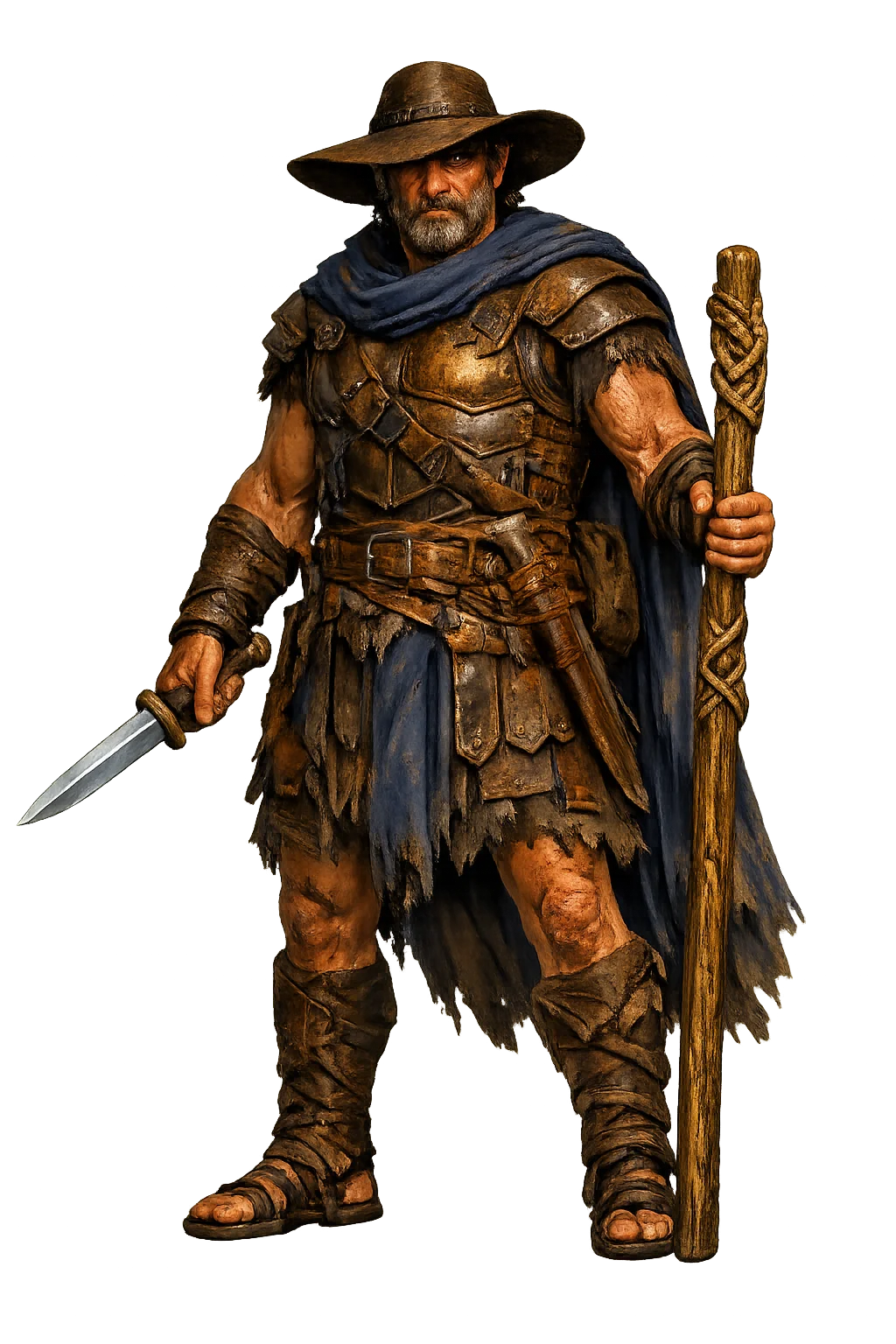
Odysseús appears in archaic and classical Greek vase painting as a bearded, travel-worn strategist: hiding among the spoils of Troy, binding himself to the mast to hear the Sirens, or slaughtering the suitors in his hall. The Sperlonga sculpture group in Italy and Roman wall paintings preserve his encounter with Polyphemus and the Cyclops. Manuscript illuminations of the Odyssey from the Byzantine and medieval periods shaped later Western iconography. Modern reception has fixed him as the wily wanderer, often depicted with bow, ship, or faithful dog Argos.

06

Reception & Transformation

The name after its own age — transmission, translation, survival

Afterlives

Odysseús's afterlife begins with the Homeric poems themselves, which became the foundational school texts of Greek education and were transmitted through Alexandrian scholarship, Roman imitation, and Byzantine copying. Virgil's Aeneas is in part a pious inversion of the wily Greek, while Dante placed the hero in the eighth bolgia of Hell as a figure of fraudulent rhetoric. The Renaissance rediscovered the Odyssey as a model for prose romance and exploration narrative, and James Joyce's Ulysses transformed him into the modern everyman. Modern scholarship reads him through narratology, postcolonialism, and gender studies, while his name has entered English as a byword for cunning endurance and long journeying.

Identifications Across Traditions

The western Greeks pronounced his name with -l-, and through them it reached Italy: Latin Ulixēs, English Ulysses. Rome admired his cunning and distrusted it; Virgil's Aeneid makes him the face of Greek deceit, while the philosophers reclaimed him as the Stoic sage. Dante's Ulisse sails beyond the Pillars of Herakles and drowns for the love of knowledge — the Christian epic's answer to Homer. Long before all this, the Odyssey itself had performed the boldest syncretism: it turned a folktale wanderer into the type of every human journey, so that his name, as the common noun 'odyssey', no longer needs him at all.

Modern Legacy

He is the most rewritten figure of the ancient world: Sophocles' divided portraits, Euripides' stage villain, Tennyson's aging voyager ('to strive, to seek, to find, and not to yield'), Joyce's Ulysses, in which a Dublin advertisement canvasser lives the whole epic in a day, Kazantzakis's modern sequel, Cavafy's Ithaka — 'wise as you will have become, so full of experience' — and a hundred films and novels. Space probes and wanderers' memoirs borrow the noun he became. Restoring Odysseús keeps the stress Greek put on his last syllable: the name itself rises at the end, like a mast coming over the horizon.

07

The Meditation

What Odysseús means — beyond the dictionary

Every other hero of the Trojan cycle is defined by what he can overpower; Odysseús is defined by what he can outlast. The epic tests him with each kind of loss — companions, ships, time, fame, even identity: he survives the Cyclops precisely by becoming Nobody, and he survives Kalypso precisely by refusing to become a god. Between those two refusals lies his whole philosophy. A man is not his name, and yet the name is all that comes home.

The ending refuses triumph. The suitors are dead, the hall is his, and still the wife he won must test him, and the test is not valor but knowledge: only the true husband knows the bed cannot move because it was built on a living root. That rootedness is the answer to all the wandering — the one unmoving thing in a life of motion, grown not made. And beyond even that, Teiresias's oar waits: the promise that he must carry the sea inland until it is no longer recognized. The man of many turns earns his peace only where nobody knows what an oar is — where even his story cannot follow him.

08

Screen & Culture

Where Odysseús echoes through film, television, and games — and how

09

Frequently Asked Questions

Common questions about Odysseús, Cunning, Journey, and Unicode restoration

01How do you pronounce Odysseús?

In reconstructed pronunciation, Odysseús is /o.dys.seús/ — approximately 'oh-dyss-SEWS' — three quick syllables gathering into a long, high final surge, like a wave cresting at the name's end.

02What does Odysseús mean?

Odysseús means Hated, painful in the greek tradition.

03What are the symbols of Odysseús?

Odysseús is associated with The great bow (The weapon only he could string; the test by which the beggar becomes the king), The olive-trunk bed (Built into a living, rooted tree — the immovable sign by which Penelope knows her husband), The scar (The boar's-tusk wound from Parnassos, by which the old nurse Eurykleia knows him first), The oar (Carried inland until a wayfarer mistakes it for a winnowing-fan — the prophecy of his peace), The ship (The vessel of the much-turned man; he loses every one and still comes home).

04Why restore Odysseús in Unicode?

Plain ASCII odysseus strips the stress, length, and script that make the name specific. Unicode restoration returns the name to its original written dignity.

05What is the most important myth about Odysseús?

“The Wooden Horse” — the The Ruse story that anchors the mythology of Odysseús, told in full on the lore page.

10

Scholarly Sources

The philological foundations of this restoration

Every claim on this page is grounded in established scholarship. The orthographic restorations follow disciplinary convention. The etymological chain follows the best available reference works. This is not invention — it is resurrection through scholarship.

◈

Lexicography & Philology

  • Beekes, R. S. P. Etymological Dictionary of Greek. Leiden: Brill, 2010.
◎

Primary Texts

  • Homer
  • Homer, Iliad and Odyssey (esp. Od. 9, 19, 21–23)
  • Virgil, Aeneid 2
  • Sophocles, Ajax
  • Euripides
  • Apollodorus, Epitome
◉

Archaeology & Art History

  • Material evidence — iconography, inscriptions, and temple archaeology — for Odysseús and related cults.
✦

Religious Studies

  • Beekes, Etymological Dictionary of Greek
Return

The Surface Awaits

You have traced the name from its earliest attestation to its Unicode restoration. Now return to the myth. The story is where the name lives.

Back to Lore
Odysseús mascot