The Living Myth
Cunning, Journey · The Much-Enduring Wanderer · Master of Cunning Return
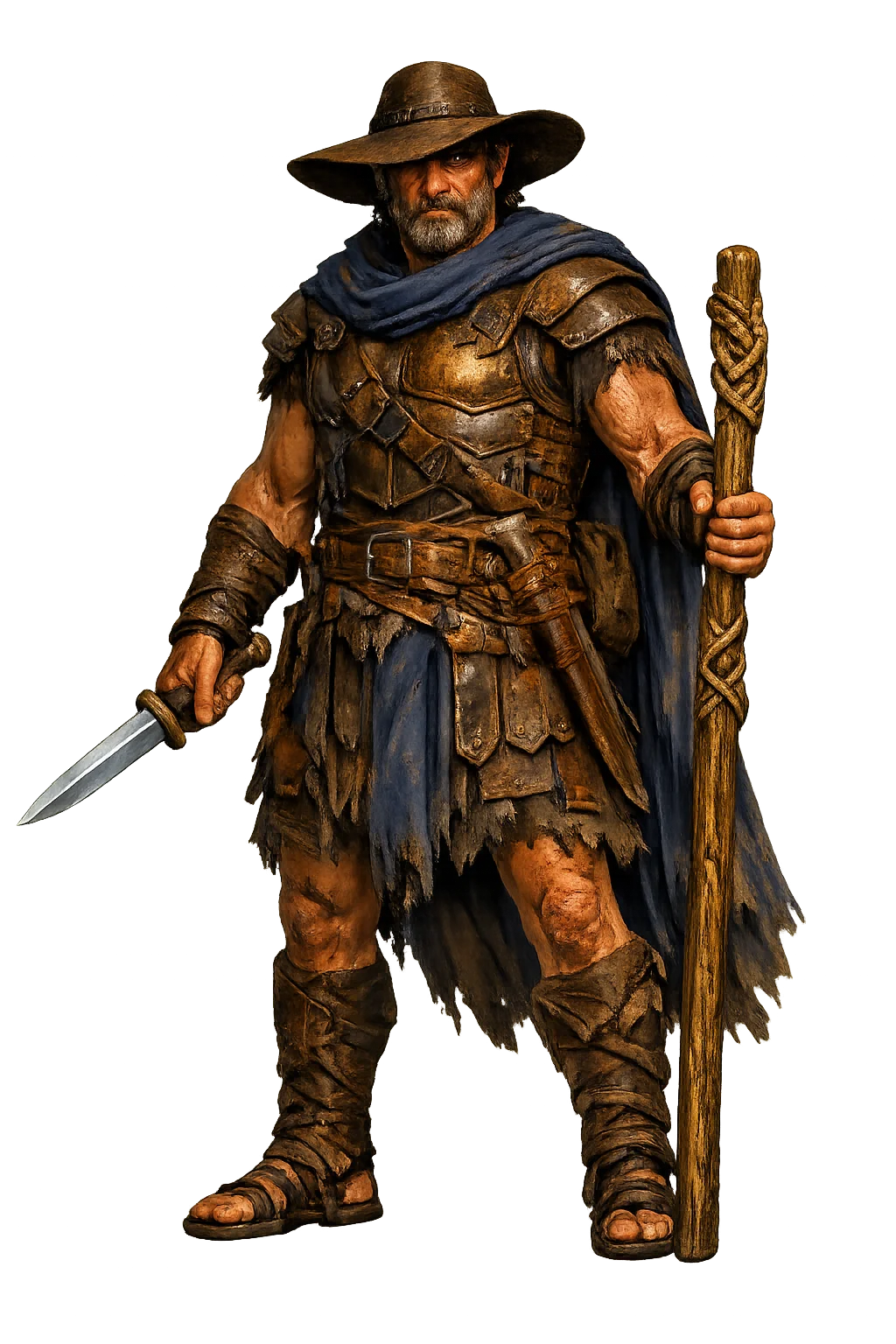
Stories of Odysseús
The Odyssey is his biography, but his story begins in the Iliad and ends in prophecy: war at Troy, ten years of wandering, and a homecoming the gods themselves had to negotiate. He is the one hero of the cycle whose full arc — force, craft, loss, return — the tradition preserves entire.
When ten years of force had not taken Troy, Odysseús took it in a night by craft. The horse was built by Epeios with Athena's help (Od. 8.492) and carried the flower of the Achaeans within the walls as a pretended offering to appease the very goddess the city had outraged. Odysseús steered the plan through its two greatest dangers: Helen walking the horse's flank and speaking with the voices of the men's wives (Od. 4.274–279), and the priest Laocoön hurling his spear into the wooden side, which rang hollow — a scene the Roman tradition expands into full tragedy (Virgil, Aeneid 2). At midnight the horse opened, the gates received the returning army, and Troy burned. The Odyssey's singers treat the ruse as Odysseús's crowning glory (Od. 8.520), while the heirs of the fallen remembered the same night as the crime that founded their own counter-epic. The myth's unease is its point: Greek heroism could conquer what Greek force could not — but only by teaching the world to fear intelligence as much as courage.
In Odyssey 9 the wanderer comes to the island of the Cyclopes and enters the cave of Polyphêmos with twelve of his men. The giant blocks the entrance with a great stone and devours two sailors at each meal; force is impossible, so Odysseús's answer is a name. He tells the Cyclops he is called Outis — 'Nobody' (Od. 9.366) — and then hands him the potent wine of Maron. Drunk and blinded by the fire-hardened olive-stake, the giant bellows that Nobody is killing him, and his neighbors take the joke for silence and walk away. The crew escapes clinging beneath the bellies of the rams, and as the ship pulls off Odysseús cannot resist shouting his true name across the water — winning Poseidôn's wrath and the ten years that followed (Od. 9.526–536). The episode is the poem's deepest meditation on identity: Odysseús survives by annihilating his name, and is nearly destroyed by reclaiming it. The self, Homer suggests, is the one treasure that cannot be shouted home.
On Aiaia, Kirke turns the scouting party into swine — 'their mind remained firm as before' (Od. 10.239–240) — until Odysseús, armed by Hermês with the moly herb, forces her to swear the oath that ends her hostility (Od. 10.343–346). A year of feasting follows, and then the strangest gift in the poem: she sends him where no living sailor has gone, down to the house of Hades to drink blood with the blind seer Teiresias (Od. 10.487–540; 11). There he meets the ghost of his mother, Achilles among the dead, and watches Tityos, Tantalos, and Sisyphos at their eternal labors. The enchantress becomes the hero's teacher, and her island the hinge of the whole epic: before Kirke, Odysseús is a raider fleeing disasters; after her, he is a man who has consulted the dead and knows what his homecoming will cost. The poem's most dangerous woman is also the one who gives it its moral map — a reversal Homer performs without comment, as if it were the most natural thing in the world.
For seven years the nymph Kalypso holds Odysseús on Ogygia, offering him immortality and agelessness — and each day he refuses, choosing Ithaka, its smoke, and a mortal wife (Od. 5.209–224; 7.256–258). Zeús orders his release; Poseidôn wrecks the raft within sight of land (Od. 5.282–381); the naked castaway, kept afloat by Ino-Leukothea's veil, crawls under twin olive bushes and buries himself in leaves 'like a brand under black ash' (Od. 5.483–490). Then comes the strangest rescue in Greek epic: Nausikáa, a princess doing the palace laundry, finds him salt-crusted and terrible — and, because Athena has steadied her heart, brings the stranger home. The Phaiakians feast him, hear his whole tale, and set him on a ship that carries him sleeping to Ithaka (Od. 13). The sequence is the Odyssey's theology in miniature: a man can lose everything except the direction of home, and the gods help only those still crawling toward it.
Twenty years gone, Odysseús enters his own hall disguised as a beggar and endures blows he could repay with blood, because revenge mistimed is ruin (Od. 17–20). Pēnelópē, at the end of her patience, sets the contest: whoever strings the great bow and sends an arrow through twelve axes shall have her (Od. 19.570–587; 21). The suitors fail one by one; the beggar strings it in a motion smooth as a lyre-player's tuning, and the hall runs red (Od. 22). Even then Pēnelópē does not trust her eyes: she orders the bridal bed moved, and Odysseús cries out that it cannot be — he built it himself around a living olive stump, rooted in the earth, the wood planed and inlaid (Od. 23.153–202). Recognition comes not from the face but from the bed. The epic ends by answering its own question: what survives twenty years of wandering is not strength but the rooted thing a man refuses to move. Teiresias's oar still waits — a last journey inland, and a gentle death from the sea (Od. 11.121–137).
Cunning, Endurance, and the Long Road Home
Odysseús is the Greeks' fullest study of intelligence under pressure: the strategist of Troy, the wanderer of ten years, the beggar who comes home to a house full of enemies and wins it back with patience, a bow, and a rooted bed. Homer gives him more words than any other hero — his weapon is speech itself.
Deviser of the Wooden Horse, and of the name Outis — 'Nobody' — by which he outwitted the Cyclops Polyphêmos.
Ten years from Troy to Ithaka: Cyclops, Kirke, the dead, the Sirens, Skylla and Charybdis, Kalypso — the sea's whole syllabus.
Disguised as a beggar in his own hall, he strings the great bow and takes back house, wife, and kingdom from the suitors.
The goddess of counsel delights in him precisely because he is like her: 'among all men you are the best in counsel and speech' (Od. 13).
From the original script to the living URL
Ὀδυσσεύς
The name in its original Greek form. Odysseús (Ὀδυσσεύς) is attested in the source tradition — “Hated, painful”. Its diphthongs and acute accents carry the full phonetic and orthographic weight of the source tradition.
odysseus
Reduced to plain odysseus, the name loses everything that made it specific: diphthongs and acute accents. What remains is an ASCII string that machines can parse but that no longer speaks with its original voice.
Odysseús
The Unicode restoration recovers what ASCII flattened. Odysseús restores diphthongs and acute accents, returning the name to its original written dignity. The domain encodes to Punycode, but the browser displays the truth.
Odysseús.com → xn--odysses-c2a.com
The non-ASCII characters in Odysseús are encoded while the ASCII remains visible. To the DNS, it is Punycode. To humanity, it is Odysseús.
Owned, ideal, and ASCII forms of Odysseús
Odysseús
Restores Ὀδυσσεύς. The live temple domain — odysseús.com.
odysseus
Flattens Ὀδυσσεύς. The plain ASCII fallback — what DNS and legacy systems see.
How Odysseús was spoken
How Odysseús is preserved in writing
A bespoke provenance study for Odysseús is being prepared by the PUNICODEX scholarly team.
Contribute scholarly provenance →The lore you have read is the living myth. Extended Lore opens the scholarly vault beneath it: the cult and its material remains, a history of the image, the name after antiquity, a meditation on what the name still means, and the full scholarly apparatus — etymology, orthography, sources.
Enter Extended Lore