PuniCodex

Extended Lore

ᚢᚦᛁᚾ Óðinn

Etymology · Orthography · Cult · Iconography · Reception · Sources

Tier 1 Óðinn.com
Óðinn — Wisdom, War, Death, Poetry
01

Quick Facts

Essential information about Óðinn, Wisdom, War, Death, Poetry

Original Scriptᚢᚦᛁᚾ
Unicode RestorationÓðinn
Reconstructed Pronunciation/ˈɔːðinː/
PantheonNorse
DomainWisdom, War, Death, Poetry
MeaningFury, possession (from *wōđanaz)
ClassificationTier 1
Primary DomainÓðinn.com
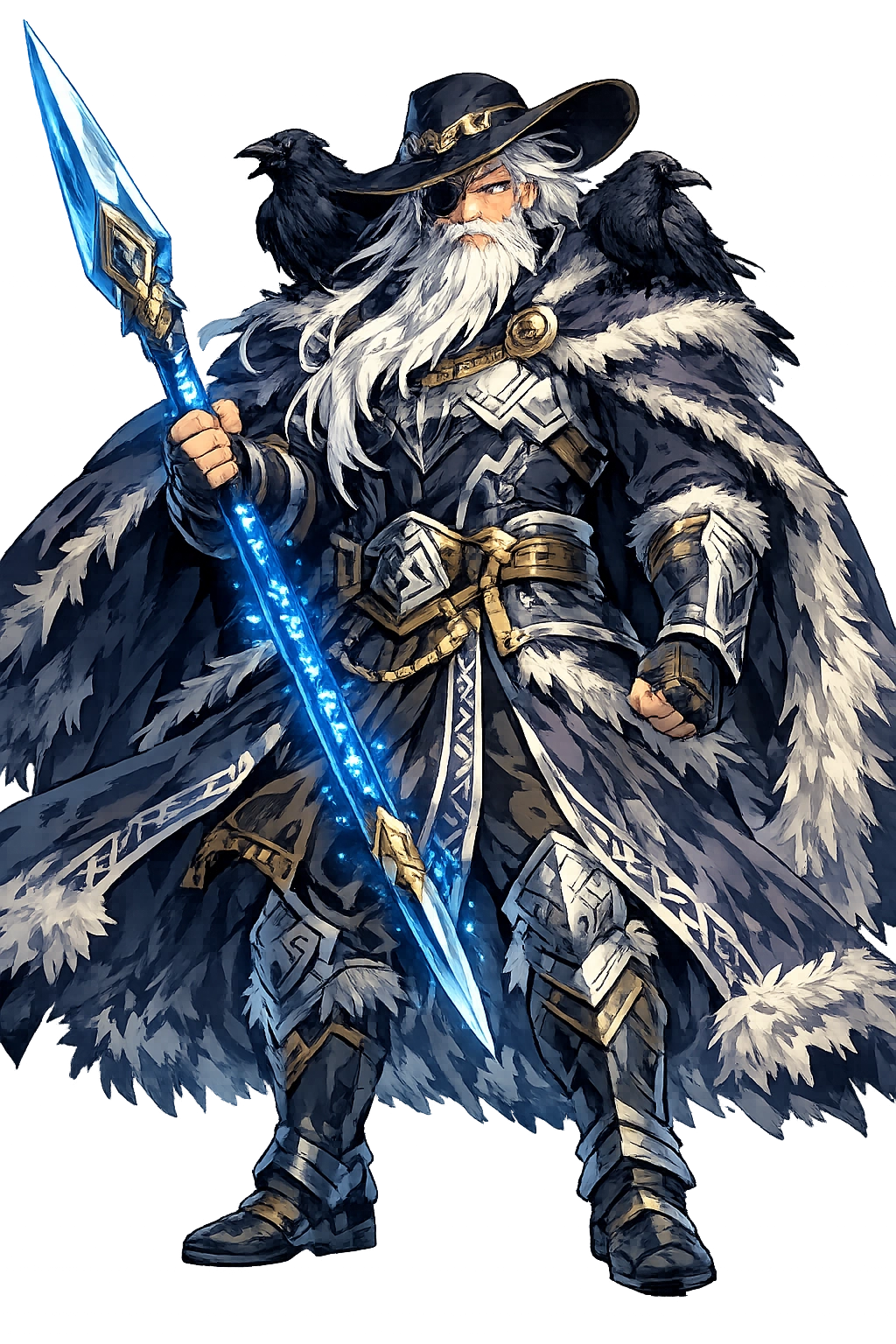
Sacred SymbolsSpear Gungnir, Two ravens Huginn and Muninn, Valknut, Sleipnir, Mímir's severed head
02

Etymology & Word Family

From original script to Unicode restoration

Proto-indo-european *Wōdanaz fury, possession, poetry
Original Script ᚢᚦᛁᚾ Óðinn — "Fury, possession (from *wōđanaz)"
Unicode Restoration Óðinn Restored stress, length, and script
Modern ASCII odinn Plain-ASCII fallback

PGmc *Wōdanaz "the furious one", from *wōđ- "fury, inspiration". Cognate with Latin vātēs "poet-seer".

03

Unicode Character Breakdown

Character-by-character philological analysis

CharacterUnicodeNameBlockPhonetic Role
ÓU+00D3Latin Capital Letter O with AcuteLatin-1 SupplementAcute on O
ðU+00F0Latin Small Letter EthLatin-1 SupplementEth: voiced dental fricative
iU+0069Latin Small Letter IBasic LatinSame
nU+006ELatin Small Letter NBasic LatinSame

The Tier 1 classification reflects how much of the original phonology this restoration preserves — stress and vowel length for Greek names, distinctive letters and diacritics for every other tradition.

04

Cult & Worship

How the sacred was kept — rites, sanctuaries, remains

The Cult

Óðinn's cult was aristocratic, expensive, and bloody. At Uppsala his image stood in the great temple between Þórr and Freyr, and Adam of Bremen reports the nine-year festival at which nine males of every living creature were sacrificed, their bodies hung in the sacred grove — the gallows god worshipped in hanged flesh. Hanging and the spear were his signature rites: late sagas still remember Vikar, sacrificed to Óðinn by noose and spear-point. The Rus chieftain's funeral described by Ibn Fāḍlān in 922 — a slave-girl killed, a ship burned — shows the elite death-cult from which Valhöll drew its power, though the god is never named. Priestly function fell to the goðar, chieftain-priests; place-names preserve his sanctuaries — Odense is Óðinsvé, 'Óðinn's sanctuary', recorded in the tenth century, and Sweden's Onsala was his hall. At the Yule feast, Heimskringla says, the first toast was drunk to Óðinn for victory and power.

In the Earth

Adam of Bremen describes the great temple at Uppsala (c. 1070s), where Óðinn was honored alongside Þórr and Freyr. The Rök runestone (Ög 136) memorializes the dead Vémóðr in riddling, eschatological stanzas; the Torslunda plate depicts a one-eyed dancer often identified with Óðinn. Valkyrie pendants and spear-god silver figurines from sites such as Lunda and Uppåkra point to his warrior cult.

05

Iconography

How Óðinn was imaged across the ages

The Image

Óðinn is the most archaeologically visible of the Norse gods, and the images track the texts. On sixth-century bracteates a crowned, spear-bearing figure stands beside raptors — often read as the god with his ravens, though the reading is debated. A seventh-century statuette from Lindby in Östergötland has one eye socket left conspicuously empty; from Gammel Lejre in Denmark, a tiny silver figure found in 2009 and dated around the year 900 sits with a bird on each arm — the closest archaeology comes to Huginn and Muninn on their perch. Gotland's picture stones carry the triple valknut and an eight-legged horse bearing a rider into the high-roofed hall. Snorri himself gives the travelling dress: broad-brimmed hat, grey cloak, spear. The raven banner sewn for Viking armies appears on the Bayeux Tapestry, and the modern one-eyed wanderer, hat pulled low, is these fragments fused by two centuries of book illustration.

06

Reception & Transformation

The name after its own age — transmission, translation, survival

Afterlives

Christianity gave Óðinn a long second life as literature. The mythic corpus survived on a handful of Iceland vellums — the Codex Regius of the 1270s, Snorri's Edda in its three codices — reaching print only when Brynjólfur Sveinsson received the Regius in 1643 and Resen printed the Edda in 1665; Ole Worm's Danicorum Monumentorum (1643) put rune-stones and gods before European eyes. Paul Henri Mallet's Introduction à l'histoire de Dannemarc (1755–56), Englished as Northern Antiquities (1770), carried the Allfather to the Romantic movement, and Grimm's Deutsche Mythologie (1835) made him the centre of Germanic antiquity. The twentieth century read him comparatively: Georges Dumézil placed him at the head of the sovereign function, half-magician, half-jurist; E. O. G. Turville-Petre's Myth and Religion of the North (1964) gave the English-speaking world its standard portrait; and Neil Price's The Viking Way (2002) reframed him as a master of seiðr, the ecstatic magic the sagas half-attribute to him. From manuscript to comparative godhead in three centuries — a career won entirely by scholarship.

Identifications Across Traditions

Interpretatio romana named him Mercury: Tacitus (Germania 9) reports that Mercury is the chief god of the Germani, and the equation stuck — the dies Mercurii became Wednesday in English, Wodanstag in Dutch, and Óðinsdagr in Iceland. Anglo-Saxon royal houses claimed descent from Woden, and the genealogies of Wessex and Mercia trace their lines back to him — a pagan ancestor quietly retained by Christian kings. On the continent he rides at the head of the Wild Hunt, the Wodanes her, and medieval German folklore kept him as leader of the furious host. His deeper kin are debated: the one-eyed wanderer, the hanged god, the lord of ecstasy — his very name, from *wōđanaz, means 'the furious, the possessed' — invite, and resist, comparison with Lugus, Rudra, and the shamans of the northern world. Wagner's Wotan, made brooding and self-doubting in the Ring, and Marvel's Odin, made cosmic and paternal, are the two great modern masks of the Allfather.

Modern Legacy

Óðinn is the best-known Norse god in the modern world. Wednesday still carries his name; place-names from Odense in Denmark to Wansdyke in England mark the roads and boundaries his cult once blessed. The Viking-Age revival of the nineteenth century and the Ásatrú movement of the twentieth restored his worship, controversially, to living religion. In mass culture he appears as Marvel's one-eyed Allfather, as Gandalf — Tolkien's wandering grey pilgrim owes him a clear debt — and as Wagner's Wotan. The runes he won hang from necks as jewellery; the valknut, his triple knot, appears on tattoos worldwide. Few pagan gods have travelled so far from their ninth-century hearths with so much of their complexity intact.

07

The Meditation

What Óðinn means — beyond the dictionary

Óðinn is the myth of intelligence as sacrifice. Every god in the Eddas has power; only Óðinn has invoices. He gives an eye for a drink from Mímir's well, nine nights on a spear-pierced tree for the runes, his dignity as a god for three nights as a snake in a giant's mountain — and what he buys is always the same commodity: to know. The Hávamál hanging makes the transaction explicit: I know that I hung on a wind-wracked tree nine whole nights, wounded by a spear, given to Óðinn, myself to myself — the only god in the corpus whose central ritual is a death he performs upon himself.

What the myth knows, and says plainly, is the price of that knowledge: Óðinn is the god who foresees Ragnarǫk and cannot prevent it. He trades happiness for certainty and calls the trade wisdom. In an information age that runs on the same bargain — everything knowable, nothing unknown, serenity sold for data — the one-eyed god is less an antique than a diagnosis.

08

Screen & Culture

Where Óðinn echoes through film, television, and games — and how

09

Frequently Asked Questions

Common questions about Óðinn, Wisdom, War, Death, Poetry, and Unicode restoration

01How do you pronounce Óðinn?

In reconstructed pronunciation, Óðinn is /ˈɔːðinː/ — approximately 'OH-thin' — hold the first vowel long like 'awe', then a soft 'th' as in 'this', and a crisp 'nin'.

02What does Óðinn mean?

Óðinn means Fury, possession (from *wōđanaz) in the norse tradition.

03What are the symbols of Óðinn?

Óðinn is associated with Spear Gungnir (The never-missing weapon that Odin hurls at the start of battle), Two ravens Huginn and Muninn (Thought and Memory, who fly across the worlds and report to his shoulder), Valknut (The triple-knot associated with Odin's power to bind and release the slain), Sleipnir (The eight-legged horse that carries Odin between worlds), Mímir's severed head (The consulted source of hidden wisdom, kept by Odin at the well).

04Why are there different spellings of Óðinn?

Each form is a historically attested restoration rather than a mistake: Oðinn is the ideal form (Eth variant: Oðinn (strict orthography)). PUNICODEX registers the full set so the tradition is preserved under every defensible spelling.

05Why restore Óðinn in Unicode?

Plain ASCII odinn strips the stress, length, and script that make the name specific. Unicode restoration returns the name to its original written dignity.

06What is the most important myth about Óðinn?

“The Hanging on the Windy Tree” — the Hávamál 138 story that anchors the mythology of Óðinn, told in full on the lore page.

10

Scholarly Sources

The philological foundations of this restoration

Every claim on this page is grounded in established scholarship. The orthographic restorations follow disciplinary convention. The etymological chain follows the best available reference works. This is not invention — it is resurrection through scholarship.

◈

Lexicography & Philology

  • Cleasby-Vigfusson
  • Zoëga
◎

Primary Texts

◉

Archaeology & Art History

  • Material evidence — iconography, inscriptions, and temple archaeology — for Óðinn and related cults.
✦

Religious Studies

  • Tacitus, Germania 9 (Mercury as chief god of the Germani)
  • Adam of Bremen, Gesta Hammaburgensis ecclesiae pontificum IV (the temple at Uppsala)
  • Turville-Petre, E. O. G., Myth and Religion of the North (1964)
  • Price, Neil, The Viking Way: Magic and Mind in Late Iron Age Scandinavia (2002)
Return

The Surface Awaits

You have traced the name from its earliest attestation to its Unicode restoration. Now return to the myth. The story is where the name lives.

Back to Lore
Óðinn mascot