The Living Myth
Primordial Waters · The Primeval Waters · The inert one, waters
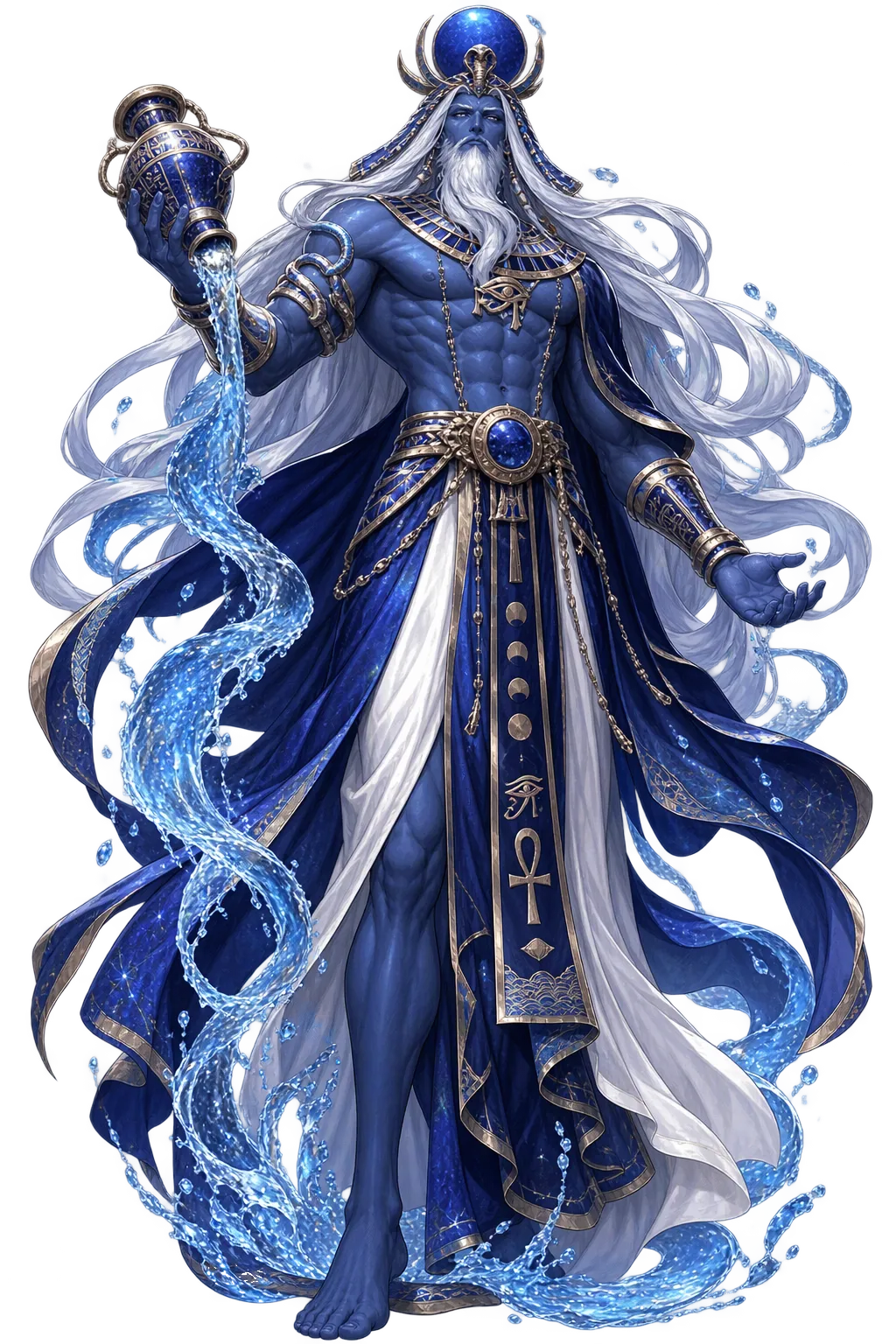
Stories of Nnw
Nun’s mythology is Egypt’s creation mythology seen from the water’s side. He never acts — that is his nature, and the meaning of his name, ‘the inert one’ — but everything that acts, acts upon or out of him. The creator gods of every temple city are alike in one thing: they stood on Nun’s surface and spoke.
At Hermopolis the theology ran: four frog-headed males and four snake-headed females — Nun and Naunet, Huh and Hauhet, Kuk and Kauket, Amun and Amaunet — swam in the primordial water until their inertness ripened into an egg, or a lotus, or the first mound. From that the sun rose. Nun heads the eight because water is first among the inert things.
The Shabaka Stone’s Memphite account has Ptah conceiving the world in the heart and speaking it on the primeval waters: creation as a command uttered over Nun. The theology made the water the page and the god’s tongue the pen — the deepest Egyptian metaphor for creation as articulation.
In the underworld books the sun’s night barque sails the Nun beneath the world — the primeval water is also the water below, the source of renewal. At dawn the barque re-emerges from Nun’s eastern flood: every sunrise is a re-creation, every night a return to the uncreated.
The Egyptians called the annual flood simply ‘the arrival’; its waters were Nun revisiting the world, refertilising the mound. Temple holy lakes and the ‘Ocean of the Temple’ pools staged the same theology in architecture: a miniature primeval water at the god’s door, in which purity and creation are the same act.
The Inert One, the Flood Before the World
Nnw — Nun — is not a god of things but of the nothing before things: the dark, inert, life-teeming water that existed before creation and surrounds the world still. Every cosmogony begins in him; every temple’s holy lake is his miniature; and every year the Nile’s flood re-stages his one eternal act — potential flooding into form.
The chaos-flood from which the first mound — and every creator — emerged.
He lifts the ben-ben: the primeval hill on which the creator stood to speak the world.
With Naunet he heads the eight frog- and snake-headed forces of primordial inertness.
The world floats in him as a bubble in a flood; beyond the horizon, Nun resumes.
From the original script to the living URL
𓈗
The name in its original Egyptian form. Nnw (𓈗) is attested in the source tradition — “The inert one, waters”. Its original diacritics and script distinctions carry the full phonetic and orthographic weight of the source tradition.
nun
The plain nun form is identical to the Unicode restoration. Because this name is already written in Latin letters, no diacritics, stress, or script information were lost — only capitalization differs.
Nnw
The Unicode restoration does not need to recover lost marks for Nnw. Its value is canonical spelling and consistent cataloguing, not the reconstruction of erased orthography. The domain is readable as-is to both DNS and humanity.
Nnw.com
This restoration is written entirely in ASCII letters — no Punycode encoding stands between Nnw and the DNS. The domain reads identically to machines and to human eyes.
The attested spelling family of Nnw
Nnw
Restores 𓈗. The full Unicode restoration. nnw.com is not in the PuniCodex collection — it is watched for release; if it drops, this temple upgrades to an owned flagship. Attested by Faulkner, Wb.
How Nnw was spoken
How Nnw travels from ancient script to the modern URL
Egyptian nnw; the original vocalisation is unknown. The name denotes the primordial inert waters.
The lore you have read is the living myth. Extended Lore opens the scholarly vault beneath it: the cult and its material remains, a history of the image, the name after antiquity, a meditation on what the name still means, and the full scholarly apparatus — etymology, orthography, sources.
Enter Extended Lore