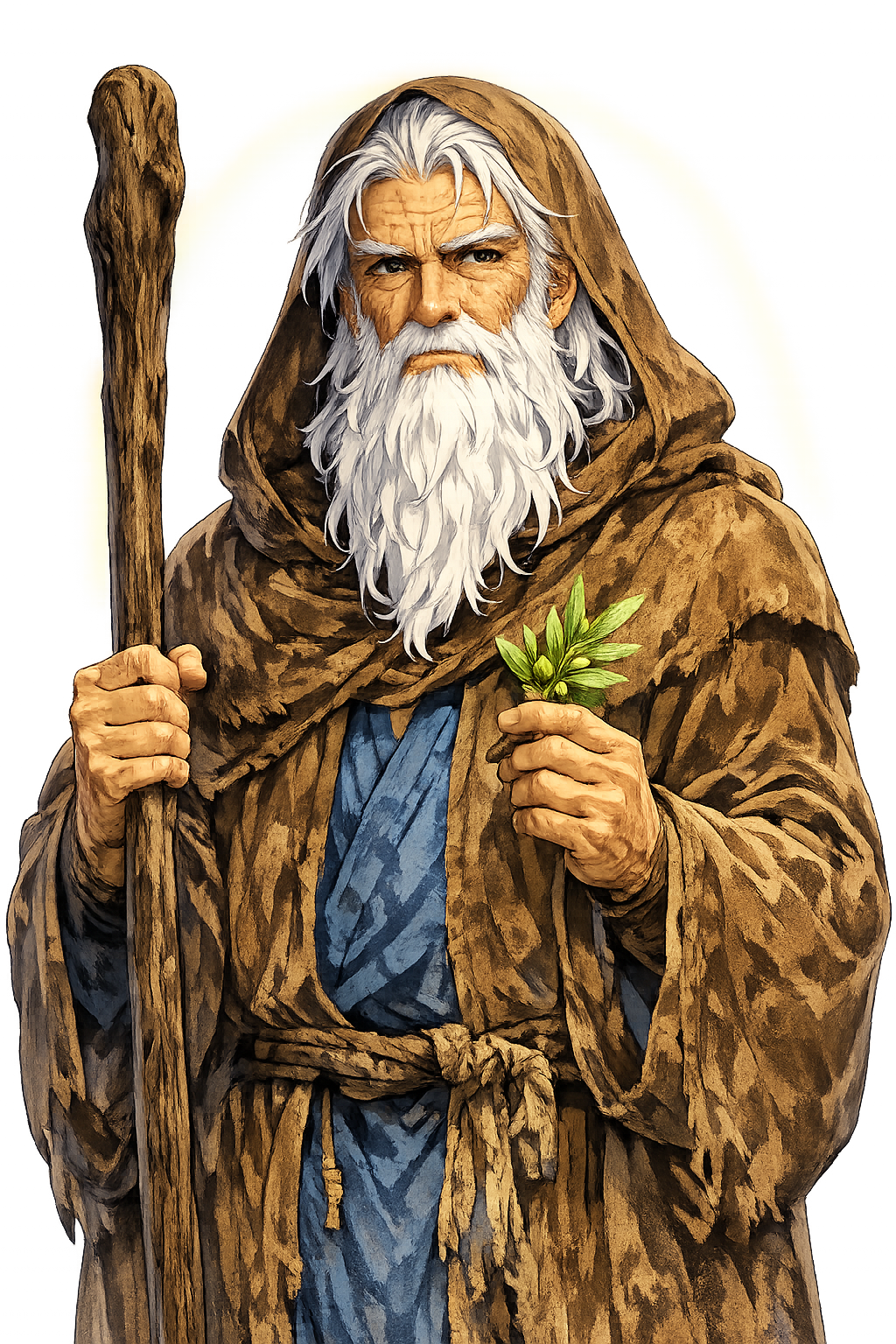
Stories of Nōaḥ
Nōaḥ's mythology is the rewriting of the world. The flood does not merely punish; it resets. After the waters, the same commands given to Adam — be fruitful, multiply, have dominion — are spoken again, as if creation itself has been given a second draft, with one amendment written in law.
The flood story opens not with water but with a diagnosis. 'The earth was corrupt before God, and the earth was filled with violence' (Genesis 6:11); the Nephilim, the fallen ones, walk it, and every imagination of the human heart is 'only evil continually'. Against this darkness the text sets one counter-example: Noah, 'a righteous man, blameless in his generation, who walked with God' (6:9) — the same phrase the tradition had used of Enoch. He is given dimensions — three hundred cubits by fifty by thirty, a window, a door in the side, three decks, gopher wood pitched within and without — the only object in Genesis that God designs like an engineer. Into it are to come seven pairs of every clean animal, two of every unclean, and food for all. The narrative is unsparing about what this costs: when the door closes, the world on the other side of it is already sentenced. Salvation, in this oldest telling, is not universal but selective — one household chosen to carry a drowning creation, and chosen for no reason the text cares to give beyond that he 'walked with God'.
The cataracts of heaven and the fountains of the great deep break open, and rain falls forty days and forty nights; the waters 'prevailed exceedingly' and covered the highest mountains by fifteen cubits, and 'all flesh died that moved upon the earth' (Genesis 7:17–24) — the only passage in the Torah where the destruction is stated as flatly and totally as the creation. The narrative then pivots on a small phrase with a large theology: 'And God remembered Noah' (8:1). Wind passes over the waters, the fountains are stopped, the ark grounds in the seventh month on the mountains of Ararat, and the tops of the hills appear in the tenth. The remembering is the hinge of the whole story: creation is not saved by its own goodness but by being kept in mind. The same verb will carry Israel out of Egypt; the flood, read this way, is the first rehearsal of the exodus — the world itself passing through water to a promise.
The ark rests; Noah opens the window and sends a raven, which goes 'to and fro until the waters were dried up' — an ambiguous bird, feeding, perhaps, on what floats. Then the dove: she finds no rest for her foot and returns to him; after seven days, sent again, she returns at evening with a freshly plucked olive leaf, 'and Noah knew that the waters were abated' (8:11). Seven days more, and the dove does not return. The sequence has the patience of a liturgy: each flight is a question, each return an answer, and the olive leaf is the first artifact of the new world — green, living, carried gently in a bird's beak out of a drowned one. The rabbis noticed that Israel chose the dove for itself, and the church noticed the Spirit descending in the same shape at the Jordan; every tradition that has read this story has looked out of Noah's window and seen its own hope. Waiting, the myth insists, is a skill — and its sign is small enough to carry.
Noah's first act on dry land is worship: he builds an altar and offers burnt offerings of every clean beast and bird, and 'the Lord smelled a sweet savour' — the only place in the Torah where God is said to smell — and resolves, for the ground's sake, never again to curse it (Genesis 8:20–22). The covenant that follows re-issues the creation charter — be fruitful, multiply, have dominion — with one tremendous amendment: 'Every moving thing that liveth shall be meat for you', but 'flesh with the life thereof, which is the blood thereof, shall ye not eat' (9:3–4). The rainbow is set in the cloud as God's own bow, unstrung and hung up: 'I do set my bow in the cloud, and it shall be for a token of a covenant between me and the earth' (9:13). The legal heart of the chapter is its new valuation of human life — blood for blood, 'for in the image of God made he man' (9:6). The new world begins not in recovered innocence but under law, with a weapon retired to the sky as its signature.
The new world inherits the old world's weakness. Noah plants a vineyard — the first vticulturalist of the reborn earth — drinks of the wine, and lies uncovered in his tent. Ham sees his father's nakedness and tells his brothers; Shem and Japheth walk in backward, their faces averted, and cover him. Awaking, Noah pronounces the curse and the blessings that have poisoned so much later history: 'Cursed be Canaan; a servant of servants shall he be unto his brethren' — and blessed be the tents of Shem and the enlargement of Japheth (9:20–27). The passage has been stretched across centuries of slavery and race theory, though the text knows no races — only three brothers and a father hung over with shame; read in its setting it is an etiology of old Levantine rivalries, Israel master of its neighbors. Its deeper function is structural and unwelcome: the Bible's second beginning already contains its first fracture. The flood washed the world; it did not wash mankind, and the covenant will have to survive the people it was made with.
Patriarch, Ark-Builder, Covenant-Keeper
Nōaḥ is the one just man in a generation drowned by its own violence. While the earth fills with corruption, he builds an impossible ship in an inland world, gathers every kind of creature, and rides out the collapse of everything he has known. His story is not only about water; it is about endurance, obedience, and the awkward mercy of being chosen to begin again.
A rectangular, pitched vessel of gopher wood, built to dimensions given in cubits and fitted for every kind of bird and beast (Genesis 6:14–16).
After the flood he sends out a raven and then a dove; the dove returns with an olive leaf, the first sign that the waters have subsided (Genesis 8:6–12).
God sets a bow in the clouds as a sign that the waters will never again destroy all flesh; the covenant is universal, including every living creature (Genesis 9:8–17).
Noah plants the first vineyard, becomes drunk, and curses Canaan while blessing Shem and Japheth — a dark postscript to the new world (Genesis 9:18–29).
From the original script to the living URL
נֹחַ
The name in its original Canaanite form. Nōaḥ (נֹחַ) is attested in the source tradition — “Builder of the ark”. Its emphatic consonants and macron-length vowels carry the full phonetic and orthographic weight of the source tradition.
noah
Reduced to plain noah, the name loses everything that made it specific: emphatic consonants and macron-length vowels. What remains is an ASCII string that machines can parse but that no longer speaks with its original voice.
Nōaḥ
The Unicode restoration recovers what ASCII flattened. Nōaḥ restores emphatic consonants and macron-length vowels, returning the name to its original written dignity. The domain encodes to Punycode, but the browser displays the truth.
Nōaḥ.com → xn--na-vra1560a.com
The non-ASCII characters in Nōaḥ are encoded while the ASCII remains visible. To the DNS, it is Punycode. To humanity, it is Nōaḥ.
Owned, ideal, and ASCII forms of Nōaḥ
Nōaḥ
Restores נֹחַ. The live temple domain — nōaḥ.com.
noah
Flattens נֹחַ. The plain ASCII fallback — what DNS and legacy systems see.
How Nōaḥ was spoken
How Nōaḥ travels from ancient script to the modern URL
Hebrew Nōaḥ; the name is connected with nāḥam “to comfort" or, in the older sense, with “rest".
Patriarch, Survivor
The Unicode restoration Nōaḥ uses registrable Latin diacritics; the Ugaritic form is not registrable in .com.
The lore you have read is the living myth. Extended Lore opens the scholarly vault beneath it: the cult and its material remains, a history of the image, the name after antiquity, a meditation on what the name still means, and the full scholarly apparatus — etymology, orthography, sources.
Enter Extended Lore