The Living Myth
Sea, Wind, Fishing, Wealth · The Wealth of Quiet Harbors
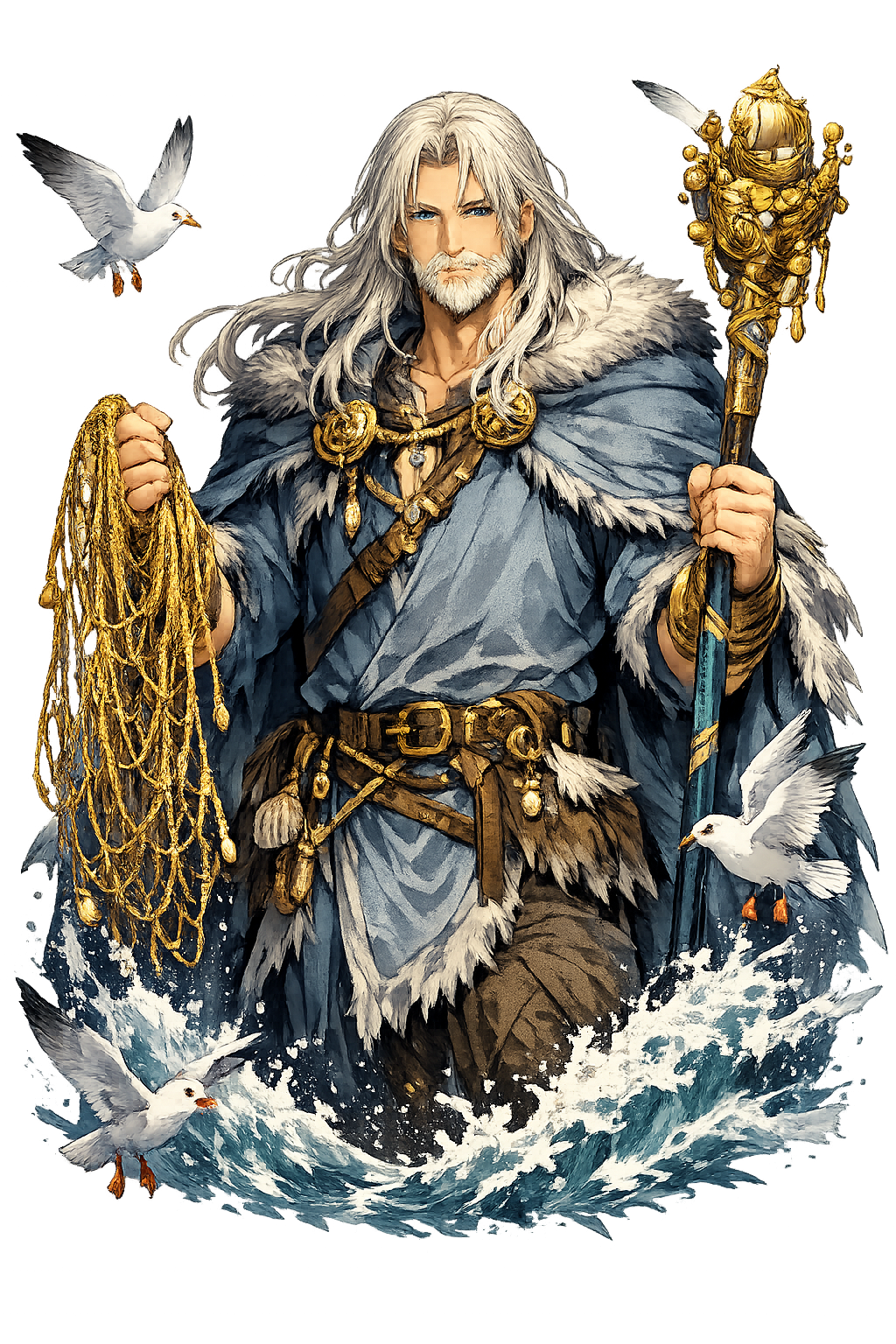
Stories of Njǫrðr
Njǫrðr's myths are stories of arrival and accommodation: the hostage who becomes indispensable, the sea-god who marries the mountain, the father of the two most beloved gods of the Viking Age. His drama is quieter than Óðinn's or Þórr's, but it turns on the same cosmic question — how do unlike powers share one world?
In Gylfaginning 23, Snorri introduces Njǫrðr with a job description rather than a biography: he “rules over the course of the wind and stills sea and fire,” and to him one must pray before voyaging and fishing. He is fésæll — lucky in wealth — and prosperous in goods. The phrasing is quietly technical: stilling the sea is a mariner's vocabulary, and adding fire to wind and water covers the three elemental accidents of a wooden-ship culture. No thunder, no hammer — Njǫrðr's power is the negative miracle, the storm that does not come, the blaze that does not spread. In a society that fed itself from the water, the god who flattens the swell was not a minor comfort but the difference between a harbor and a grave. The Eddas preserve that economy in a single sentence: pray to Njǫrðr before you sail.
Grímnismál is Óðinn in disguise, reciting the geography of the gods to the doomed King Geirrǫðr, and its sixteenth verse assigns Njǫrðr his seat: Nóatún, “the Enclosure of Ships” or “Ships' Haven.” Every hall in Óðinn's list is a portrait — Bilskírnir is Þórr's fortress, Breiðablik Baldr's brightness — so Nóatún tells us what the skalds thought Njǫrðr was: not the terror of the deep but its landlord, the god whose house is a safe anchorage. The name itself is a gift to the kenning-makers, seafaring compressed into two syllables, and Snorri repeats it whenever he catalogs the worlds. For a faith carried in boats, heaven had to have a harbor, and Grímnismál gave it one: the one divine residence that sounds like a place a fisherman could actually come home to.
The war between Æsir and Vanir — the only war the gods ever fought among themselves — ended in the first recorded hostage exchange. The Vanir sent Njǫrðr and Freyr; the Æsir sent Hœnir and Mímir, and the exchange soured when the Vanir, finding Hœnir indecisive without his counselor, beheaded Mímir and sent the head back (Ynglinga saga 4). Njǫrðr, sent to a foreign pantheon as surety for peace, did what hostage stories rarely allow: he flourished, became one of the twelve judges of the Æsir, and fathered the two most beloved gods of the Viking Age. Snorri adds the detail that scandalized later readers — that Njǫrðr had fathered Freyr and Freyja on his own sister before the exchange, a custom permitted among the Vanir but forbidden among the Æsir. The myth is the Edda's study in successful integration: the outsider who negotiates, accommodates, and becomes indispensable.
When the giantess Skaði came to Ásgarðr demanding weregild for her father Þjazi, the Æsir offered her a husband chosen by his feet alone. Certain she was picking the shining Baldr, she chose the cleanest limbs in the hall and found herself betrothed to Njǫrðr, god of the coast. The marriage negotiated the Norse world's oldest boundary: nine nights in Nóatún by the sea, then nine in Þrymheimr among the mountains, and neither spouse could bear the other's element — she hated the wailing of the gulls; he the howling of the wolves. They parted, and Skaði kept her consolation: her father's eyes, which Óðinn set among the stars (Skáldskaparmál; Gylfaginning). The comic mismatch is also a cosmology: sea and mountain can marry, the myth says, but neither can live where the other breathes — and the stars above still remember the giant the sea-god could not save.
In Lokasenna, Loki turns on the hostage with the one insult that cannot be denied: “Be silent, Njǫrðr — you were sent east from Vanaheimr as a hostage to the gods.” Njǫrðr's answer is the Edda's most serene self-defense: “Small harm that I was a hostage; when I came I fathered a son whom no one dislikes and who counts himself a chief among the Æsir” (Lokasenna 33–34). He does not deny the origin; he prices it. The exchange is a complete theology of the Vanir in two lines — mocked for having been given away, they answer with what their peace produced. And the audience knew he was right: Freyr's temple at Uppsala and Freyja's seat at Fólkvangr stood as evidence that the hostage had out-bargained his keepers. The sea-god's dignity, like his sea, is calm on the surface and very deep.
Sea, Wealth, and the Vanir Hostage
Njǫrðr is the Vanir god who learned to live among the Æsir, a deity of harbors, hauls of fish, and the sudden stillness that falls when a storm turns. He owns Nóatún, the Ships' Haven, and his power reaches into wind, fire, and the silver piled on merchant decks. Where Þórr battles the sea, Njǫrðr negotiates with it.
He stills waves and governs the wind's course, the divine patron of sailors who read the water rather than fight it.
Fishermen and mariners invoked Njǫrðr for full nets, fair winds, and the calm that lets a hull come home.
Prosperity follows him like gulls follow a laden ship; he is the rich god whose blessing is measured in cargo and harvest.
His hall, the Enclosure of Ships, is the safe anchorage where seafaring and sovereignty meet.
From the original script to the living URL
ᚾᛁᚢᚱᚦᚱ
The name in its original Norse form. Njǫrðr (ᚾᛁᚢᚱᚦᚱ) is attested in the source tradition — “Vigorous (from *nerþuz)”. Its original diacritics and script distinctions carry the full phonetic and orthographic weight of the source tradition.
njordr
Reduced to plain njordr, the name loses everything that made it specific: original diacritics and script distinctions. What remains is an ASCII string that machines can parse but that no longer speaks with its original voice.
Njǫrðr
The Unicode restoration recovers what ASCII flattened. Njǫrðr restores original diacritics and script distinctions, returning the name to its original written dignity. The domain encodes to Punycode, but the browser displays the truth.
Njǫrðr.com → xn--njrr-dqa81m.com
The non-ASCII characters in Njǫrðr are encoded while the ASCII remains visible. To the DNS, it is Punycode. To humanity, it is Njǫrðr.
Owned, ideal, and ASCII forms of Njǫrðr
Njǫrðr
Restores ᚾᛁᚢᚱᚦᚱ. The live temple domain — njǫrðr.com.
njordr
Flattens ᚾᛁᚢᚱᚦᚱ. The plain ASCII fallback — what DNS and legacy systems see.
How Njǫrðr was spoken
How Njǫrðr travels from ancient script to the modern URL
Old Norse Njǫrðr; from Proto-Germanic *Nerþuz; a Vanir god of the sea, wind, and wealth.
Sea, Wind, Fishing, Wealth
The Unicode restoration Njǫrðr uses registrable Thorn and vowel accents; the runic form is not used because runic TLD support is impractical.
The lore you have read is the living myth. Extended Lore opens the scholarly vault beneath it: the cult and its material remains, a history of the image, the name after antiquity, a meditation on what the name still means, and the full scholarly apparatus — etymology, orthography, sources.
Enter Extended Lore