PuniCodex

Extended Lore

日光 Nikkō

Etymology · Orthography · Cult · Iconography · Reception · Sources

Tier 1 Nikkō.com
Nikkō — Sacred Site, Tochigi
01

Quick Facts

Essential information about Nikkō, Sacred Site, Tochigi

Original Script日光
Unicode RestorationNikkō
Reconstructed Pronunciation/ɲi.kːoː/
PantheonJapanese
DomainSacred Site, Tochigi
MeaningSunlight
ClassificationTier 1
Primary DomainNikkō.com
Sacred SymbolsShinkyō (Sacred Bridge), Three wise monkeys (sanzaru), Sleeping cat (nemuri-neko), Yōmeimon Gate, Cedar trees (sugi)
02

Etymology & Word Family

From original script to Unicode restoration

Original Script 日光 Nikkō — "Sunlight"
Unicode Restoration Nikkō Restored stress, length, and script
Modern ASCII nikko Plain-ASCII fallback

The name Nikkō carries the orthographic signature of the japanese tradition: 日光. Unicode restoration recovers what ASCII flattens.

03

Unicode Character Breakdown

Character-by-character philological analysis

CharacterUnicodeNameBlockPhonetic Role
NU+004ELatin Capital Letter NBasic LatinSame
iU+0069Latin Small Letter IBasic LatinSame
kU+006BLatin Small Letter KBasic LatinSame
ōU+014DLatin Small Letter O with MacronLatin Extended-AMacron: long vowel

The Tier 1 classification reflects how much of the original phonology this restoration preserves — stress and vowel length for Greek names, distinctive letters and diacritics for every other tradition.

04

Cult & Worship

How the sacred was kept — rites, sanctuaries, remains

The Cult

Nikkō's cult is a calendar of festivals around a deified shogun. The Tōshōgū keeps two Great Festivals — the Spring Grand Festival (17–18 May) and the Autumn Grand Festival (16–17 October) — when the three sacred palanquins (mikoshi) believed to hold Ieyasu's spirit are carried through the precinct; the spring event revives the Thousand-Samurai Procession, a re-enactment of the journey of the remains in 1617 restored in 1976. Daily offerings follow Shinto rite before the hidden honden, while the Buddhist layer stripped in the Meiji separation of 1868 remains legible in the Sanbutsudō, where the mountain kami appear as three Buddhas. The older Futarasan shrine, founded by Shōdō Shōnin in the eighth century, serves the mountain itself. The Edo shogunate treated the site as dynastic sanctuary; after 1868 the state ranked the Tōshōgū among its premier shrines, and pilgrims and visitors have climbed the same cedar avenue ever since.

In the Earth

The Tōshōgū complex as it exists today is primarily an Edo-period creation (1634–1636), though it rests on older religious layers. The main hall, Yōmeimon gate, five-storied pagoda, and Okumiya inner shrine are outstanding examples of early Edo architecture and polychrome decoration. The Shinkyō bridge, rebuilt in 1904, preserves the form of the original sacred crossing. Archaeological and architectural study of the site has documented the materials, craftsmen, and techniques employed in Iemitsu's rebuilding, while the surrounding cedar avenue (planted in the 17th century) remains one of Japan's most impressive designed landscapes.

05

Iconography

How Nikkō was imaged across the ages

The Image

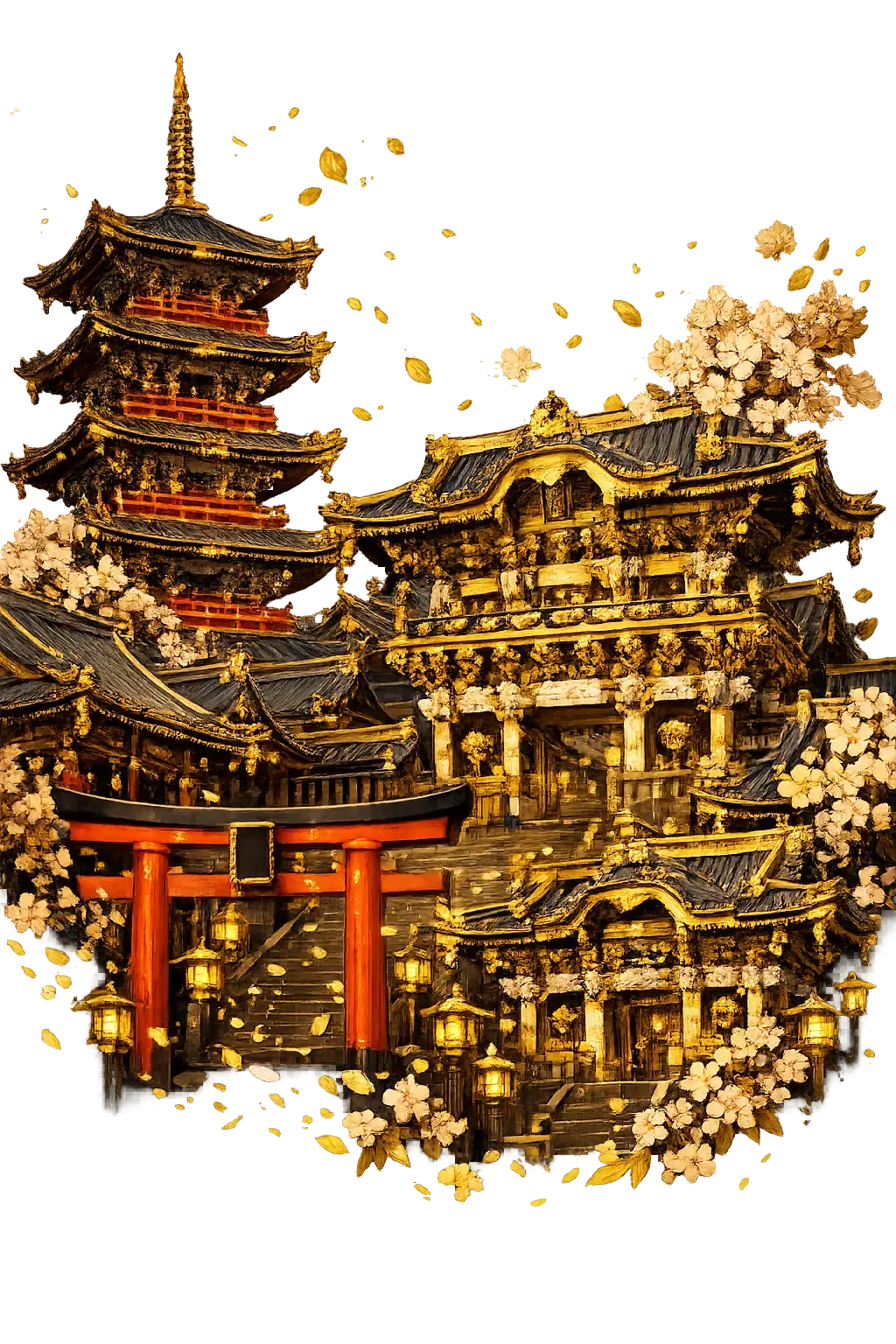
Nikkō's iconography is carved architecture. The Yōmeimon — Gate of Sunlight (1636) — is its jewel: two stories of some five hundred polychrome carvings, white dragons and sages on gilded lacquer, engineered so the ornamented underside reads correctly to the gods above. Over the sacred stable the monkeys perform their famous morality play — see no evil, hear no evil, speak no evil — one panel in a whole cycle of monkey life carved to guard the horses. The Sleeping Cat (nemuri-neko) above the gate to the inner shrine is traditionally ascribed to the master-carver Hidari Jingorō and reads as peace after war: a realm quiet enough for a cat to nap. The five-storied pagoda, the vermilion Shinkyō bridge, and the gold-encrusted Okumiya complete a total work of art in which the Tokugawa peace was written in wood, color, and dragon.

06

Reception & Transformation

The name after its own age — transmission, translation, survival

Afterlives

Nikkō's transmission is the story of Japan modernizing its own sacred past. Ieyasu's deification as Tōshō Daigongen in 1616 made the site a political theology: the shogun posthumously declared a great avatar manifesting both Amaterasu and the Buddha Yakushi, in the gongen idiom that had already sanctified rulers. Edo-period pilgrims made the ascent a cultural credential. Europe met the complex early: Britain's minister Rutherford Alcock described the Tōshōgū in The Capital of the Tycoon (1863), and Isabella Bird's Unbeaten Tracks in Japan (1880) carried its cedar avenues into English letters. The Meiji state first expropriated the site — stripping Buddhist elements in the 1868 separation of Shinto and Buddhism — then adopted it as a shrine of imperial prestige. The twentieth century recast it as heritage: the postwar Shinto Directive severed state sponsorship, scholarship reframed the gongen cult, and in 1999 UNESCO inscribed the Shrines and Temples of Nikkō, fixing the shogun's sermon on authority as a world's inheritance.

Identifications Across Traditions

Nikkō is a textbook case of shinbutsu shūgō, the medieval Japanese synthesis of Shinto and Buddhism. Tōshō Daigongen was simultaneously a Shinto kami and a Buddhist avatar; the shrine's architecture borrows from both traditions. This synthesis was forcibly dismantled in the Meiji period but survives in the layered art and ritual of the site. Nikkō also sits within a broader East Asian culture of mountain sacredness, where peaks serve as boundaries between worlds and repositories of ancestral power. The cedar avenues and vermillion bridges echo Chinese and Korean models, while the specific cult of Ieyasu is uniquely Japanese.

Modern Legacy

Nikkō is one of Japan's most visited sacred sites and a UNESCO World Heritage property. Its autumn maples, snow-covered gates, and the famous proverb Nikkō wo mizu shite kekkō to iu nakare (日光を見ずして結構と言うなかれ — 'don't say «splendid» until you've seen Nikkō') continue to shape Japanese aesthetics. The Three Wise Monkeys have become a global visual proverb, and images of the Shinkyō and Yōmeimon appear in travel literature, photography, and advertising worldwide. For Japanese nationalism, Nikkō is a symbol of the Tokugawa peace and imperial continuity; for contemporary visitors, it is a place where nature, art, and history converge. The Unicode restoration Nikkō preserves the long vowel and geminate consonant that distinguish the place name from ordinary nikkō ('sunlight').

07

The Meditation

What Nikkō means — beyond the dictionary

Nikkō asks what it means to make power visible. The Tokugawa shogunate did not bury its founder in quiet simplicity; it wrapped him in gold, cedar, and carved beasts, turning a mountainside into a sermon on authority. Yet the forest is older than the shogunate, and the sunlight falls on the gates without preference.

To visit Nikkō is to walk between these two truths: that humans build monuments to themselves, and that the world continues indifferently splendid. The Three Wise Monkeys remind us that not everything seen needs to be spoken, and the cedars remind us that what endures is often what was planted in silence.

08

Frequently Asked Questions

Common questions about Nikkō, Sacred Site, Tochigi, and Unicode restoration

01How do you pronounce Nikkō?

In reconstructed pronunciation, Nikkō is /ɲi.kːoː/ — approximately 'NEE-koh' — the first syllable is quick with a soft 'ny' color; hold the final 'koh' long, as if pronouncing two k's in a row.

02What does Nikkō mean?

Nikkō means Sunlight in the japanese tradition.

03What are the symbols of Nikkō?

Nikkō is associated with Shinkyō (Sacred Bridge) (The vermillion bridge that marks the entrance to the sacred precinct and the crossing from mundane to holy space), Three wise monkeys (sanzaru) (The carved monkeys embodying the proverb 'see no evil, hear no evil, speak no evil'), Sleeping cat (nemuri-neko) (The famous carved cat attributed to Hidari Jingorō, guarding Ieyasu's mausoleum), Yōmeimon Gate (The 'Gate of Sunlight' (yōmei, 陽明), lavishly carved and gilded, symbolizing the wealth of the shogunate and the light of the east that names the shrine.), Cedar trees (sugi) (The ancient avenue of cryptomeria linking the town to the shrines, a living sacred architecture).

04Why restore Nikkō in Unicode?

Plain ASCII nikko strips the stress, length, and script that make the name specific. Unicode restoration returns the name to its original written dignity.

05What is the most important myth about Nikkō?

“Shōdō Shōnin and the Sacred Bridge” — the Foundation legend story that anchors the mythology of Nikkō, told in full on the lore page.

09

Scholarly Sources

The philological foundations of this restoration

Every claim on this page is grounded in established scholarship. The orthographic restorations follow disciplinary convention. The etymological chain follows the best available reference works. This is not invention — it is resurrection through scholarship.

◈

Lexicography & Philology

  • Hepburn
◎

Primary Texts

  • Kojiki
  • Kojiki (foundation myths and kami references)
  • Nihon Shoki (imperial chronicle to 697 CE)
  • Philippi, Kojiki
◉

Archaeology & Art History

  • UNESCO World Heritage listing for Shrines and Temples of Nikko
✦

Religious Studies

  • Tōshōgū engi and Tokugawa-period shrine records
  • Aston, Nihongi: Chronicles of Japan from the Earliest Times to A.D. 697
  • Bock, Engi-shiki
Return

The Surface Awaits

You have traced the name from its earliest attestation to its Unicode restoration. Now return to the myth. The story is where the name lives.

Back to Lore
Nikkō mascot