
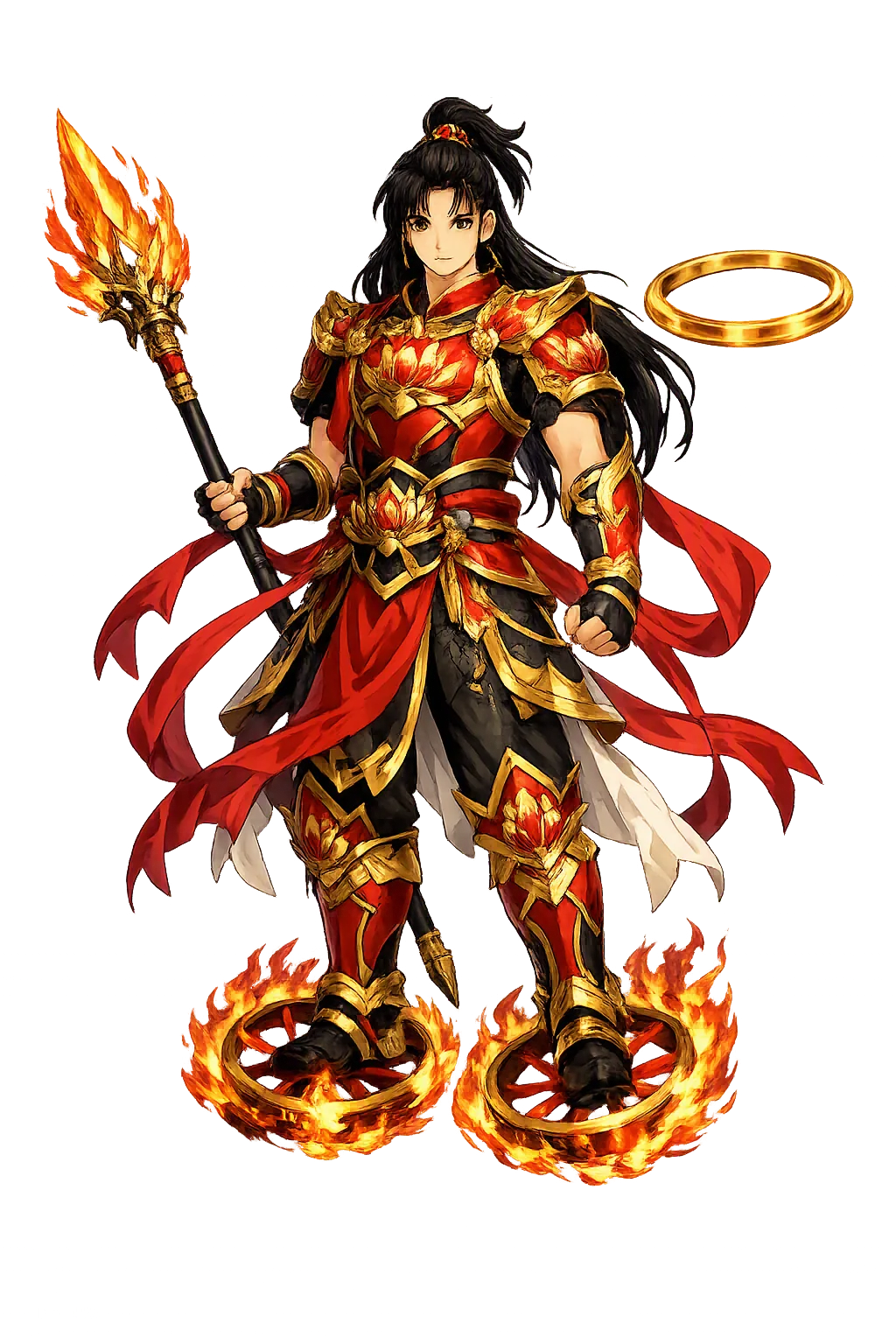
Nézhā: the stories first, then the spelling
You cannot weigh an accent without knowing what it carries. Here is what Nézhā has been carrying.
The Stories That Carry the Name
The Flesh Ball. In the Investiture of the Gods (ch. 12), Lady Yin, wife of the garrison commander Li Jing, has carried her third child for three years and six months when the birth finally comes — and what emerges is not an infant but a ball of flesh, glowing like a lantern. Certain he faces a demon, Li Jing strikes it with his sword, and the ball splits: inside stands a boy already able to walk and speak.
The Dragon King's Third Son. Bathing one summer day in the Nine-Bend River where it meets the East Sea, the seven-year-old dips his Red Armillary Sash into the water — and the cosmic instrument does what it is for: it churns the sea until the crystal palace of the Dragon King Āo Guǎng trembles on its foundations (Fēngshén Yǎnyì, ch. 12–13). Āo Guǎng sends his yaksha enforcer Lǐ Gèn to seize the offender; Nézhā kills him with a single cast of the Universe Ring.
Flesh to Father, Bone to Mother. Āo Guǎng comes to Li Jing in dragon form with an ultimatum: the culprit's life, or an impeachment before the Jade Emperor and a flood over Chéntāngguān. Nézhā answers with the most shocking sentence in Chinese popular mythology — I return my flesh to my father and my bones to my mother (削骨還父,削肉還母) — and cuts his own throat, so that the debt of his crime dies with him and cannot be collected from his house (Fēngshén Yǎnyì, ch. 14).
And Here Is What the Spelling Preserves
Against those stories, the attestation: 哪吒, on the evidence Xǔ Zhònglín (attrib.), Fēngshén Yǎnyì, ch. 12–14 and Wu Cheng'en (attrib.), Xīyóujì, ch. 4 & 83 set down. The name means "Nezha (from Sanskrit Nalakuvara)".
The restoration keeps 2 features the ASCII form nezha cannot show:
- e → é — Stress on e: where the voice peaks.
- a → ā — Long vowel: how long the vowel is held.
A storyteller pronouncing the name would restore every one of them by instinct. The file only writes down what the voice already knows.
At a Glance
- Restored name: Nézhā
- ASCII form: nezha
- Meaning: "Nezha (from Sanskrit Nalakuvara)"
- Domain of influence: Youth, War, Rebellion
- Pantheon: Chinese
- Classification: Tier 1
- Original script: 哪吒
- Series: The Restoration Files, No. 332 of 546
The Name Travels
Nézhā is himself a product of transmission: the name enters Chinese through Buddhism as a transcription of Sanskrit Nalakūvara, a son of the guardian king Vaiśravaṇa, and the earliest Chinese forms (那吒, read closer to Nata) preserve that foreign sound. As the figure was naturalized, the genealogy was rewritten — his father became the historical-flavored general Li Jing, who absorbed Vaiśravaṇa's iconography wholesale and became the pagoda-bearing Heavenly King (托塔天王) of the Chinese celestial court.
The Address It Earned
The temple of Nézhā stands at /nezha/ — lore, scholars, patterns — because a name carrying this much story deserves more than a parking page. What survives here cannot be shown in ASCII: a feature of the original that the fallback alphabet flattens. That is the Tier-1 test, and this name passes it without argument.
The Sources Are Open
The myths above are retold from the temple's record; the primary voices are in the Sacred Texts: Tao Te Ching. Nothing in this file outranks them.
The File Continues
Read the founding dispatch for the name's full story, the Resonance File for the archetype at work — or the whole archive in one sitting.
Continue the series — previous file: Nergal (read it here) · next file: Ngalyod (read it here).
The Restoration Files are written from the same canonical record as the temples themselves: the lexicon, the lore catalog, the pattern atlas, and the cited scholarly sources. If a file ever disagrees with its temple, the temple is right — tell us, and the file will be corrected.