Stories of Nézhā
The Nézhā cycle is the great Chinese myth of the filial rebel — a story in which the most radical act of disobedience and the most extreme act of filial piety turn out to be the same act. Its canonical form was fixed by the Ming dynasty's two great novels, the Investiture of the Gods and Journey to the West; its oldest motifs are Buddhist, carried into China along the Silk Road.
In the Investiture of the Gods (ch. 12), Lady Yin, wife of the garrison commander Li Jing, has carried her third child for three years and six months when the birth finally comes — and what emerges is not an infant but a ball of flesh, glowing like a lantern. Certain he faces a demon, Li Jing strikes it with his sword, and the ball splits: inside stands a boy already able to walk and speak. The immortal Taiyi Zhenren arrives to claim the child as his destined disciple, names him Nézhā, and arms him beyond all reason — the Universe Ring (Qiánkūnquān) and the seven-chi Red Armillary Sash (Hùntiānlíng). The boy grows at supernatural speed; at seven he is already the terror of the riverbanks, his two treasures humming with borrowed cosmic power. The wrongness of the birth is the myth's point. Nézhā enters the world not owed to ordinary nature — a disciple sent down from above, whose "parents" receive him rather than make him.
Bathing one summer day in the Nine-Bend River where it meets the East Sea, the seven-year-old dips his Red Armillary Sash into the water — and the cosmic instrument does what it is for: it churns the sea until the crystal palace of the Dragon King Āo Guǎng trembles on its foundations (Fēngshén Yǎnyì, ch. 12–13). Āo Guǎng sends his yaksha enforcer Lǐ Gèn to seize the offender; Nézhā kills him with a single cast of the Universe Ring. Then the third prince, Āo Bǐng, rises from the waves on his beast of the deep, and Nézhā kills him too, stripping out his sinews to make a belt. A child has bloodied the oldest bureaucracy in heaven — the ancient administration of the waters — and the Dragon King, robbed of an heir, will have justice or drown Chéntāngguān. The myth stages a collision it never resolves: ungovernable youth against an institution that mistakes its palace for the world.
Āo Guǎng comes to Li Jing in dragon form with an ultimatum: the culprit's life, or an impeachment before the Jade Emperor and a flood over Chéntāngguān. Nézhā answers with the most shocking sentence in Chinese popular mythology — I return my flesh to my father and my bones to my mother (削骨還父,削肉還母) — and cuts his own throat, so that the debt of his crime dies with him and cannot be collected from his house (Fēngshén Yǎnyì, ch. 14). The gesture has older roots than the novel: Song-dynasty Chan transmission literature already tells of Nézhā rending his flesh and bone to repay his parents. Filial piety, pushed to its absolute limit, inverts into annihilation — the debt of the body paid back in full. The myth refuses comfort. His sacrifice is genuinely filial and genuinely self-erasing, and no later glory quite forgives the parents who let the sea demand it.
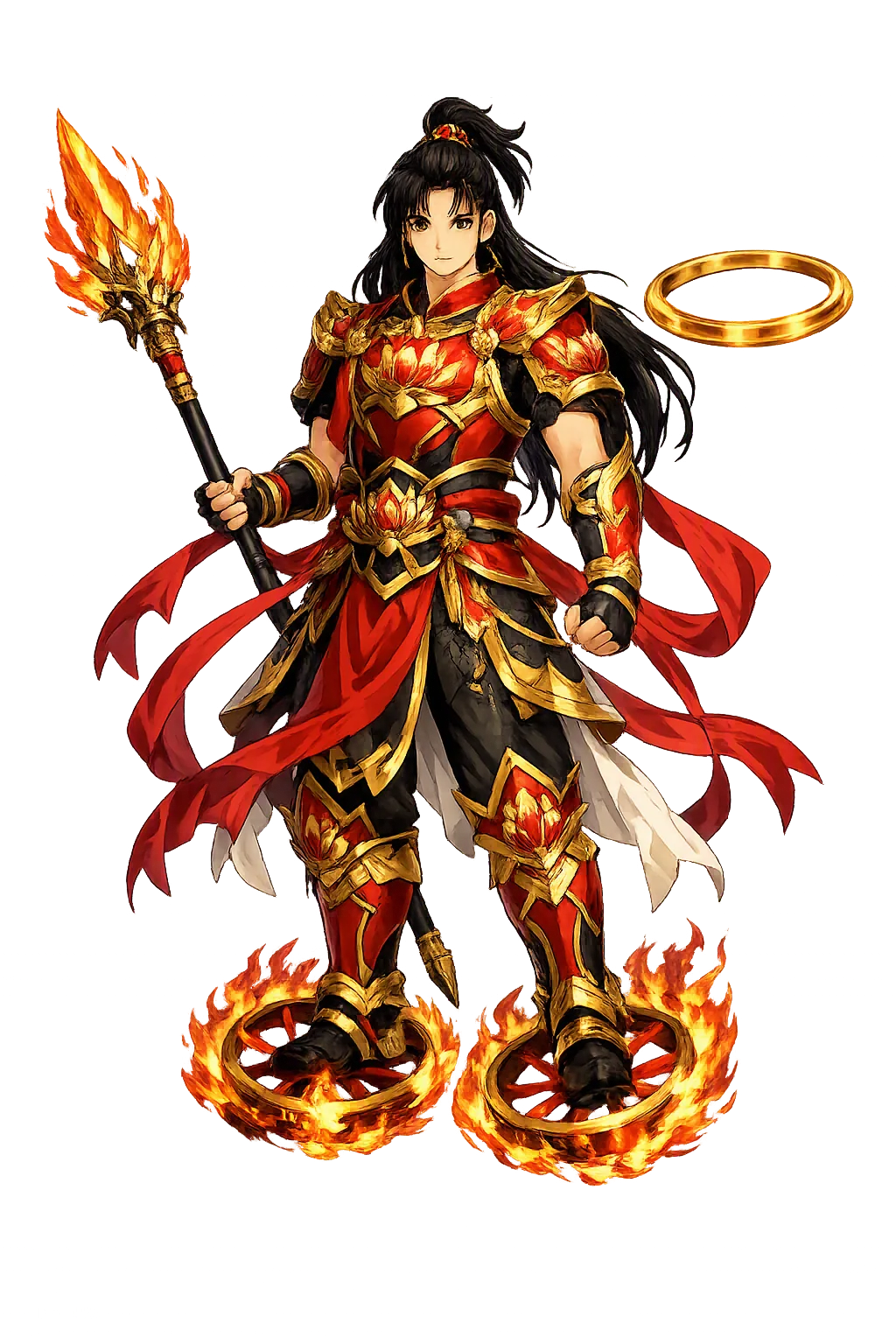
Taiyi Zhenren gathers the wandering soul and rebuilds it — lotus roots for limbs, lotus petals for flesh — a body owed to no womb (Fēngshén Yǎnyì, ch. 14). Remade, Nézhā takes up the Fire-Tipped Spear and Wind Fire Wheels and does what the cycle has been building toward: he hunts his father. Li Jing flees until the immortal Randeng Daoren hands him a golden treasure-pagoda whose flames compel the son's submission; the pagoda becomes his permanent attribute. Journey to the West (ch. 83) retells the same quarrel but changes the paperwork — there the pagoda is a gift of the Buddha, which is itself evidence of how the tale migrated between Daoist and Buddhist retelling. The rebirth completes the cycle: a body with no debt of flesh, and a son whose obedience must be engineered by fire. Freedom from the womb, it turns out, requires a new master.
Filial Sacrifice, Divine Weaponry, Unconquerable Youth
Nézhā is the child who would not stay born: third son of the garrison commander Li Jing, armed by the immortal Taiyi Zhenren with ring, sash, spear, and wind-fire wheels — and destined to repay the debt of his own body to his parents in the most harrowing act of filial sacrifice in Chinese myth, before heaven rebuilt him from lotus.
Qiánkūnquān, the golden ring of heaven and earth, first of the weapons Taiyi Zhenren bestowed — a cosmic bracelet that strikes with the weight of the world it names.
Bathing in the sea, Nézhā stirred the waters with his sash until the Dragon King's palace shook — the act that killed Āo Bǐng and set the cycle of debt and sacrifice in motion.
His soul rebuilt from lotus roots and blossoms by Taiyi Zhenren, Nézhā returns in a body owing flesh to no parent — purity, renewal, and freedom from the debt of birth.
Fēnghuǒlún, the paired wheels of wind and flame beneath his feet — the mount that carries the celestial vanguard faster than storm across the three realms.
From the original script to the living URL
哪吒
The name in its original Chinese form. Nézhā (哪吒) is attested in the source tradition — “Nezha (from Sanskrit Nalakuvara)”. Its macron-length vowels and acute stress marks carry the full phonetic and orthographic weight of the source tradition.
nezha
Reduced to plain nezha, the name loses everything that made it specific: macron-length vowels and acute stress marks. What remains is an ASCII string that machines can parse but that no longer speaks with its original voice.
Nézhā
The Unicode restoration recovers what ASCII flattened. Nézhā restores macron-length vowels and acute stress marks, returning the name to its original written dignity. The domain encodes to Punycode, but the browser displays the truth.
Nézhā.com → xn--nzh-bma6j.com
The non-ASCII characters in Nézhā are encoded while the ASCII remains visible. To the DNS, it is Punycode. To humanity, it is Nézhā.
Owned, ideal, and ASCII forms of Nézhā
Nézhā
Restores 哪吒. The live temple domain — nézhā.com.
nezha
Flattens 哪吒. The plain ASCII fallback — what DNS and legacy systems see.
How Nézhā was spoken
How Nézhā is preserved in writing
A bespoke provenance study for Nézhā is being prepared by the PUNICODEX scholarly team.
Contribute scholarly provenance →The lore you have read is the living myth. Extended Lore opens the scholarly vault beneath it: the cult and its material remains, a history of the image, the name after antiquity, a meditation on what the name still means, and the full scholarly apparatus — etymology, orthography, sources.
Enter Extended Lore