PuniCodex

Extended Lore

𓈖𓏏𓋌 Nt

Etymology · Orthography · Cult · Iconography · Reception · Sources

ASCII-equivalent form Nt
Nt — Weaving, War, Hunting
01

Quick Facts

Essential information about Nt, Weaving, War, Hunting

Original Script𓈖𓏏𓋌
Unicode RestorationNt
Reconstructed Pronunciation/ˈneɪɪθ/ (conventional)
PantheonEgyptian
DomainWeaving, War, Hunting
MeaningWater, the terrifying one
ClassificationASCII-equivalent form
Primary DomainNt
Sacred SymbolsThe Weaver, Mistress of the Bow, Mother of the Gods, Lady of Sais
02

Etymology & Word Family

From original script to Unicode restoration

Original Script 𓈖𓏏𓋌 Nt — "Water, the terrifying one"
Unicode Restoration Nt Canonical scholarly spelling — ASCII-identical
Modern ASCII neith Plain-ASCII fallback

The name Nt reaches the modern world through scholarly transliteration of the egyptian tradition. Because the conventional spelling uses only Latin letters, its Unicode and ASCII forms coincide — the tradition it carries is in the name itself, not in diacritics.

03

Unicode Character Breakdown

Character-by-character philological analysis

CharacterUnicodeNameBlockPhonetic Role
NU+004ELatin Capital Letter NBasic LatinSame
—N/ADropped characterEgyptian orthographyVowel not written
tU+0074Latin Small Letter TBasic LatinSame
—N/ADropped characterEgyptian orthographyNot written

This restoration reflects fidelity to the attested tradition, not recovered diacritics: every character of Nt already survives in ASCII. What the restoration preserves is the canonical spelling itself — the form scholarship standardised.

04

Cult & Worship

How the sacred was kept — rites, sanctuaries, remains

The Cult

The mysteries of Neith at Sais were among Egypt’s most secret rites; her priesthood was famously matrilineal in the late period, and the kings of Dynasty 26 took her name into their titulary to legitimise their Saïtic line. Her festival of the ‘Burning of the Lamps’ lit the temple through the night in mystery.

In the Earth

Her Delta city Sais — biblical and classical Saïs — was the capital of the Twenty-sixth Dynasty, which consciously revived her archaic cult; its great temple is now largely lost to the water table, but the Esna inscriptions record its liturgy. The crossed-arrows emblem occurs from Naqada-period potsherds to Roman stelae.

05

Iconography

How Nt was imaged across the ages

The Image

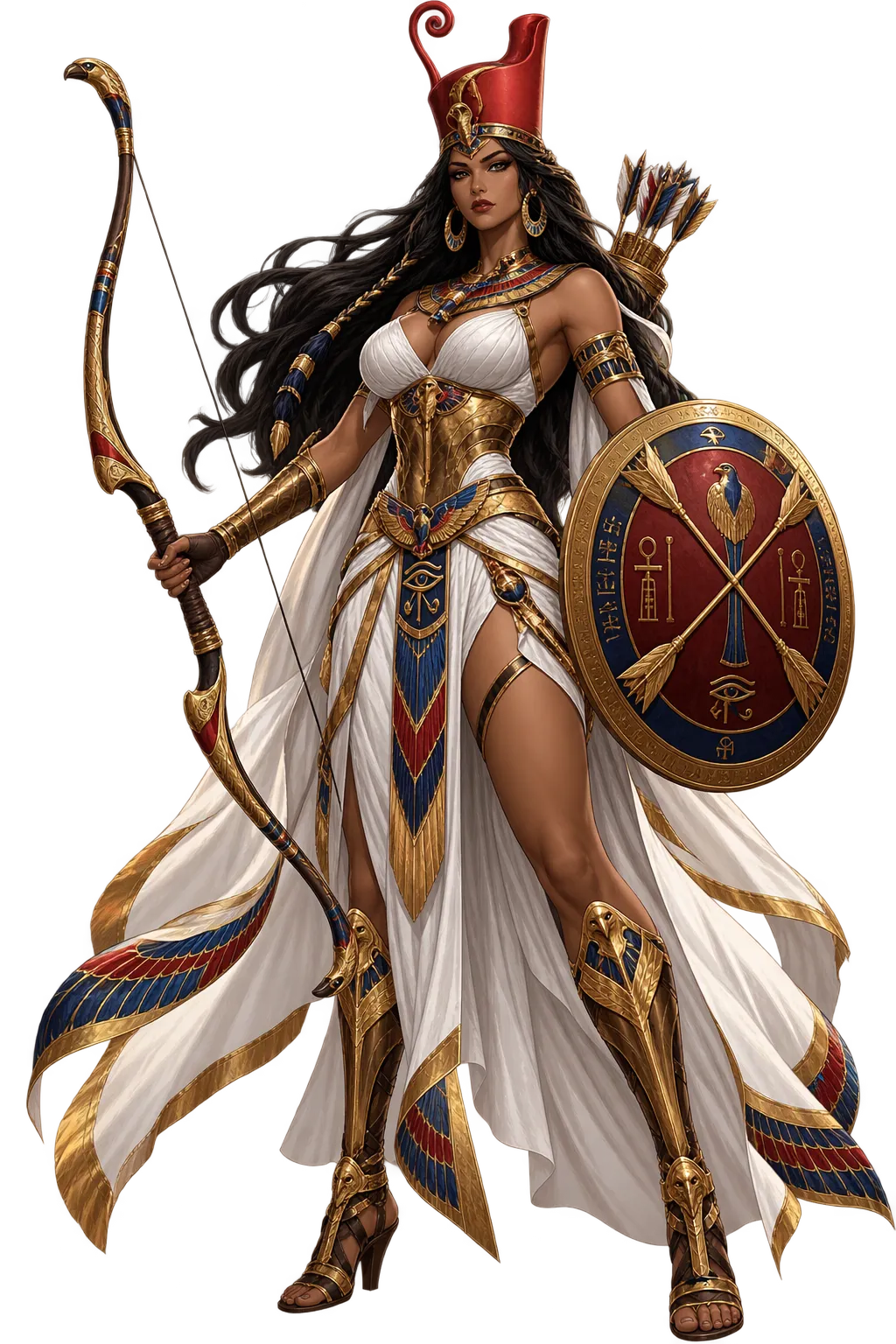
A woman wearing the Deshret red crown of Lower Egypt, holding crossed arrows and a shield, or suckling the infant crocodiles — her Fayum maternity. In her primeval form she is the great cow whose body spans the sky, the sun between her horns.

06

Reception & Transformation

The name after its own age — transmission, translation, survival

Afterlives

Plutarch’s veiled inscription made her the ancient world’s favourite image of transcendent nature; Renaissance Neoplatonists, Enlightenment freemasonry and even the inscription on early geology societies borrowed ‘no mortal has lifted my veil’. She remains the standard example of a goddess whose cult outlived every dynasty that served her.

Identifications Across Traditions

Neith merges with the great mother-goddesses — Mut, Hathor, Nut — and in the Roman period with Athena, whose war-and-craft profile fit her uncannily; the Greeks of Sais simply called her Athena. The identification was so natural that Herodotus describes her Sais temple in Athenian terms.

Modern Legacy

Her Sais oracle became a proverb of ancient wisdom, quoted from Plutarch to the Renaissance Hermetica; ‘lifting the veil of Isis (Neith)’ passed into modern language as the image of unveiled nature. In Egyptology she anchors the study of Predynastic religion — her crossed-arrows sign is among the earliest divine emblems known.

07

The Meditation

What Nt means — beyond the dictionary

Nt is a name that predates the temples that housed it. Restoring it in plain letters is a kind of archaeological act: the further back a goddess stands, the fewer marks she needs. Her weaving metaphor survives every translation — the world as text, the text as fabric, the goddess as the first author of both.

08

Frequently Asked Questions

Common questions about Nt, Weaving, War, Hunting, and Unicode restoration

01How do you pronounce Nt?

In reconstructed pronunciation, Nt is /ˈneɪɪθ/ (conventional) — approximately “NAY-ith”.

02What does Nt mean?

Nt means Water, the terrifying one in the egyptian tradition.

03What are the symbols of Nt?

Nt is associated with The Weaver (Creator as textile-worker: she wove the world’s fabric on her loom at Sais.), Mistress of the Bow (War-goddess whose arrows decide battles; her symbol is the crossed arrows on a shield.), Mother of the Gods (Sole parent of Sobek in the Fayum tradition; in the Esna theology she bears the sun.), Lady of Sais (Her city in the western Delta held her great temple and the mysteries of the primeval waters.).

04Why restore Nt in Unicode?

Nt is written entirely in ASCII letters, so its restoration is about canonical fidelity rather than recovered diacritics: the temple fixes the name in its scholarly standard spelling, attested in the source tradition, instead of leaving it to drift.

05What is the most important myth about Nt?

“The Cow Who Bore the Sun” — the Esna Cosmogony story that anchors the mythology of Nt, told in full on the lore page.

09

Scholarly Sources

The philological foundations of this restoration

Every claim on this page is grounded in established scholarship. The orthographic restorations follow disciplinary convention. The etymological chain follows the best available reference works. This is not invention — it is resurrection through scholarship.

◈

Lexicography & Philology

  • Faulkner, R. O. A Concise Dictionary of Middle Egyptian. Oxford: Griffith Institute, 1962.
  • Wb
◎

Primary Texts

  • Plutarch, De Iside et Osiride (the veiled image of Sais)
◉

Archaeology & Art History

  • Material evidence — iconography, inscriptions, and temple archaeology — for Nt and related cults.
✦

Religious Studies

  • Esna temple hymns (the great Neith cosmogonies)
  • Contendings of Horus and Seth (Neith’s oracle)
  • Herodotus, Histories 2.59 (the Saïtic festival)
  • El-Saady, ‘Neith’ in Lexikon der Ägyptologie
Return

The Surface Awaits

You have traced the name from its earliest attestation to its Unicode restoration. Now return to the myth. The story is where the name lives.

Back to Lore
Nt mascot