The Living Myth
Weaving, War, Hunting · Weaving, War, the Primeval Waters · Water, the terrifying one
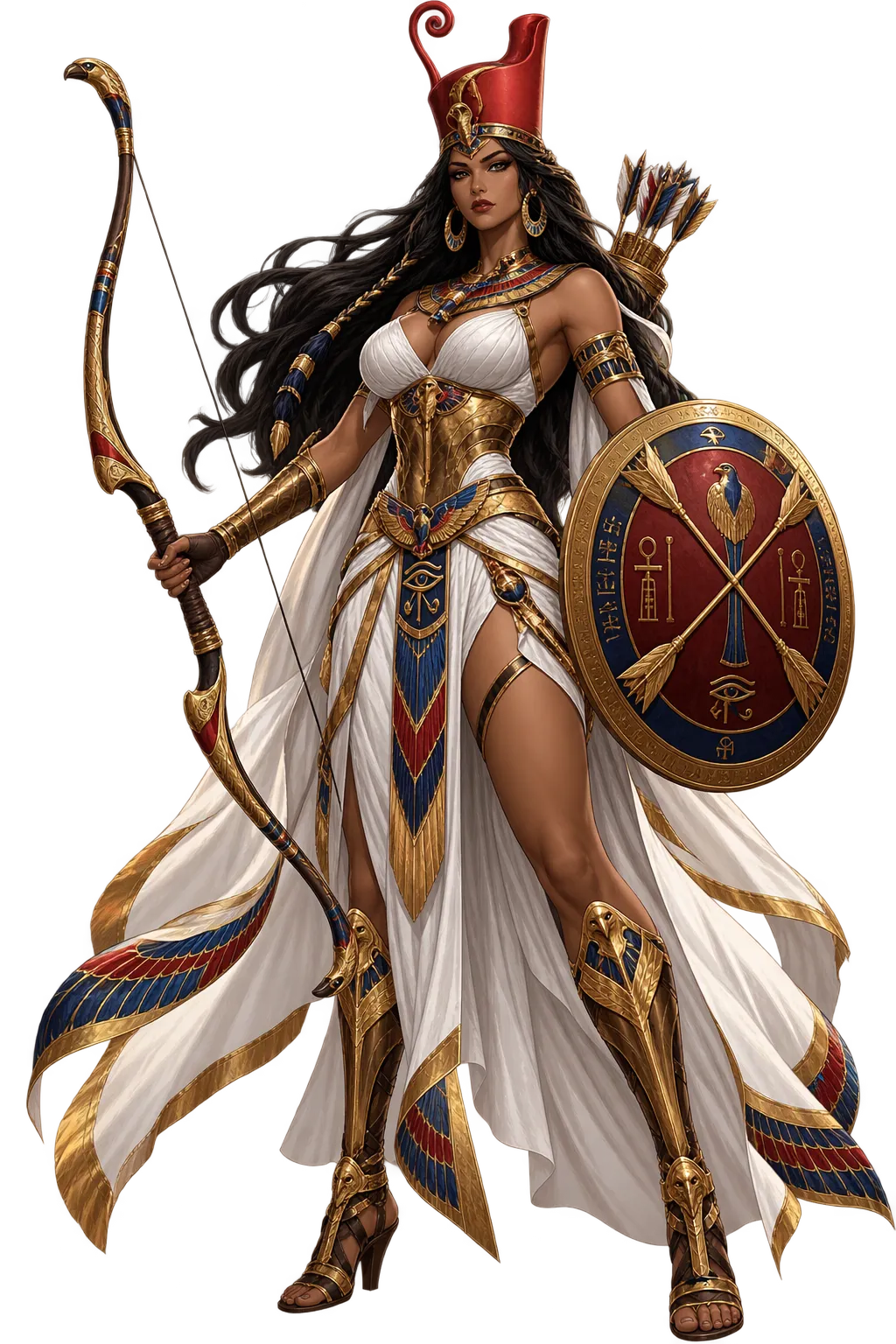
Stories of Nt
Neith’s mythology is theology in the superlative: she is not a goddess within the pantheon but the condition of it. Her priesthood at Sais taught that she was self-generated, that she wove the world, and that all gods were her children — a doctrine so old it survived into the latest periods essentially unchanged.
The great hymns of Esna make Neith the mother of Ra: she as the celestial cow gives birth to the sun-disc from between her horns, and the seven scorpions that escort Isis are her daughters. Creation here is maternity on a cosmic scale — the goddess is the source from which the solar order proceeds.
In the crocodile-god’s country, Neith is Sobek’s mother and the lady of the deep waters he rises from. The pairing of a primeval water-goddess with her crocodile son gives the Fayum’s theology its structure: she is the Nun-like depth, he its dangerous, fertile emergence.
When the divine tribunal deadlocked over the succession of Horus and Seth, Neith was consulted as the eldest of counsel. Her written oracle — quoted verbatim in the New Kingdom narrative — demands the throne for Horus and compensation for Seth, and threatens to make the sky fall if the gods disobey. They obeyed.
Plutarch preserves the mystery of her cult-image at Sais: an image that was never unveiled, before which stood the inscription ‘I am all that has been, and is, and shall be; and no mortal has ever lifted my veil.’ The aisa-mysteries of Sais entered the Hermetic and Platonic imagination as the emblem of unknowable first-nature.
The Terrible One, Mother of the Gods
Nt — Neith — is Egypt’s primordial goddess: older than the Ennead, mistress of the arrows of war and the loom of creation, who wove the world’s fabric at Sais before the gods had names. The ancients called her “the great cow who bore the sun”, and made her the mother of Sobek, of the crocodiles, and of Ra himself in the oldest cosmogonic strand.
Creator as textile-worker: she wove the world’s fabric on her loom at Sais.
War-goddess whose arrows decide battles; her symbol is the crossed arrows on a shield.
Sole parent of Sobek in the Fayum tradition; in the Esna theology she bears the sun.
Her city in the western Delta held her great temple and the mysteries of the primeval waters.
From the original script to the living URL
𓈖𓏏𓋌
The name in its original Egyptian form. Nt (𓈖𓏏𓋌) is attested in the source tradition — “Water, the terrifying one”. Its original diacritics and script distinctions carry the full phonetic and orthographic weight of the source tradition.
neith
The plain neith form is identical to the Unicode restoration. Because this name is already written in Latin letters, no diacritics, stress, or script information were lost — only capitalization differs.
Nt
The Unicode restoration does not need to recover lost marks for Nt. Its value is canonical spelling and consistent cataloguing, not the reconstruction of erased orthography. The domain is readable as-is to both DNS and humanity.
Nt.com
This restoration is written entirely in ASCII letters — no Punycode encoding stands between Nt and the DNS. The domain reads identically to machines and to human eyes.
The attested spelling family of Nt
Nt
Restores 𓈖𓏏𓋌. The full Unicode restoration. nt.com is not in the PuniCodex collection — it is watched for release; if it drops, this temple upgrades to an owned flagship. Attested by Faulkner, Wb.
How Nt was spoken
How Nt travels from ancient script to the modern URL
Egyptian Nt; the original vocalisation is unknown. The name is connected with water and with weaving; it may mean “the terrifying one".
The lore you have read is the living myth. Extended Lore opens the scholarly vault beneath it: the cult and its material remains, a history of the image, the name after antiquity, a meditation on what the name still means, and the full scholarly apparatus — etymology, orthography, sources.
Enter Extended Lore