Stories of Namtar
Namtar moves through Mesopotamian literature as an officer rather than a hero. His myths are stories of protocol, plague, and the irreversible moment when a decree from the underworld becomes binding.
The Sumerian name is a transparent compound, and the compound is the whole theology. Nam is the abstract prefix of the fixed and ordained — as in nam-lú, 'human status,' or the divine me-decrees that hold civilization in shape; tar is the verb 'to cut, decide, separate,' written with a sign (𒋻) whose wedges evoke a knife. Nam-tar is therefore 'that which is cut out' — destiny not as something woven but as something severed: the point at which the possible is cut away and the actual remains, the stroke by which a life is separated from the unlived lives around it. Because Sumerian uses the same word for the abstract decree and the demon who executes it, the god never needed a myth of origin: he was the noun, personified, from his first wedge. The name is an icon of fatal decision — and in Mesopotamia, where every transaction was pressed into clay, the icon was also the bureaucrat's signature.
In the Standard Babylonian poem Nergal and Ereškigal (tablets from Nineveh, Assur, and Sultantepe), the queen's vizier gets the plot moving. Ereškigal, furious at the gods' feasting, sends Namtar up as her ambassador to demand honor; the gods rise for him — all but Nergal, who stays seated. Namtar reports the insult, and Ereškigal demands the offender be delivered. Ea arms Nergal with fourteen demons and orders him to disguise himself: when Namtar comes down to seize him, he scans the assembly of minor death-powers throne by throne and cannot find the one he was sent for, so the decree fails on a technicality — the criminal is invisible inside his own rank. The episode defines Namtar's office with bureaucratic precision: he is the executive agent of the underworld throne, owed the protocol due his mistress, whose decrees he delivers and enforces. Even in myth, Mesopotamian death arrives as an official — and officials, as every petitioner knows, are bound by forms. Ea's counter-move is the oldest trick in the files: if the warrant cannot find its man, the warrant cannot run.
In the Akkadian Descent of Ištar, Namtar is both executioner and physician. When Ištar forces the seven gates and is stripped, judged, and hung on a hook, the upper world withers; Ea sends his servant Aššušunamir, whose beauty makes Ereškigal relent — but first she commands: 'Go, Namtar, afflict Ištar with sixty diseases — against her eyes, her sides, her feet, her heart, her head' — one for every part of her body. When the order is reversed, it is Namtar again who sprinkles the water of life on the goddess and leads her up through the gates, her ornaments restored one by one. The symmetry is the point: the same hand that inscribes the sixty strokes writes the release. The underworld does not forgive; it processes — and Namtar is the one who reads the tablet aloud, first in one direction and then, when the decree changes, in the other. Disease and cure are one office here, which is why the diagnostic tradition never separated them.
Beyond the epics, Namtar's true kingdom is the archive of suffering. In the Diagnostic Handbook (SA.GIG) and the udug-hul incantation series, 'the hand of Namtar' is the standard diagnosis for illness without visible wound — fever, paralysis, wasting, the sudden death of a household. The city laments, mourning the destruction of Ur and Sumer, speak of him stalking the districts as the decree runs its course. He is not a moral judge like a later Angel of Death, nor a predator like Lamashtu; he is a civil servant of mortality, delivering sentences already written. To appease him is to request a stay of execution, not a pardon — and the incantations know it, bargaining with the same patience they dread. What the thousands of tablets record is a civilization's long conversation with the fact that death keeps appointments: qāt Namtari, the hand is on the door, and it knocks on schedule.
Fate · Plague · Underworld Bureaucracy
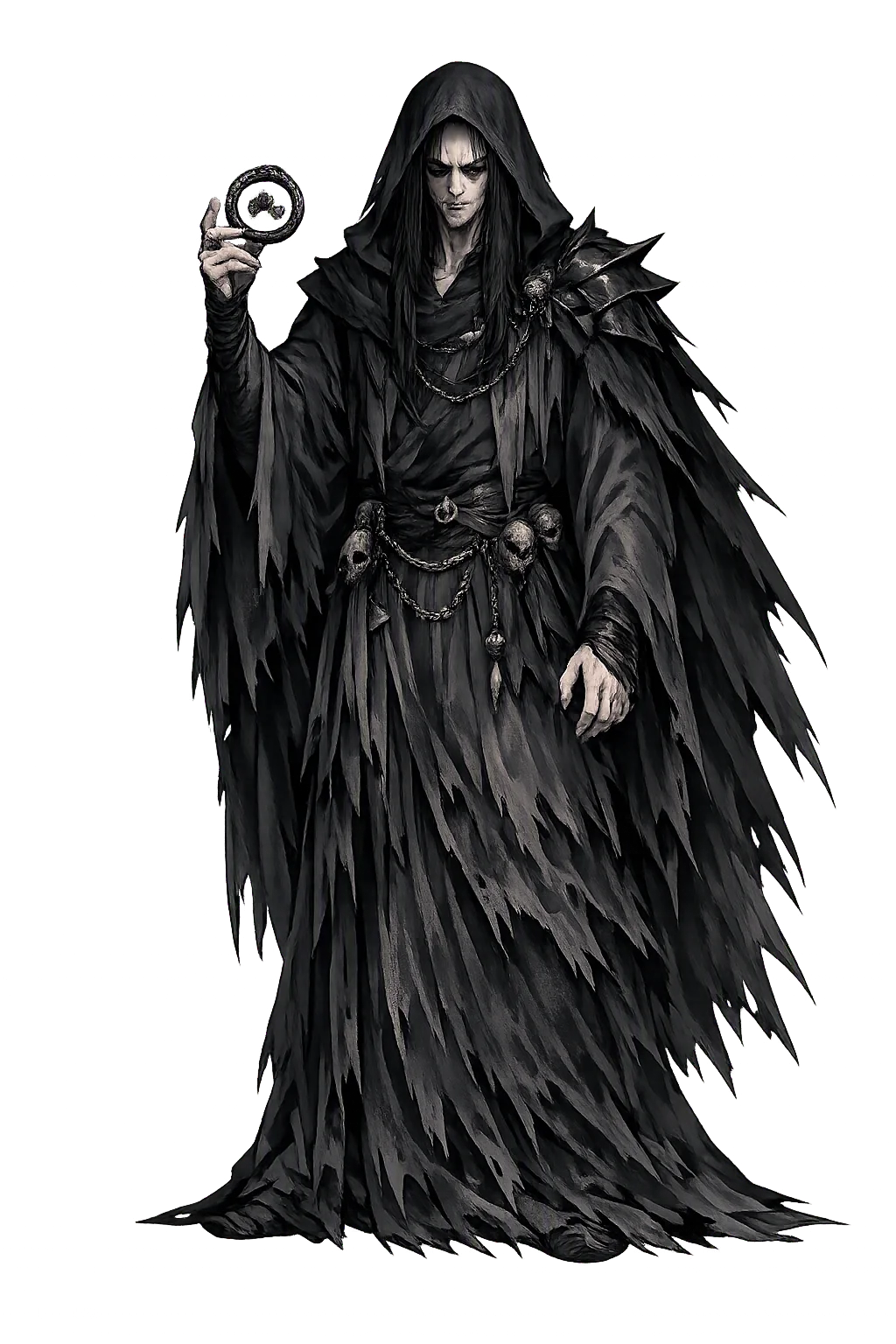
The name is written 𒀭𒈾𒀭𒋻. In Sumerian it is a compound: nam, 'destiny,' and tar, 'to cut, decide, separate.' Namtar is therefore the one who cuts the thread of what must be. In myth he is not a cosmic creator but a terrifying official: the sukkallu (vizier) of Ereškigal, queen of the underworld, the messenger who delivers disease, the clerk of death whose decree even the gods must acknowledge.
Where Enlil decrees destiny from the heights, Namtar executes it in the depths. He embodies the moment when possibility collapses into necessity — the stroke, the fever, the final sentence.
The cuneiform record on which Namtar writes what is cut out for a life — a decree, not a negotiation.
In incantations and medical omens, 'the hand of Namtar' is the touch that brings fever, paralysis, and plague.
The sukkallu who carries the queen of the dead's commands to heaven and enforces her judgment in the underworld.
The etymological heart of the name: tar is the knife-edge where destiny separates the living from the dead.
From the original script to the living URL
𒀭𒉆𒋻
The name in its original Mesopotamian form. Namtar (𒀭𒉆𒋻) is attested in the source tradition — “Fate, destiny”. Its original diacritics and script distinctions carry the full phonetic and orthographic weight of the source tradition.
namtar
The plain namtar form is identical to the Unicode restoration. Because this name is already written in Latin letters, no diacritics, stress, or script information were lost — only capitalization differs.
Namtar
The Unicode restoration does not need to recover lost marks for Namtar. Its value is canonical spelling and consistent cataloguing, not the reconstruction of erased orthography. The domain is readable as-is to both DNS and humanity.
Namtar.com
This restoration is written entirely in ASCII letters — no Punycode encoding stands between Namtar and the DNS. The domain reads identically to machines and to human eyes.
Owned, ideal, and ASCII forms of Namtar
Namtar
Restores 𒀭𒉆𒋻. The full Unicode restoration. namtar.com is not in the PuniCodex collection — it is watched for release; if it drops, this temple upgrades to an owned flagship.
How Namtar was spoken
How Namtar travels from ancient script to the modern URL
The lore you have read is the living myth. Extended Lore opens the scholarly vault beneath it: the cult and its material remains, a history of the image, the name after antiquity, a meditation on what the name still means, and the full scholarly apparatus — etymology, orthography, sources.
Enter Extended Lore