
The Cult
No separate cult; the Pāṇḍava-brotherhood cults of the Himalayan west (the Pāṇḍavas as five village gods of Jaunsar-Bawar) worship the set, the twins within it. The epic-recitation traditions keep his books in the cycle.
Extended Lore
Etymology · Orthography · Cult · Iconography · Reception · Sources
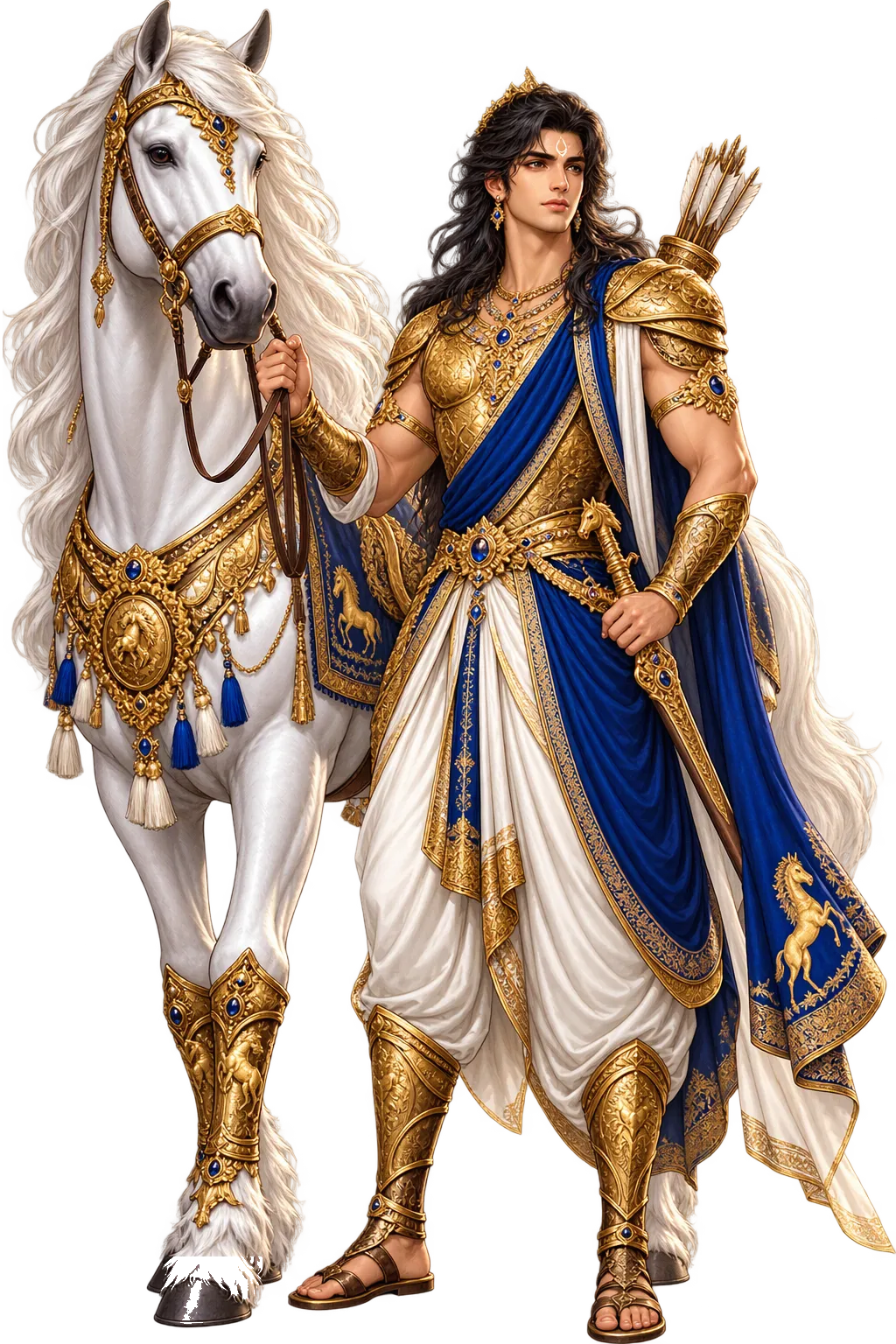
Essential information about Nakula, Twin, Son of Madri
From original script to Unicode restoration
The name Nakula reaches the modern world through scholarly transliteration of the sanskrit tradition. Because the conventional spelling uses only Latin letters, its Unicode and ASCII forms coincide — the tradition it carries is in the name itself, not in diacritics.
Character-by-character philological analysis
| Character | Unicode | Name | Block | Phonetic Role |
|---|---|---|---|---|
| N | U+004E | Latin Capital Letter N | Basic Latin | Same, capitalized |
| a | U+0061 | Latin Small Letter A | Basic Latin | Same |
| k | U+006B | Latin Small Letter K | Basic Latin | Same |
| u | U+0075 | Latin Small Letter U | Basic Latin | Same |
| l | U+006C | Latin Small Letter L | Basic Latin | Same |
| a | U+0061 | Latin Small Letter A | Basic Latin | Same |
This restoration reflects fidelity to the attested tradition, not recovered diacritics: every character of Nakula already survives in ASCII. What the restoration preserves is the canonical spelling itself — the form scholarship standardised.
How the sacred was kept — rites, sanctuaries, remains
No separate cult; the Pāṇḍava-brotherhood cults of the Himalayan west (the Pāṇḍavas as five village gods of Jaunsar-Bawar) worship the set, the twins within it. The epic-recitation traditions keep his books in the cycle.
Nakula has no monuments of his own — his are the epic’s performance traditions, where the twins’ matched brilliance is a stage convention of the Kathakali and Yakṣagāna repertories. The Pāṇḍava-ratha reliefs of Mamallapuram include the twin chariots of the Aśvin-born.
How Nakula was imaged across the ages
The twin beside Sahadeva — the two differentiated by their mounts and emblems in the Purāṇic charts: Nakula with the sword and the horse. His icon is the matched half: no image of Nakula stands alone without its twin.
The name after its own age — transmission, translation, survival
Comparative epic studies use Nakula and Sahadeva as the case of the hero-pair — Castor-and-Pollux structure inside an Indian frame. Literary criticism of the Mahābhārata increasingly reads him as the epic’s study of distributed excellence: the heroism that needs no chapter of its own.
Nakula is the Aśvins’ son in the epic’s divine-accounting, linking the heroic age to the Vedic physician-gods; and in later tradition the twins became the exemplars of brotherly symmetry — the epic’s only perfectly matched pair. The veterinary and medical lore the epic assigns him passed into the practical traditions of horse-culture across the subcontinent.
The twins Nakula-Sahadeva are the subcontinent’s byword for matched pairs — in cards, in teams, in twins generally. His name graced South Indian kings (Nakula of the Cōḻa line’s theophorics); and in the epic retellings, his quiet excellence is the standard against which the louder heroes’ fireworks are measured.
What Nakula means — beyond the dictionary
Nakula: the name that means ‘mongoose’ — small, quick, and immune to the serpent’s venom. Restored plainly, it suits the brother whose gifts never advertised themselves: the handsomest of five, the steadiest of five, the one whose fall on the mountain was for loving his own face too well. Two syllables, a twin’s half of a whole.
Common questions about Nakula, Twin, Son of Madri, and Unicode restoration
In reconstructed pronunciation, Nakula is /nəˈkuːlə/ — approximately “nuh-KOO-luh”.
Nakula means Son of the Aśvins and Mādrī — twin of Sahadeva, fourth of the Pāṇḍu princes, master of horses in the sanskrit tradition.
Nakula is associated with The Aśvin-Born (Conceived by Mādrī’s mantra-call to the divine twin physicians — hence the brothers’ medical genius.), Master of Horses (His care of horses was legendary; in the incognito year he served as Virāṭa’s horse-groom, a master among masters.), The Sword (His blade-work the epic ranks first among the brothers — the quiet specialist of the five.), Cattle-Lore (He knew herds as he knew horses — the brother of the epic’s animal-husbandry books.).
Nakula is written entirely in ASCII letters, so its restoration is about canonical fidelity rather than recovered diacritics: the temple fixes the name in its scholarly standard spelling, attested in the source tradition, instead of leaving it to drift.
“The Second Mantra-Birth” — the Ādi Parvan story that anchors the mythology of Nakula, told in full on the lore page.
The philological foundations of this restoration
Every claim on this page is grounded in established scholarship. The orthographic restorations follow disciplinary convention. The etymological chain follows the best available reference works. This is not invention — it is resurrection through scholarship.
You have traced the name from its earliest attestation to its Unicode restoration. Now return to the myth. The story is where the name lives.
Back to Lore