The Living Myth
Twin, Son of Madri · Twin of Sahadeva, Master of Horses · Son of the Aśvins and Mādrī — twin of Sahadeva, fourth of the Pāṇḍu princes, master of horses
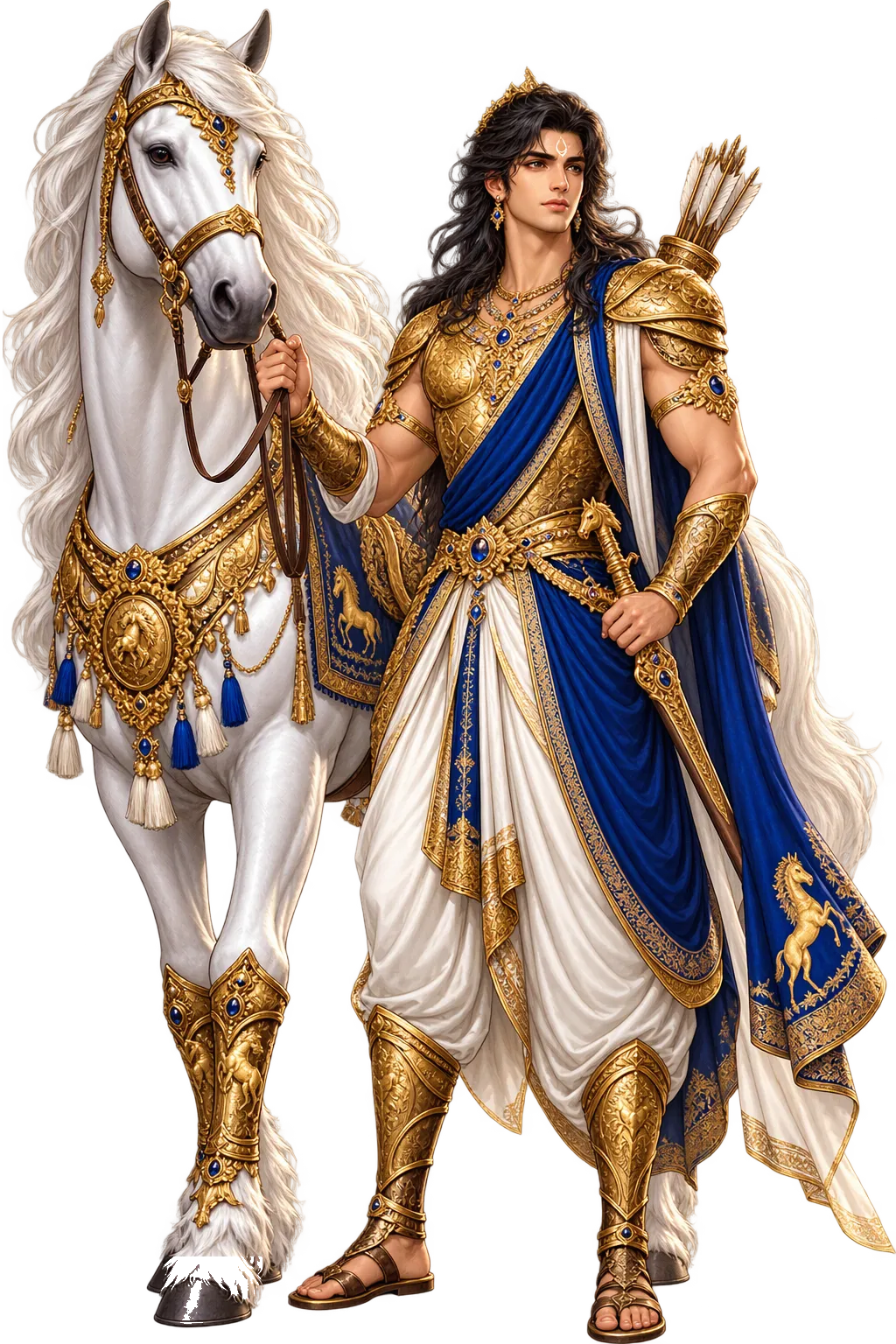
Stories of Nakula
Nakula’s mythology is the epic of the competent: the twin born to the physician-gods, trained in every martial art, steady through exile, war, and loss. He has no single great myth because his greatness was distributed — the brother who never failed at anything assigned to him, and whose death on the final mountain was the quietest of the five.
After Kuntī bore three sons by mantra, Pāṇḍu asked Mādrī to use the boon; she called not one god but the Aśvin twins, and bore the twins Nakula and Sahadeva — radiant, the epic says, as the gods themselves. When Pāṇḍu died, Mādrī entered his funeral pyre, leaving the twins to Kuntī’s care: the youngest of five mothers’ sons.
In the thirteenth year of exile, spent incognito, Nakula served King Virāṭa as Granthika the horse-trainer — so skilled that the king’s herds and stables prospered beyond record. The disguise-book is the epic’s comedy of excellence: each brother, hidden, cannot help being the best at the humble job assigned.
In the great war Nakula fought at the head of a division, slew his share of the hundred brothers — Duhśaha among them — and was never once routed. The epic’s tallies of his duels are long and undramatic: the record of a professional among heroes of fire.
On the last walk, Yudhiṣṭhira explained each brother’s fall: Bhīma for gluttony, Arjuna for vanity, Sahadeva for pride of wisdom. Nakula’s sin was the subtlest — the pride of beauty: ‘he thought none his equal in form’. The verdict completes the epic’s economy: even the quietest gift, treasured as superiority, weighs.
The Fourth Pāṇḍava, the Handsomest of the Five
Nakula is the fourth Pāṇḍava: son of the Aśvin twins by Pāṇḍu’s second queen Mādrī, twin of Sahadeva, master of horses, swords, and the lore of cattle. The epic’s verdict on his beauty is unambiguous — among the five, Nakula was the most beautiful — and his quiet competence made him the brother wars could not unsettle.
Conceived by Mādrī’s mantra-call to the divine twin physicians — hence the brothers’ medical genius.
His care of horses was legendary; in the incognito year he served as Virāṭa’s horse-groom, a master among masters.
His blade-work the epic ranks first among the brothers — the quiet specialist of the five.
He knew herds as he knew horses — the brother of the epic’s animal-husbandry books.
From the original script to the living URL
नकुल
The name in its original Sanskrit form. Nakula (नकुल) is attested in the source tradition — “Son of the Aśvins and Mādrī — twin of Sahadeva, fourth of the Pāṇḍu princes, master of horses”. Its original diacritics and script distinctions carry the full phonetic and orthographic weight of the source tradition.
nakula
The plain nakula form is identical to the Unicode restoration. Because this name is already written in Latin letters, no diacritics, stress, or script information were lost — only capitalization differs.
Nakula
The Unicode restoration does not need to recover lost marks for Nakula. Its value is canonical spelling and consistent cataloguing, not the reconstruction of erased orthography. The domain is readable as-is to both DNS and humanity.
Nakula.com
This restoration is written entirely in ASCII letters — no Punycode encoding stands between Nakula and the DNS. The domain reads identically to machines and to human eyes.
The attested spelling family of Nakula
Nakula
Restores नकुल. The full Unicode restoration. nakula.com is not in the PuniCodex collection — it is watched for release; if it drops, this temple upgrades to an owned flagship. Attested by MW, Mahabharata.
How Nakula was spoken
How Nakula travels from ancient script to the modern URL
The lore you have read is the living myth. Extended Lore opens the scholarly vault beneath it: the cult and its material remains, a history of the image, the name after antiquity, a meditation on what the name still means, and the full scholarly apparatus — etymology, orthography, sources.
Enter Extended Lore