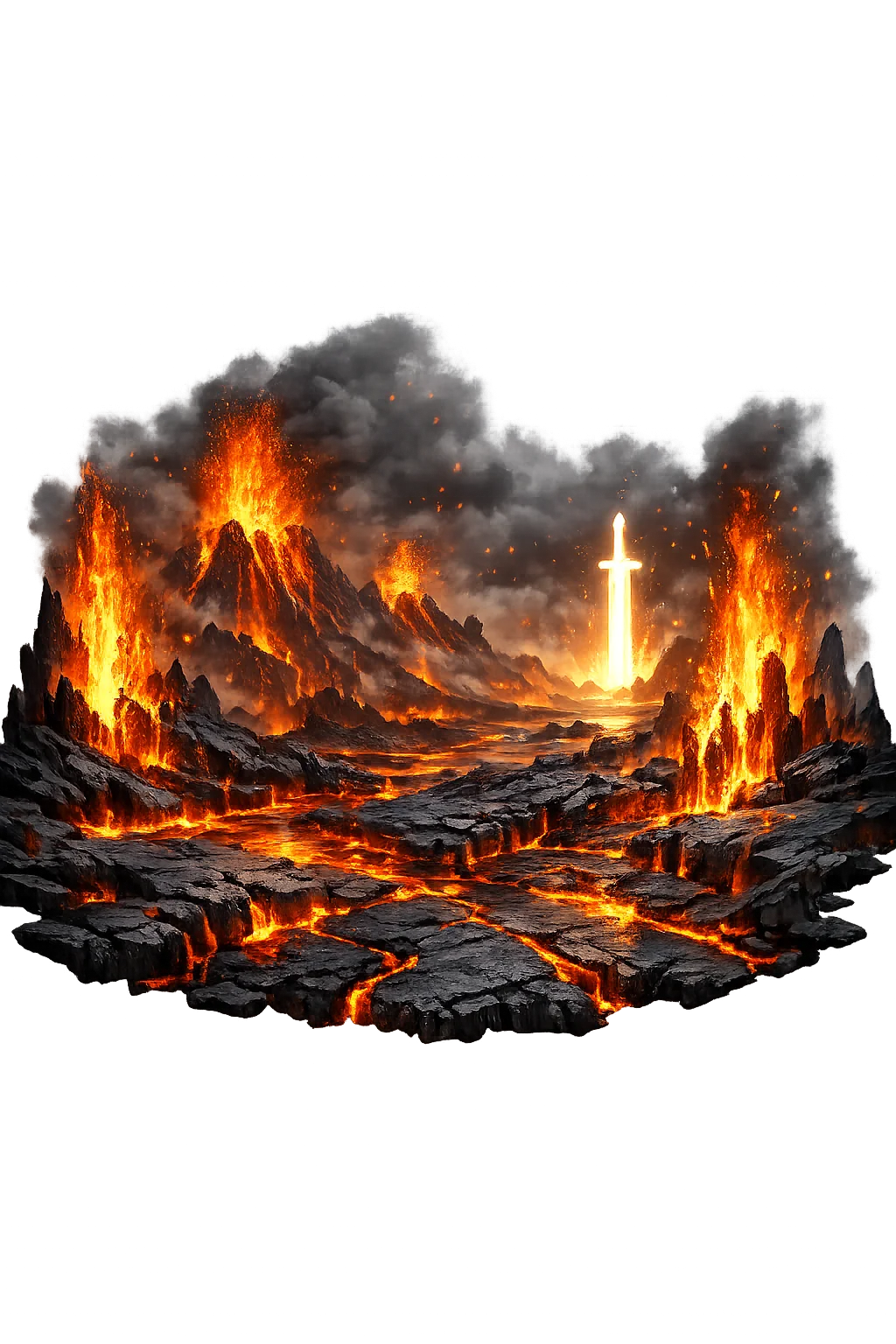
Stories of Muspellheimr
Muspellheimr is the world of fire, the southern realm that burned before the cosmos was shaped and will burn it again at Ragnarǫk. Home of Surtr and his sons, it is both the furnace whose sparks quickened Ymir's rime and the terminal conflagration that ends the ordered world.
The seeress of Völuspá ends her prophecy with Muspell's arrival: Surtr comes from the south, and the sun of the battle-gods shines from his sword. Behind him ride the sons of Muspell, and the rainbow bridge Bifröst breaks beneath their company as they cross. The wolf Fenrir has swallowed the sun; the ship Naglfar, built from the nails of the dead, sails with Loki at the helm; and in the tumult Surtr finds Freyr and kills him — the fertility god defenseless because he gave his own sword to his messenger Skírnir for love of Gerðr. Then Surtr casts fire over the earth: the sun grows dark, the land sinks in the sea, the bright stars vanish, and a life-nourishing flame licks against heaven itself until the sky splits. Fire here is not punishment but atmosphere — the world's element returning to claim it. The stanzas make Muspellheimr the last thing the seeress sees before the earth rises green from the sea: its fire ends the world and, by clearing it, permits the renewal.
Snorri's Gylfaginning sets the physics of creation as a collision: from the north, the rivers of Niflheimr poured into Ginnungagap and froze into rime and hoarfrost; from the south, sparks and molten fragments blew out of Muspellheimr into the same void. Just as cold and all harsh things came from Niflheim, Snorri writes, so that which lay nearest Muspell was hot and glowing — and where the heat met the rime, the ice began to melt and drip. From the quickened drops came the sweat of Ymir, the primordial giant from whose body the worlds would later be built. Muspellheimr is thus written into the world's first paragraph as one of its two parents. Without its fire the rime of Niflheimr would have lain on the void forever, unmelting and lifeless; creation begins exactly at the frontier where the two realms touch. The realm that will destroy the world is, in the beginning, the reason the world can exist at all — the furnace and the funeral pyre are the same fire, seen from opposite ends of time.
Of Muspellheimr's interior Snorri says almost nothing, because nothing in it needs describing: it is brightness, heat, and flame, impassable to anyone not born to it. What matters is its border, where he who sits at the world's end to defend it is called Surt; he has a flaming sword, and at the end of the world he will go and wage war and defeat all the gods and burn the whole world with fire. The southern realm also gave the heavens their lamps: when the sons of Borr built the world, they caught the sparks and glowing embers that flew about loosely and had been cast out of Muspellheim, and set them in the sky — fixed in their places as sun, moon, and stars. The image is exact and beautiful: every star is a spark of Muspell caught and pinned. The realm's fire is therefore both guard and clock — the wall of flame at the world's edge and the burning points by which giants and men tell the hours until Surtr leaves his post. Muspellheimr never does anything; it simply is, at both ends of everything.
The name escaped the north. Around 870 an anonymous monk in the south of the German-speaking world composed a poem on the Last Judgment in which muspilli means the destruction of the world by fire: Elias will fight the Antichrist, but bitter will be the muspilli for the souls unprepared — a word reused, evidently, from the old Germanic vocabulary of the world-ending blaze. The poem survives incomplete in a Munich manuscript (Clm 14098), and a generation earlier the Old Saxon Heliand had already used mūdspelli, 'day of doom,' in its gospel harmony. Whether the word itself is pre-Christian Germanic or a Christian coinage is a question scholars have argued for a century without settlement; what is certain is that the southern fire-realm of the Norse cosmos left its name in monasteries that had never heard of Surtr. Muspell crossed the frontier the way the myth says its sparks do — thrown outward from the burning world to lodge, still glowing, in foreign darkness.
The domain of Muspellheimr
In the Norse cosmology, Muspellheimr is the southern world of fire — the realm that burned before the ordered cosmos existed and will burn it again at Ragnarǫk. It is the forge whose sparks quickened the primordial rime and the conflagration that ends the world, ruled from its border by the fire giant Surtr.
The fire giant Surtr will lead Muspell's sons across Bifröst, burning the world at Ragnarǫk.
Sparks from Muspellheimr met Niflheimr's ice in Ginnungagap, melting the primordial rime from which Ymir emerged.
Muspellheimr's inhabitants are burning beings for whom order itself is fuel; no gods dwell there.
The southern realm of flame is both the furnace of creation and the terminal conflagration of the cosmos.
From the original script to the living URL
ᛘᚢᛋᛒᛁᛚᛚᚼᛁᛘᚱ
The name in its original Norse form. Muspellheimr (ᛘᚢᛋᛒᛁᛚᛚᚼᛁᛘᚱ) is attested in the source tradition — “Muspel-home (world-ender)”. Its original diacritics and script distinctions carry the full phonetic and orthographic weight of the source tradition.
muspellheimr
The plain muspellheimr form is identical to the Unicode restoration. Because this name is already written in Latin letters, no diacritics, stress, or script information were lost — only capitalization differs.
Muspellheimr
The Unicode restoration does not need to recover lost marks for Muspellheimr. Its value is canonical spelling and consistent cataloguing, not the reconstruction of erased orthography. The domain is readable as-is to both DNS and humanity.
Muspellheimr.com
This restoration is written entirely in ASCII letters — no Punycode encoding stands between Muspellheimr and the DNS. The domain reads identically to machines and to human eyes.
Owned, ideal, and ASCII forms of Muspellheimr
Muspellheimr
Restores ᛘᚢᛋᛒᛁᛚᛚᚼᛁᛘᚱ. The live temple domain — muspellheimr.com.
How Muspellheimr was spoken
How Muspellheimr travels from ancient script to the modern URL
Old Norse Muspellheimr; from Muspell, the fire-giant or fire-realm, + heimr “home"; the world of fire.
World of Fire
The Unicode restoration Muspellheimr uses registrable Thorn and vowel accents; the runic form is not used because runic TLD support is impractical.
The lore you have read is the living myth. Extended Lore opens the scholarly vault beneath it: the cult and its material remains, a history of the image, the name after antiquity, a meditation on what the name still means, and the full scholarly apparatus — etymology, orthography, sources.
Enter Extended Lore