
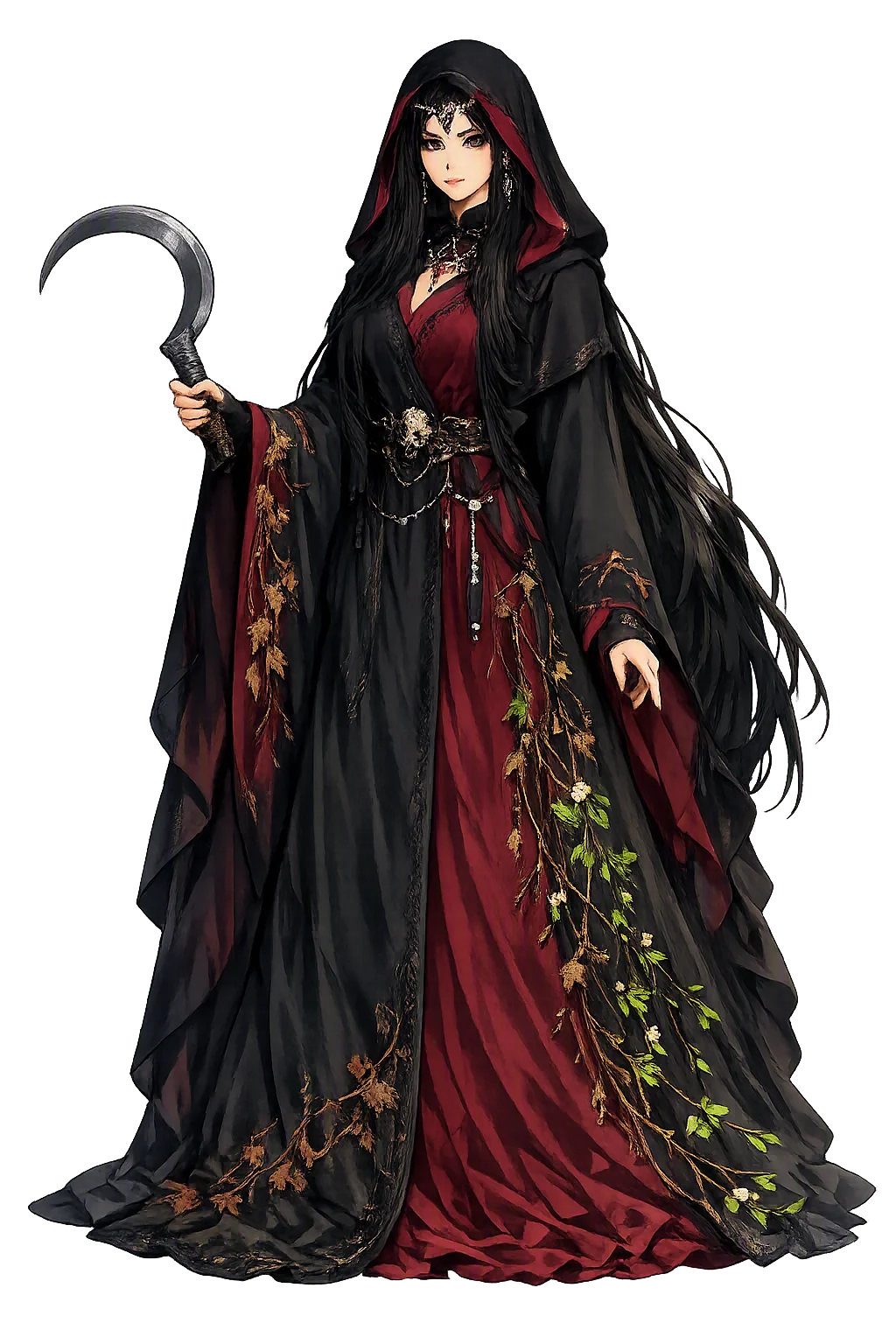
The name Morana and the world it opens
A name is a door. Morana opens onto one of the darkest but most necessary rooms in Slavic mythology: the realm of winter and death, the frozen threshold where life ends and something else begins. She is the death goddess, the cold woman, the one who takes the dying and rules the barren months. Unlike Marzanna, with whom she is often confused, Morana is less tied to a single seasonal ritual and more broadly understood as a personification of mortality itself. Yet the two names flow into each other like tributaries of the same dark river. This post explores the world that Morana opens: her etymology, her mythology, her place in folk belief and seasonal custom, her cultural afterlife, and the Unicode restoration that returns her name to the address bar.
Morana confronts us with a truth that every culture must address: death is universal, but our ways of imagining it are particular. The Slavs gave death a name, a face, and a season. They called her Morana, and in doing so they made the unimaginable slightly more bearable. She is not a comfortable figure, but she is an honest one. She tells us that winter comes, that life ends, and that the only response is to endure with dignity and hope for spring.
For the modern seeker, Morana offers a way to think about endings without despair. Her name does not deny death but names it, gives it a shape, and places it within a cycle that includes renewal. The restoration of her name is therefore not morbid but life-affirming: it preserves a cultural tool for facing mortality.
At a Glance
- Restored name: Morana
- ASCII form: morana
- Meaning: "Death"
- Domain of influence: Winter, Death
- Pantheon: Slavic
- Classification: Tier 2
Overview
Morana belongs to the Slavic tradition, where she is catalogued under the domains of winter and death. Her name is one of the most direct and uncompromising in the Slavic pantheon: it means, simply, "Death." This is not a euphemism or a poetic epithet but a stark statement of her nature. To name her is to name the force that ends all life. And yet, as with so many death deities, Morana is not purely malevolent. She is the necessary guardian of the boundary, the one who makes the return of spring meaningful by first bringing winter.
In Slavic folk belief, death is not an abstract concept but a personified power. It can appear as an old woman, a skeleton, a cold wind, or a pale maiden. Morana is one of the most important forms of this personification. She is the White Lady, the Frozen Woman, the queen of the graveyard and the frozen field. Where she walks, leaves wither, rivers freeze, and the breath turns to mist. Her presence is felt in every funeral, every long winter night, every moment when life seems to retreat before an implacable cold.
The PuniCodex restoration presents Morana in the scholarly form used in English-language discussions of Slavic folklore. The ASCII form morana is a technical compromise; the restored form preserves the name's status as a proper noun and a divine name. Because the name does not require diacritics or distinctive letters, it is classified as Tier 2, but its cultural weight is immense.
Morana also opens questions about the relationship between language and belief. To have a word for death is one thing; to make it a goddess is another. The personification suggests that the Slavs did not merely fear death but engaged with it as a power that could be addressed, propitiated, and even defeated seasonally. Morana is not an impersonal fate; she is a being with whom one can have a relationship.
Etymology and Meaning
The etymology of Morana is strikingly direct. The name comes from a Proto-Slavic root mor- meaning "death," "plague," or "pestilence." This root appears in many Slavic words related to death and disease, giving the name a broad semantic field. To call a goddess Morana is to identify her with the very fact of mortality. She is not merely a messenger or servant of death; she is death itself, conceived as a feminine power.
Some scholars have connected the root to an even older Indo-European root meaning "to die" or "to wither," which would place Morana in a very ancient lineage of death goddesses. Others have emphasized the connection to cold and frost, seeing her name as related to words for biting cold and barrenness. Both approaches converge on the same picture: Morana is the force that withers life, whether through disease, old age, or the winter season.
The name has many variants across Slavic languages and regions: Morana, Mara, Mora, Marzanna, and others. These variants reflect local dialect differences and the merging of related figures over centuries. In some areas, Mara is a nightmare demon who sits on sleepers' chests; in others, Morana is a winter goddess drowned in springtime. The common thread is the association with death, cold, and the liminal state between waking and sleeping, living and dying.
The meaning "Death" gives Morana's name a terrible clarity. Unlike Belobog, whose name describes his nature in positive terms, or Lada, whose name hints at beauty and harmony, Morana's name leaves no room for illusion. She is what she is. This directness has made her both frightening and fascinating to generations of storytellers.
The root mor- also connects Morana to broader Slavic vocabulary. Words for plague, pestilence, decay, and nightmare echo her name across the languages. This linguistic web means that Morana is not confined to mythological texts; she is present in everyday speech, in the names of diseases and bad dreams, in the warnings of elders and the fears of children.
Mythology and Domain
Morana's mythology is woven from the imagery of winter and the grave. She is often depicted as a pale woman dressed in white or gray, with long hair and cold hands. In some traditions she is beautiful but deadly, like a frozen flower; in others she is old and haggard, the hag of winter. She may ride a pale horse, drive a chariot of ice, or simply walk through the world leaving frost behind her.
The domain of winter is her seasonal manifestation. During the cold months, Morana rules. The earth sleeps under her hand, the rivers are locked in her grip, and the dead rest in her keeping. She is the goddess of the long night, the one who tests the living by withholding warmth and light. In agricultural societies, winter was always a dangerous season, a time when stored food could run out and the weak could die. Morana embodied that danger.
The domain of death is her deeper and more permanent realm. Morana takes the dying, guides them to the otherworld, and keeps the dead in their graves. She is the boundary guardian, the one who ensures that the dead do not return to trouble the living and that the living do not trespass into the realm of the dead. In this role she overlaps with other Slavic chthonic figures, including Veles, the god of the underworld and cattle.
One of the most important mythic themes associated with Morana is her seasonal defeat. As winter gives way to spring, Morana's power is broken. In some regions, this is enacted through the drowning or burning of a straw effigy, a ritual she shares with Marzanna. The effigy represents the death goddess herself, and its destruction marks the return of life. Yet even in defeat, Morana is not destroyed forever. She withdraws, waits, and returns with the next winter. Death cannot be permanently vanquished; it can only be endured and ritually overcome for a season.
The liminal quality of Morana is essential to her character. She stands at the threshold between day and night, summer and winter, life and death. This makes her a figure of great magical power in folk belief. Witches and sorcerers might invoke her, and those who die at the wrong time — during liminal periods or without proper rites — might become her servants. She is dangerous precisely because she is neither fully alive nor fully dead.
Cultural Legacy
Morana's cultural legacy is both dark and fertile. As a personification of death, she appears in Slavic folklore, literature, and art as one of the most memorable figures of the supernatural world. She is the cold woman at the crossroads, the pale bride who leads men to their doom, the winter queen who must be defeated for spring to come. Her imagery has influenced everything from folk tales to Romantic opera to modern fantasy.
In the nineteenth century, Slavic Romantic artists often depicted Morana as a tragic or seductive figure, sometimes contrasting her with the spring goddess Vesna or the summer goddess Kupala. This artistic tradition drew on folk sources but transformed them into high culture. Morana became a symbol of the Slavic nation's suffering and endurance, her winter representing foreign oppression and her eventual defeat representing hope for national rebirth.
Contemporary pagan and folk revival movements continue to honor Morana, though often with ambivalence. She is not a goddess one worships for joy, but she is acknowledged as a necessary power. Rituals in her honor may take place at midwinter, at funerals, or at times of personal loss. Practitioners may leave offerings at crossroads, graveyards, or bodies of water, asking her to take the dead gently and to spare the living from plague and famine.
Morana also survives in everyday language. The root mor- appears in words for plague, pestilence, and nightmare across Slavic languages. To have a mora is to experience a night terror; to suffer a mor is to endure a devastating epidemic. These linguistic traces keep the goddess present in daily speech, even when her cultic identity has been forgotten.
The figure of Morana has also found a place in modern psychological and ecological interpretation. As a personification of winter and death, she can be read as an archetype of the necessary descent, the dark phase without which renewal is impossible. In an age of climate anxiety, she also serves as a reminder of nature's cycles and the limits of human control.
Unicode Restoration and Conclusion
The PuniCodex restoration of Morana returns the name to its proper form. The ASCII fallback morana is useful for routing but fails to convey the name's gravity as a divine name. The restored spelling, with its capital M, marks Morana as a figure of myth and religion, not a common noun. It also preserves the simplicity and directness that make the name so powerful.
The restoration matters because death is one of the subjects that most needs to be named correctly. To reduce Morana to a lowercase string is to diminish the reality she represents. The Unicode domain allows the name to stand in full, acknowledging the goddess and the cultural world she opens. It is a small technical gesture with a large symbolic resonance.
The restoration also connects Morana to a broader project of honoring Slavic feminine and chthonic deities. Too often, the spotlight falls on the warrior sky-gods while the dark goddesses linger in the background. By restoring Morana's name, PuniCodex brings her forward, acknowledging her role in the full Slavic pantheon.
The restoration of Morana also challenges us to think about the dignity of dark names. In a digital culture that favors the cheerful and the marketable, a death goddess might seem an unlikely candidate for restoration. But PuniCodex is not in the business of curating only pleasant names. It is in the business of preserving the full range of human naming, including the names that confront mortality. Morana's restoration is a statement that death, too, deserves its proper name.
In the end, Morana reminds us that every culture must find ways to face mortality. The Slavs faced it by giving death a name, a face, and a season. The name is cold, but it is also honest. It does not flinch from the truth that life ends, and it finds beauty even in that truth — the beauty of winter, the dignity of the grave, the promise that spring follows even the longest night. The restoration ensures that this honest name continues to be spoken.
Morana and the Psychology of Winter
The figure of Morana offers a window into the psychological experience of winter in premodern societies. For communities dependent on agriculture, winter was not merely a season of cold and darkness but a period of genuine danger. Stored food could run out, disease could spread, and the weak — the very young, the very old, the sick — were at heightened risk. Morana personifies these dangers, giving them a face and a name. In doing so, she makes the terror of winter manageable by making it familiar.
The personification of winter as a death goddess reflects a common human strategy for coping with unpredictable threats. When danger is embodied as a being, it can be addressed through ritual, prayer, and symbolic action. One cannot bargain with the weather, but one can propitiate Morana. One cannot defeat death, but one can enact her seasonal defeat through the drowning of an effigy. These symbolic actions do not change the weather, but they change the human relationship to it, transforming helplessness into participation.
Morana also speaks to the experience of grief and loss. In traditional societies, death was a more constant presence than it is in much of the modern world. Infant mortality, infectious disease, accidents, and famine meant that most families experienced loss regularly. A goddess of death provided a way to conceptualize and mourn these losses. She was not a comforter in the modern therapeutic sense, but she was a witness, a power who acknowledged the reality of death and held the dead in her keeping.
The seasonal cycle associated with Morana offers a kind of natural therapy. Just as winter gives way to spring, so grief gives way to healing, and death gives way to new life. The ritual defeat of Morana enacts this transition in communal form. It tells participants that the darkness is temporary, that the cold will pass, and that life will return. This message is as psychologically necessary today as it was in the premodern world.
In contemporary culture, Morana can be read as an archetype of the necessary descent. Psychologists from Carl Jung onward have emphasized that growth often requires a period of darkness, withdrawal, or confrontation with mortality. Morana represents this phase in mythic form. She is the winter of the soul, the time when life seems barren but is secretly preparing for renewal.
The Unicode restoration of Morana thus has psychological as well as cultural significance. It preserves a name for the difficult aspects of existence that modern culture often tries to ignore or euphemize. By typing Morana, we acknowledge death, winter, and loss as real forces that shape human life. The restoration does not make these forces less frightening, but it gives us a name with which to face them.
In this sense, Morana is not only a Slavic goddess but a resource for anyone grappling with the darker seasons of life. Her name reminds us that winter is not an error or an interruption but a necessary part of the cycle. The restoration ensures that this wisdom remains available, spelled correctly and honored as the ancient insight it is.
Sources and Further Exploration
The study of Morana draws on Slavic folklore, linguistics, and comparative mythology. Works on Slavic folk demonology explore the figure of the mora and related nightmare beings, showing how the root mor- permeates the vocabulary of fear and death. Scholarly studies of winter customs and seasonal ritual provide context for understanding Morana's place in the agricultural year. Comparative Indo-European scholarship places her within the broader family of death and winter goddesses.
For contemporary engagement, Morana is honored in Slavic pagan revival communities through midwinter rituals, offerings at boundaries and waters, and meditations on the necessary descent. Artistic representations in painting, music, and fiction continue to reinterpret her image for modern audiences. The PuniCodex temple for Morana offers a curated collection of sources, images, and discussion, all accessible under the properly restored name.
Related Names
- Baba Jagá — Forest Witch, Death
- Černobog — Darkness, Chaos, Evil
- Dažbog — Sun, Wealth, Giving
- Domovój — Household Spirit
- Kikimóra — House Spirit, Swamp Hag
Sources
- N. I. Tolstoi et al., Slavic Antiquities: Ethnolinguistic Dictionary (1995–2012).
- Vyacheslav Ivanov & Vladimir Toporov, comparative Slavic mythology studies.
- L. Niderle, The Slavic Antiquities (1902–1924).