The Living Myth
War, Falcons, Thebes · War, the Falcon of Thebes · Nomad, warrior god
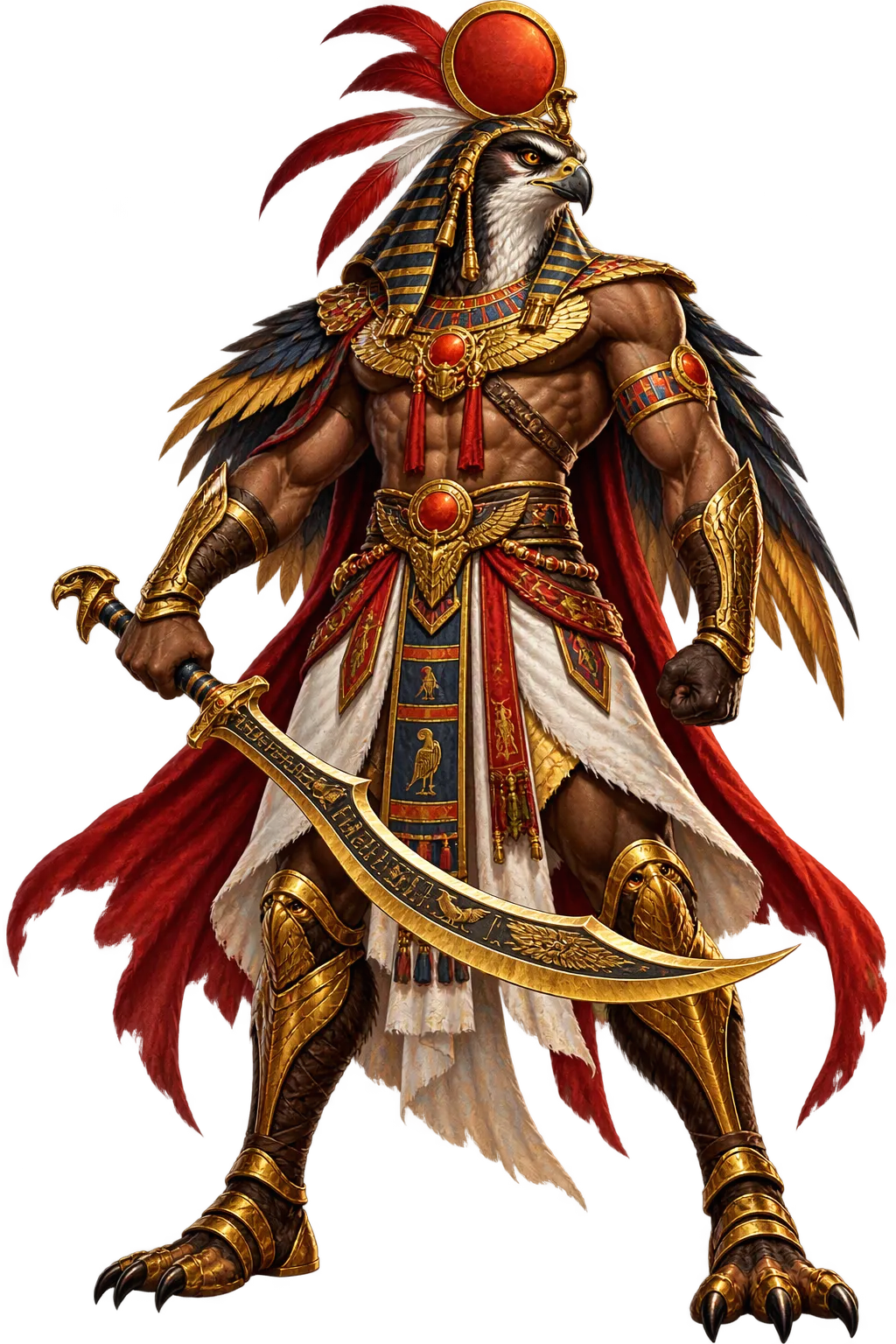
Stories of Mntw
Montu’s mythology is the mythology of Egyptian victory itself. He has few narrative myths and many battlefields: wherever the king’s chariot charged, Montu charged ahead of it. His theology fused with Ra and with Amun until, in the New Kingdom, he was the war-faculty of the supreme god and the personal patron of the warrior pharaohs.
When Thebes rose under the Eleventh Dynasty, its local falcon Montu rose with it: Nebhepetre Mentuhotep — ‘Montu is satisfied’ — bore his name as a programme. The reunification of Egypt was, in its official theology, Montu’s victory before it was any king’s.
Thutmose III at Megiddo, Amenhotep II at the Orontes, Ramesses II at Kadesh — the annals cast the king as Montu incarnate, and Montu as the king’s vanguard. The god’s four manifestations — of Thebes, Medamud, Armant and Tod — marched as a squadron in the royal war-poem of the Sphinx Stela.
As Amun absorbed Thebes, Montu was not displaced but concentrated: fused with Ra he became the sun’s war-power, a disc-crowned falcon whose heat is the battlefield’s. The ‘Lord of Armant’ retained his own great temples and festivals down to the Roman Nile level marks scratched on his columns.
In the solar barque’s nightly combat, Montu stands among the defenders of the sun against Apophis — the falcon’s talons against the serpent of the deep. War, in Egyptian theology, is never far from cosmology: every battle rehearses the first victory of order over the uncreated.
The Nomad, Lord of Medamud and Armant
Mntw — Montu — is the ancient falcon of Theban war: older than Amun, harder than victory, the god whose name the great warrior-pharaohs bore as their own. Thutmose III was “the Montu of kings”; before the theology of hidden Amun rose over Thebes, Montu was the city’s first lord of power.
Falcon-headed lord of battle; his name becomes an epithet of the victorious king himself.
His cult centres — Medamud, Armant, Tod — ringed the Theban nome before Amun’s primacy.
His name likely means “nomad” — the outsider’s ferocity harnessed to the state’s wars.
Royal titulary from the Middle Kingdom onward: the pharaoh goes to war as Montu.
From the original script to the living URL
𓏠𓈖𓍿𓅱
The name in its original Egyptian form. Mntw (𓏠𓈖𓍿𓅱) is attested in the source tradition — “Nomad, warrior god”. Its original diacritics and script distinctions carry the full phonetic and orthographic weight of the source tradition.
montu
The plain montu form is identical to the Unicode restoration. Because this name is already written in Latin letters, no diacritics, stress, or script information were lost — only capitalization differs.
Mntw
The Unicode restoration does not need to recover lost marks for Mntw. Its value is canonical spelling and consistent cataloguing, not the reconstruction of erased orthography. The domain is readable as-is to both DNS and humanity.
Mntw.com
This restoration is written entirely in ASCII letters — no Punycode encoding stands between Mntw and the DNS. The domain reads identically to machines and to human eyes.
The attested spelling family of Mntw
Mntw
Restores 𓏠𓈖𓍿𓅱. The full Unicode restoration. mntw.com is not in the PuniCodex collection — it is watched for release; if it drops, this temple upgrades to an owned flagship. Attested by Faulkner, Wb.
How Mntw was spoken
How Mntw travels from ancient script to the modern URL
Egyptian Mntw; the original vocalisation is unknown. The name is connected with the Theban war-god and perhaps with a word for “nomad".
The lore you have read is the living myth. Extended Lore opens the scholarly vault beneath it: the cult and its material remains, a history of the image, the name after antiquity, a meditation on what the name still means, and the full scholarly apparatus — etymology, orthography, sources.
Enter Extended Lore