
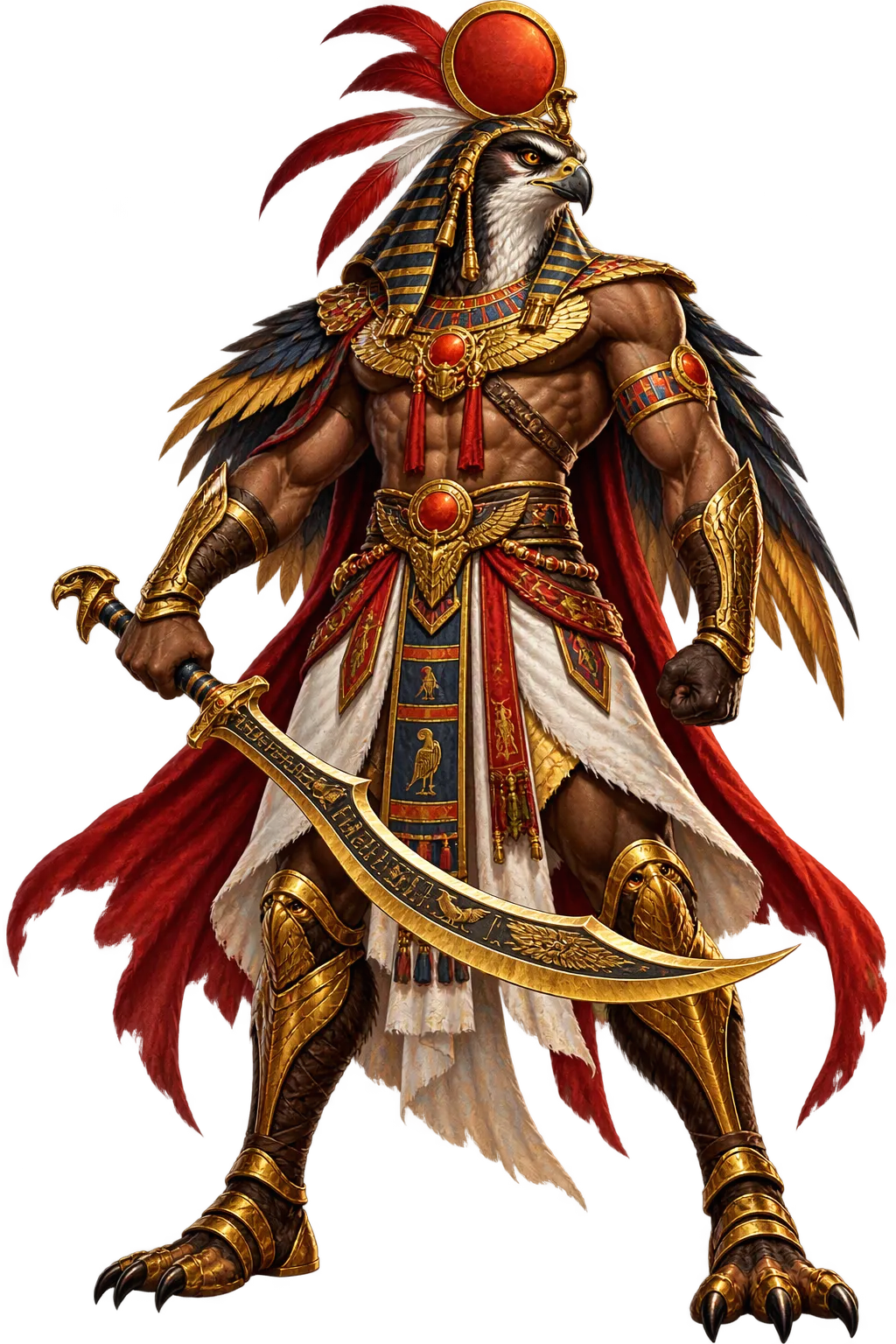
The appointments Mntw made — and who is keeping them
One myth is a story. A cycle of myths is a specification. Read Mntw's cycle in order and the industries fall out of it one by one.
At a Glance
- Temple: Mntw
- Pantheon: Egyptian
- Domain of influence: War, Falcons, Thebes
- Pattern seats: 3
- Sectors touched: Commerce & Governance · Technology & Innovation
- Strongest seat: Defense, Military & Security
- Series: The Resonance Files, No. 347 of 597
The Cycle, Read Forward
Defense, Military & Security — through The First War-God of the State
When Thebes rose under the Eleventh Dynasty, its local falcon Montu rose with it: Nebhepetre Mentuhotep — ‘Montu is satisfied’ — bore his name as a programme. The reunification of Egypt was, in its official theology, Montu’s victory before it was any king’s.
The atlas states the seat in one line: The war-falcon of Thebes — "the Montu of kings" is the annals' name for the victorious pharaoh himself. The story above is the long version of the same sentence. That is the cycle working: story becomes duty, duty becomes trade.
Aviation & Aerospace — through The Montu of Kings
Thutmose III at Megiddo, Amenhotep II at the Orontes, Ramesses II at Kadesh — the annals cast the king as Montu incarnate, and Montu as the king’s vanguard. The god’s four manifestations — of Thebes, Medamud, Armant and Tod — marched as a squadron in the royal war-poem of the Sphinx Stela.
The atlas states the seat in one line: The war-falcon of Thebes — the sky as the falcon's field, the god's patrol. The story above is the long version of the same sentence. That is the cycle working: story becomes duty, duty becomes trade.
Leadership, Governance & Public Administration — through Montu-Ra, the Solar Warrior
As Amun absorbed Thebes, Montu was not displaced but concentrated: fused with Ra he became the sun’s war-power, a disc-crowned falcon whose heat is the battlefield’s. The ‘Lord of Armant’ retained his own great temples and festivals down to the Roman Nile level marks scratched on his columns.
The atlas states the seat in one line: The war-god in whose image the pharaoh governed — "Montu of kings" is the office's divine prefix. The story above is the long version of the same sentence. That is the cycle working: story becomes duty, duty becomes trade.
The Theme That Runs the Cycle
Montu’s mythology is the mythology of Egyptian victory itself. He has few narrative myths and many battlefields: wherever the king’s chariot charged, Montu charged ahead of it. His theology fused with Ra and with Amun until, in the New Kingdom, he was the war-faculty of the supreme god and the personal patron of the warrior pharaohs.
The Method, Stated Plainly
The atlas is not a horoscope. Seats are earned from the sources — argued, weighted, published — and every one of them can be challenged at the methodology page. A match that cannot survive an argument does not survive review. That is the whole trick: the patterns are claims, and claims can be tested.
For the Ones Who Work There
If you work in defense, military & security, aviation & aerospace, or any trade this temple holds a seat in, this is the honest version of what a placement means: your industry beside the story it has been re-telling all along — on the temple floor itself, before an audience that came specifically to read it. The patron tier and the advertising terms describe the mechanics; the resonance above describes the fit.
The File Continues
One of 597 Resonance Files — the series where the pantheon goes to work. Read the founding dispatch for the name, the Restoration File for the spelling, or the whole archive end to end.
Continue the series — previous: Monókerōs (read it) · next: Morana (read it).
The Resonance Files are argued from the same canonical record as the pattern atlas itself: the lexicon, the lore catalog, and the cited sources. Every seat can be challenged at the methodology page — and the challenge is the point.