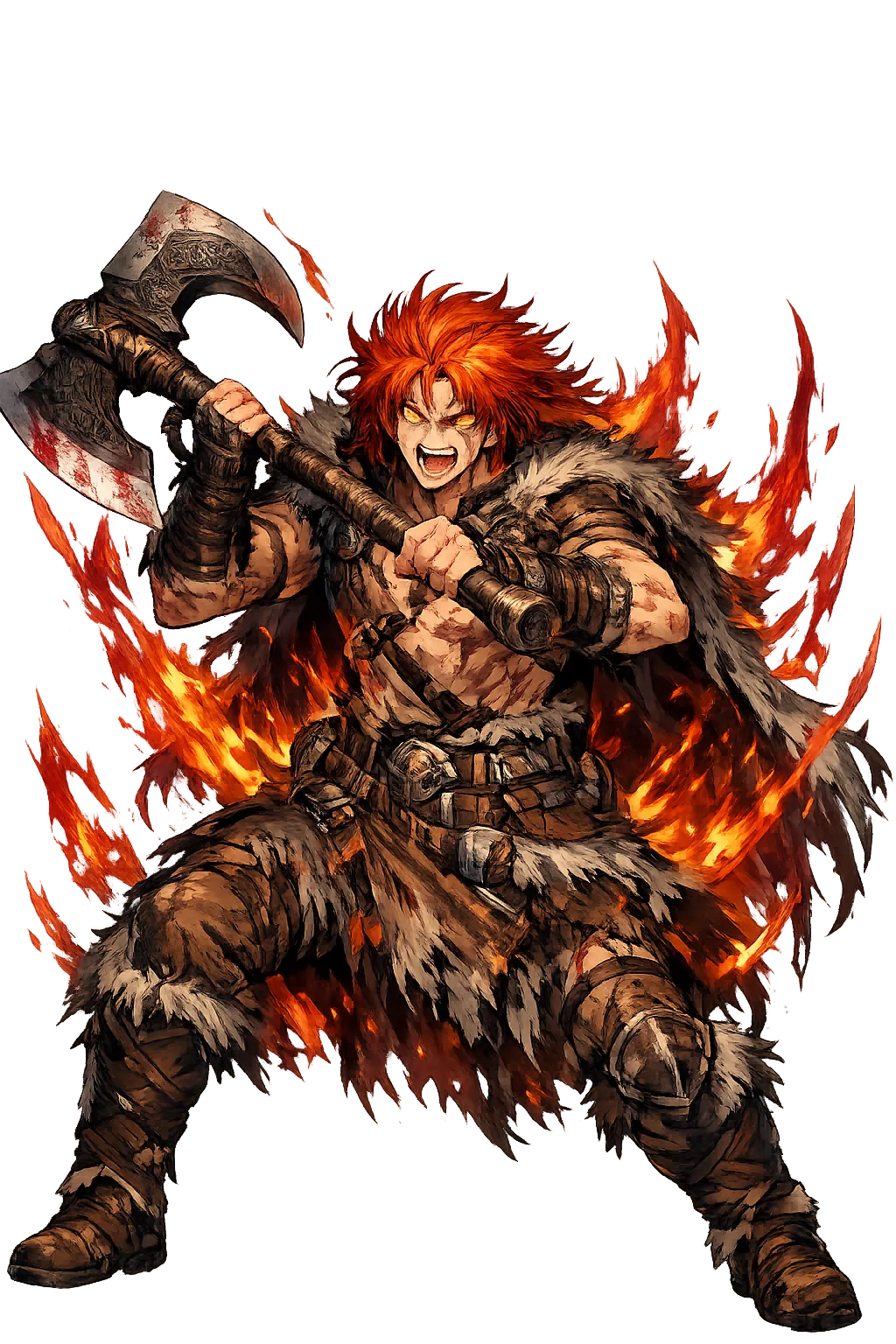
Stories of Móði
Móði is not a god of independent myths. His entire dossier is a handful of verses: his name in a list of survivors, his place in a genealogy, and the skalds' habit of naming Þórr as his father. His significance lies in what he represents — the wrath that inherits the hammer — and in what his survival promises after Ragnarök.
The eddic poem Vafþrúðnismál asks the question every Norse listener cared about: who lives when the fire dies? Óðinn, disguised as Gagnráðr, puts it to the all-wise giant: what of the gods survives Surtr's flames? Vafþrúðnir answers (st. 51): Víðarr and Váli will dwell in the gods' holy seats when the blaze is slaked — 'and Móði and Magni shall have Mjölnir when Vingnir's war-work is ended.' Snorri repeats the list in Gylfaginning: Móði and Magni among the few who inherit the renewed world, the hammer passing to Þórr's sons. The stanza is nearly Móði's entire dramatic corpus — his name, his survival, his inheritance, in a single half-line. Its meaning is a Viking family's hope written cosmically: the work outlives the worker, and the sons keep the hammer.
After Þórr kills the giant Hrungnir in single combat at the ford, the giant's corpse falls across him, one leg pinning the thunder-god's neck to the ground. The Æsir tug and heave in vain; none can shift the dead weight. Then Magni, Þórr's son by the giantess Járnsaxa — three nights old — toddles up, rebukes his father for such helplessness, and flings the leg aside as though it were light (Gylfaginning 51). Móði is named in the same genealogy as Magni's brother, though he does not act in the scene. Hrungnir had come to Ásgarð in a boasting match and challenged the gods to single combat, and Þórr's victory left him with a whetstone lodged in his skull — an ache the sorceress Gróa famously failed to charm away. Against that stubborn wound the tale sets its other lesson: pain in the father's head, impossible strength in the sons' arms. The story's function is to establish the impossible strength of Þórr's giant-born sons — and, for a careful listener, to foreshadow Ragnarök: the strength that lifts the dead off the father will one day lift the hammer off the grave.
Snorri lists Þórr's children across his Edda, naming Móði and Magni as Þórr's sons by Járnsaxa, one of the giantesses (Gylfaginning; Skáldskaparmál 14), with the daughter Þrúðr among the children of Sif. Their names are the point: Mag-ni, 'Might,' and Mó-ði, 'Wrath' — the two halves of the thunder-god's power personified as an inheritance. Where Magni is raw strength, the word his brother embodies is the fierce courage that carries a fighter past fear, the same móðr that fills the skalds' verses. A god of storm fathering his own qualities as sons is Norse theology in its plainest form: Þórr's power is not a possession but a lineage, and lineages outlive persons. The sagas and poems keep the word in ordinary circulation — móðr names the fighter's surge in the heat of the press — so the personification runs in both directions: the god named for the quality, and the quality never quite losing the god.
Most of what can be said about Móði comes not from stories but from the skalds' grammar. Snorri's Skáldskaparmál (ch. 14) teaches how to name Þórr in verse: son of Óðinn and Jörð, husband of Sif, father of Magni and Móði and Þrúðr — and Viking-Age poets actually called Þórr by his children's names, 'Móði's father' standing for the god himself. The common noun móðr, wrath or courage, runs through the whole skaldic corpus as the word for what a warrior feels at the shield-wall. So Móði's afterlife is grammatical: he survives wherever a poet needs to say 'Þórr' in a metre too tight for 'Þórr.' It is a strangely fitting fate for a personified quality — a god whose whole mythology is his name, spoken inside his father's.
The Angry God and Survivor of Ragnarök
Móði is the son of Þórr, the personification of wrath and courage. He appears in only a handful of passages, yet his role is consequential: he survives Ragnarök alongside his brother Magni and inherits their father's hammer Mjölnir. Where Magni is 'mighty,' Móði is 'fierce' — the emotional force that drives the thunder-god's line forward into the new world.
His name is the Old Norse word for fierce courage and battle-fury.
Born of the thunder-god and the giantess Járnsaxa in the Prose Edda.
He and Magni live through the twilight to inherit the renewed earth.
After Þórr falls to the serpent, Móði receives the hammer.
From the original script to the living URL
ᛘᚢᚦᛁ
The name in its original Norse form. Móði (ᛘᚢᚦᛁ) is attested in the source tradition — “The angry one”. Its acute stress marks carry the full phonetic and orthographic weight of the source tradition.
modi
Reduced to plain modi, the name loses everything that made it specific: acute stress marks. What remains is an ASCII string that machines can parse but that no longer speaks with its original voice.
Móði
The Unicode restoration recovers what ASCII flattened. Móði restores acute stress marks, returning the name to its original written dignity. The domain encodes to Punycode, but the browser displays the truth.
Móði.com → xn--mi-wjal.com
The non-ASCII characters in Móði are encoded while the ASCII remains visible. To the DNS, it is Punycode. To humanity, it is Móði.
Owned, ideal, and ASCII forms of Móði
Móði
Restores ᛘᚢᚦᛁ. The live temple domain — móði.com.
modi
Flattens ᛘᚢᚦᛁ. The plain ASCII fallback — what DNS and legacy systems see.
How Móði was spoken
How Móði travels from ancient script to the modern URL
The lore you have read is the living myth. Extended Lore opens the scholarly vault beneath it: the cult and its material remains, a history of the image, the name after antiquity, a meditation on what the name still means, and the full scholarly apparatus — etymology, orthography, sources.
Enter Extended Lore