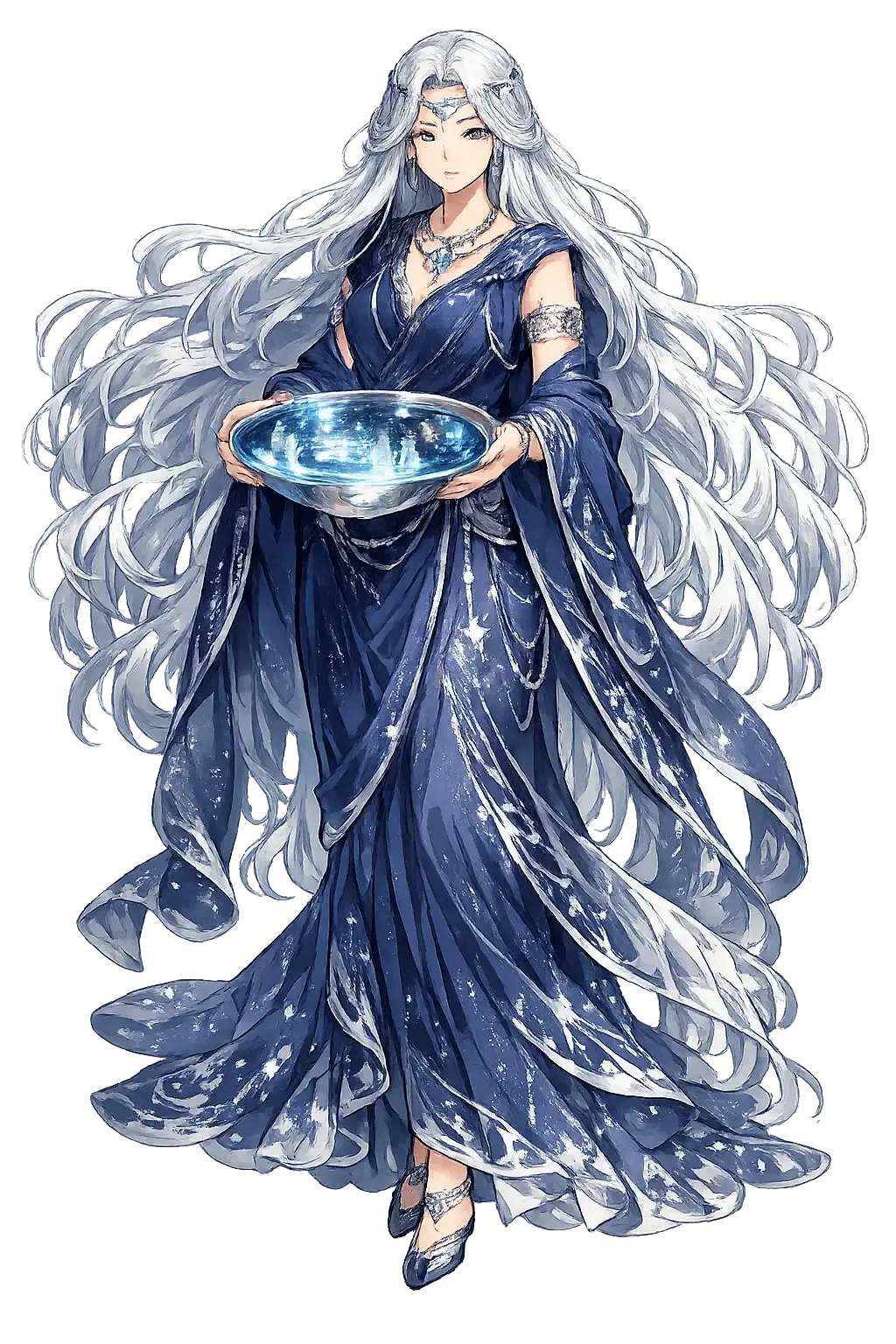
Stories of Mnēmosýnē
Mnēmosýnē's myths are few because her function is everywhere. A Titaness daughter of Ouranos and Gaia, mother of the nine Muses by Zeus, she is the ground of narrative itself — the reason anything Greek can be told twice in the same words. Her two great monuments are her daughters and the gold tablets of the mysteries.
Hesiod closes his catalogue of Zeus's unions with the one that matters most to poets. 'Zeus... lay with Mnēmosýnē, giver of delights, on Pieria, for nine nights, apart from the other deathless gods; and when the year's seasons had revolved and the months waned and many days were accomplished, she bore nine daughters' (Theogony 915–917). The arithmetic is deliberate: nine nights of lovemaking, nine months of gestation, nine Muses — the human rhythm of memory growing into song. The place, Pieria at the northern foot of Olympus, is the Muses' own homeland; and Hesiod adds, in his proem, that the Muses 'once taught Hesiod beautiful song' on nearby Helicon (22–34) — a scene with a family feel: the mother of the Muses initiates the first poet the tradition can name. Memory is the womb of poetry: the myth states the craft's genealogy in a single conception.
Small gold tablets buried with the dead — from Petelia in southern Italy, from Hipponion, Pherai, and Pharsalos in Thessaly, fourth century BCE and later — carry the most haunting instructions in Greek religion. The soul arrives in the underworld and finds two springs and a white cypress: one spring belongs to Mnēmosýnē, the other to Lḗthē, Forgetfulness. Guardians warn the traveler away from the water of Forgetfulness; instead the soul is to say: 'I am a child of Earth and starry Heaven... I am parched with thirst and perishing; quickly give me the cold water flowing from the lake of Mnēmosýnē' (after the translations collected by Graf & Johnston, Ritual Texts for the Afterlife). The soul that drinks remembers its divine origin and goes on 'the sacred way by which the other glorious initiands and bacchants travel'. Salvation, for the Orphics, is a mnemonic act: only the remembered self escapes the wheel of rebirth.
Hesiod opens the Theogony by invoking the Muses as daughters of Zeus 'and Mnēmosýnē, who rules over the hills of Eleuther' (53–55) — the one line where the goddess reigns as a sovereign in her own right — and at once gives them their function: through song they grant mortals 'a forgetting of ills and a rest from cares' (53–62). The paradox is the myth in miniature: Mnēmosýnē's daughters cure suffering not by erasing the past but by redeeming it in song. When the Muses breathe into Hesiod a wondrous voice on Helicon and teach him to sing 'what will be and what was' (22–34), the transmission is complete: memory's house now owns both tenses. Every epic invocation that follows — every poet asking a Muse to make an event unforgettable — is implicitly an invocation of Mnēmosýnē, and the whole Greek experiment in history, from Herodotus to Thucydides, is her grandchildren's work.
Mnēmosýnē had no great independent sanctuary; her cult was woven into her daughters'. At the grove of the Muses on Mount Helicon — the valley Pausanias describes (9.29–31) with its tripods, images, and the spring of Hippokrēnē that burst from the rock where Pēgasos struck it — she stood at the head of the company, addressed in libations as the Muses' mother. Plato, significantly, made her the patroness of his critique of writing: in the Phaedrus (274c–275b), King Thamus tells the inventor Theuth that letters will produce 'forgetfulness in the souls of learners', who will trust external marks instead of internal recollection — Mnēmosýnē defended against her most successful rival. Between the Orphic tablets, the Heliconian grove, and Plato's polemic, her worship is everywhere and nowhere: honored always in the second person of her daughters, the Titaness whom no one forgot because forgetting her was the one thing Greece refused to do.
Memory, the Muses, and the Waters of Remembrance
Mnēmosýnē is the personification of memory and the mother of the nine Muses. Without her, there is no poetry, no history, no law, no song. She is the deep reservoir from which all the arts draw, and the spring from which the initiates of the mysteries drink so that they may remember their divine origin after death.
She and Zeus produced the nine Muses on Pieria, one for each art and science (Theogony 915–917).
Memory is not merely human recollection but the cosmic retention of all that is and was.
The Orphic tablets send the dead to her spring — drink, and remember your divine origin.
Poets invoked her daughters so that language would not fail at the moment of making.
From the original script to the living URL
Μνημοσύνη
The name in its original Greek form. Mnēmosýnē (Μνημοσύνη) is attested in the source tradition — “Memory (from μνήμη)”. Its long vowels and acute accents carry the full phonetic and orthographic weight of the source tradition.
mnemosyne
Reduced to plain mnemosyne, the name loses everything that made it specific: long vowels and acute accents. What remains is an ASCII string that machines can parse but that no longer speaks with its original voice.
Mnēmosýnē
The Unicode restoration recovers what ASCII flattened. Mnēmosýnē restores long vowels and acute accents, returning the name to its original written dignity. The domain encodes to Punycode, but the browser displays the truth.
Mnēmosýnē.com → xn--mnmosn-fza6of.com
The non-ASCII characters in Mnēmosýnē are encoded while the ASCII remains visible. To the DNS, it is Punycode. To humanity, it is Mnēmosýnē.
Owned, ideal, and ASCII forms of Mnēmosýnē
Mnēmosýnē
Restores Μνημοσύνη. The live temple domain — mnēmosýnē.com.
mnemosyne
Flattens Μνημοσύνη. The plain ASCII fallback — what DNS and legacy systems see.
How Mnēmosýnē was spoken
How Mnēmosýnē is preserved in writing
A bespoke provenance study for Mnēmosýnē is being prepared by the PUNICODEX scholarly team.
Contribute scholarly provenance →The lore you have read is the living myth. Extended Lore opens the scholarly vault beneath it: the cult and its material remains, a history of the image, the name after antiquity, a meditation on what the name still means, and the full scholarly apparatus — etymology, orthography, sources.
Enter Extended Lore