
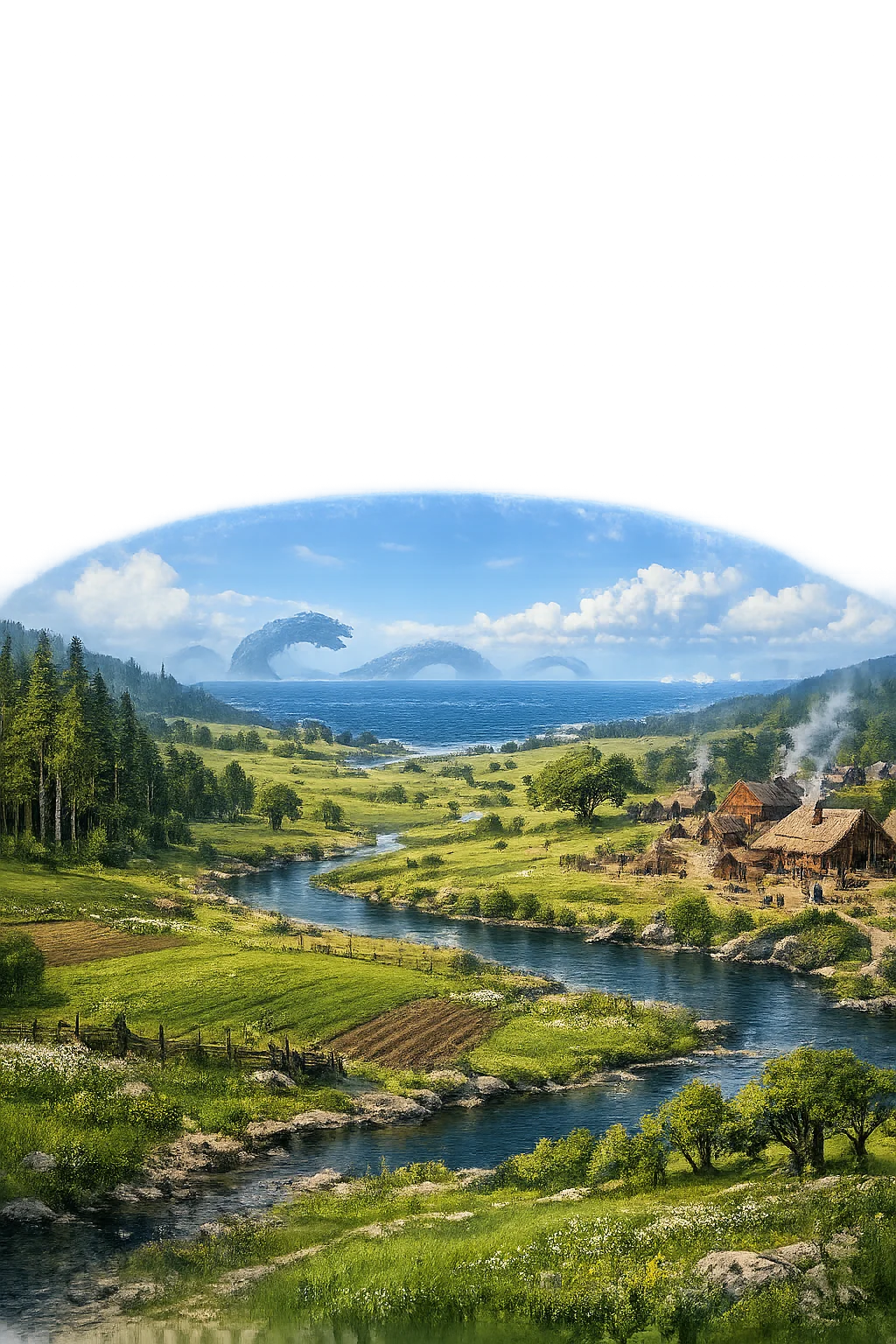
The provenance file on Miðgarðr
The provenance file for Miðgarðr. Nothing here is unsourced; that is what the file is for.
Provenance
1. The attestation. ᛘᛁᚦᚴᛅᚱᚦᛁ, from the tradition's own record. On record: Poetic Edda: Vafþrúðnismál 40–41 (Miðgarðr made from Ymir's eyebrows); Völuspá 17–18 (Ask and Embla), 57 (the sinking of the earth), Poetic Edda: Hymiskviða 22–30 (fishing for the world serpent), Snorri Sturluson, Prose Edda: Gylfaginning 8–9, 51 (the making of the world, the first humans, and its ending), Wulfila's Gothic gospels (midjungards); the Old English verse corpus (middangeard); the Old High German Muspilli (mittilagart).
2. The narrative record. The Making of the Middle Earth — When the sons of Borr slew the primeval giant Ymir, his body became the substance of everything. Óðinn, travelling in disguise to test the giant Vafþrúðnir, asks directly: from what was the earth and the sky made? The First People Inside the Fence — The enclosure was not made for gods but for the fated. Völuspá 17–18 tells of the time when the Æsir found on the shore two trees, weak and rootless, named Askr and Embla — ash and elm — and lifted them into the shape of a man and a woman: Óðinn gave them breath and spirit, Hœnir gave them understanding, Lóðurr gave blood, colour, and the working senses.
3. The physical record. The material model of a garðr — a fenced enclosure — stands excavated across the Norse world: the chieftain's farm at Borg in Lofoten and the hall at Hofstaðir in Iceland are the built form of the middle-yard. The myth's own scenes survive in stone: the Altuna runestone (U 1161, Uppland, Sweden) carves Þórr's foot braced through the fishing boat's floor as he swings the hammer at the world serpent, and the tenth-century Gosforth Cross in Cumbria fills one face with scenes widely read as Ragnarǫk — bound Loki, Heimdall with the horn, Víðarr opening the wolf's jaws — the enclosure's ending carved into a churchyard monument. The Mästermyr find from Gotland, a smith's complete tool chest buried about the year 1000, and the emporia of Hedeby, Birka, and Kaupang show the inhabited middle world working; and the hammer-amulets worn across the Viking diaspora from the ninth century are the small, personal archaeology of the god whose job was the fence.
4. The current holding. The temple at /midgardr/, classified Tier 1. Tier-1 is not a compliment; it is a measurement. This restoration keeps something the ASCII form provably loses, and the measurement is repeatable.
5. The documented resonances. Environmental & Climate Services, Gaming, Fantasy & Entertainment IP, Disaster Resilience & Recovery — seats argued and weighted in the pattern atlas, read through the myths in this temple's Resonance File.
6. The primary sources. Poetic Edda, Prose Edda — the library this file answers to, open at the Sacred Texts collection.
7. The continuing record. Miðgarðr's afterlife runs from the Codex Regius to the multiplex. In Old English poetry it was already a native word; through Tolkien's deliberate calque it became the name of the most-read invented world in modern literature, and his publishers' maps fixed 'Middle-earth' in the imagination of hundreds of millions.
At a Glance
- Restored name: Miðgarðr
- ASCII form: midgardr
- Meaning: "Middle enclosure (from mið + garðr)"
- Domain of influence: Middle Enclosure (Earth)
- Pantheon: Norse
- Classification: Tier 1
- Original script: ᛘᛁᚦᚴᛅᚱᚦᛁ
- Series: The Restoration Files, No. 312 of 546
The File Continues
Read the founding dispatch for the name's full story, the Resonance File for the archetype at work — or the whole archive in one sitting.
Continue the series — previous file: Mídas (read it here) · next file: Midir (read it here).
The Restoration Files are written from the same canonical record as the temples themselves: the lexicon, the lore catalog, the pattern atlas, and the cited scholarly sources. If a file ever disagrees with its temple, the temple is right — tell us, and the file will be corrected.