PuniCodex

Extended Lore

Mictlāntēcutli

Etymology · Orthography · Cult · Iconography · Reception · Sources

Tier 1 Mictlāntēcutli.com
Mictlāntēcutli — Lord of Mictlān, Death, Underworld
01

Quick Facts

Essential information about Mictlāntēcutli, Lord of Mictlān, Death, Underworld

Scholarly TransliterationMictlāntēcutli
Unicode RestorationMictlāntēcutli
Reconstructed Pronunciation/mik.tlaːn.ˈteː.kutɬi/
PantheonNahuatl
DomainLord of Mictlān, Death, Underworld
MeaningLord of the Land of the Dead
ClassificationTier 1
Primary DomainMictlāntēcutli.com
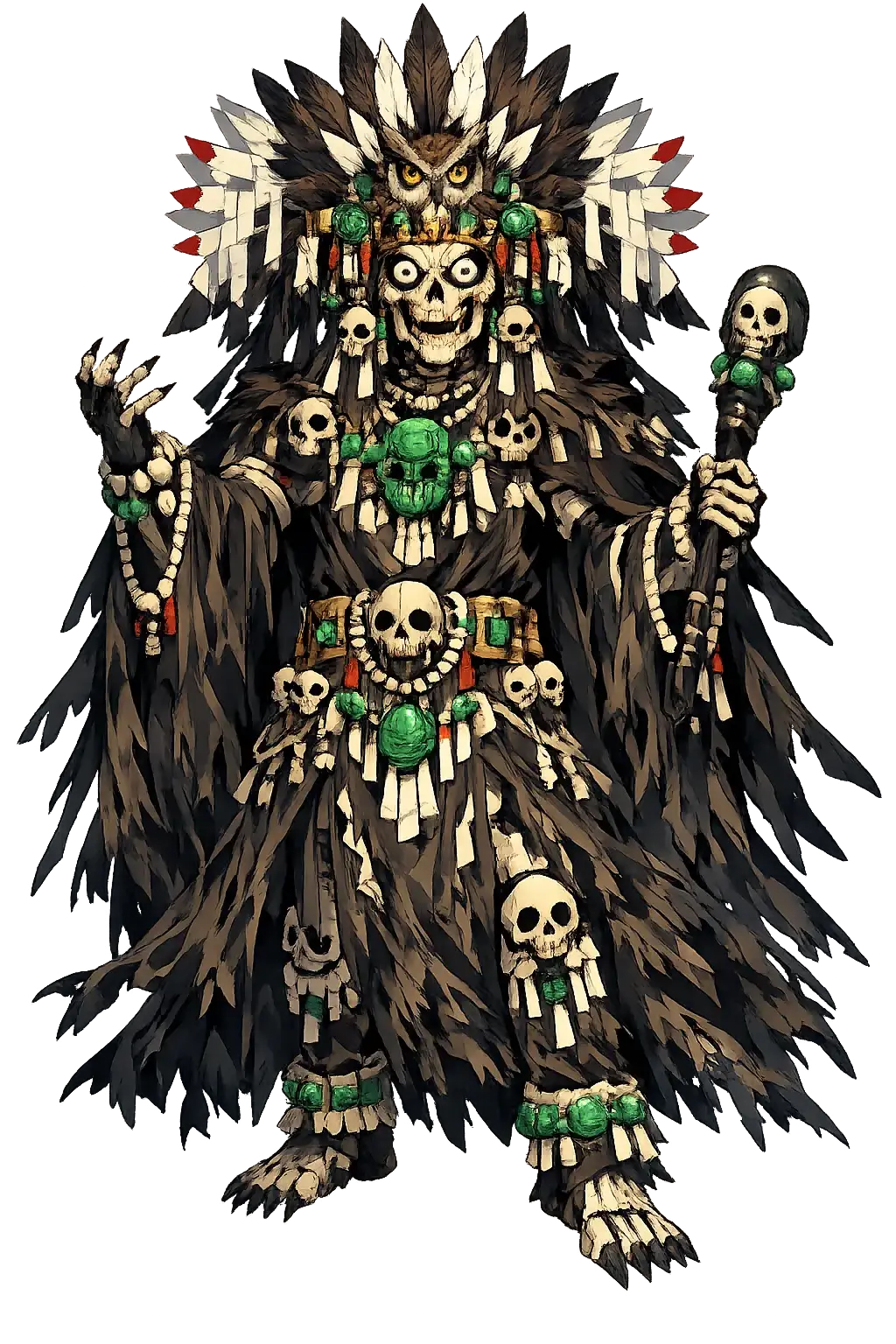
Sacred SymbolsSkull, Owl, Obsidian blade, Paper banner (amate)
02

Etymology & Word Family

From original script to Unicode restoration

Scholarly Transliteration Mictlāntēcutli Mictlāntēcutli — "Lord of the Land of the Dead"
Unicode Restoration Mictlāntēcutli Restored stress, length, and script
Modern ASCII mictlantecutli Plain-ASCII fallback

The name Mictlāntēcutli carries the orthographic signature of the nahuatl tradition. Unicode restoration recovers what ASCII flattens.

03

Unicode Character Breakdown

Character-by-character philological analysis

CharacterUnicodeNameBlockPhonetic Role
MU+004DLatin Capital Letter MBasic LatinSame, capitalized
iU+0069Latin Small Letter IBasic LatinSame
cU+0063Latin Small Letter CBasic LatinSame
tU+0074Latin Small Letter TBasic LatinSame
lU+006CLatin Small Letter LBasic LatinSame
āU+0101Latin Small Letter A with MacronLatin Extended-AMacron: long vowel
nU+006ELatin Small Letter NBasic LatinSame
tU+0074Latin Small Letter TBasic LatinSame
ēU+0113Latin Small Letter E with MacronLatin Extended-AMacron: long vowel
cU+0063Latin Small Letter CBasic LatinSame
uU+0075Latin Small Letter UBasic LatinSame
tU+0074Latin Small Letter TBasic LatinSame
lU+006CLatin Small Letter LBasic LatinSame
iU+0069Latin Small Letter IBasic LatinSame

The Tier 1 classification reflects how much of the original phonology this restoration preserves — stress and vowel length for Greek names, distinctive letters and diacritics for every other tradition.

04

Cult & Worship

How the sacred was kept — rites, sanctuaries, remains

The Cult

Mictlāntēcutli was worshipped through funerary rite and temple sacrifice rather than through a civic festival calendar. The Templo Mayor in Tenochtitlan was dedicated jointly to Huitzilopochtli and Tlaloc, but the underworld complex within Mexica religion gave Mictlāntēcutli a major role in mortuary ritual, in offerings associated with the dead, and in the cult of the Cihuateteo, women who died in childbirth. Cremation and burial goods were meant to equip the deceased for the journey to Mictlān, and human remains deposited in sacred contexts were interpreted as gifts to the lord of the dead. The colonial Día de los Muertos festival preserves some of this emotional and ritual world, though in Christianized form.

In the Earth

The most arresting artifact is the monumental stone figure of Mictlāntēcutli excavated in Mexico City in the 1930s and now the centerpiece of the Mexica hall of the Museo Nacional de Antropología — nearly two metres of basalt, arms raised, eye-sockets once inlaid, its torso stripped of flesh in the god’s flayed aspect. The great double pyramid of the Templo Mayor was dedicated to Huitzilopochtli and Tlāloc, but the precinct beneath it is layered with the lord of bones’ own archaeology: caches of skulls, sacrificial victims interred with death-god regalia, and — excavated beside the temple in 2015 — a massive tzompantli, a skull rack that once displayed the heads of the sacrificed above the sacred precinct. The painted record survives equally well: the Codex Borgia, a screenfold produced around 1500 in the Puebla–Cholula region and now in the Vatican Library, devotes whole registers to the skeletal lords of the underworld enthroned among the night hours.

05

Iconography

How Mictlāntēcutli was imaged across the ages

The Image

The most powerful image of Mictlāntēcutli is the nearly two-metre basalt figure excavated in Mexico City in the 1930s, now in the Museo Nacional de Antropología: arms raised, eye-sockets once inlaid, torso stripped of flesh to show the flayed aspect of the god. Mexica codices depict him with a skull face, liver hanging from his chest, and black body paint, often wearing paper ornaments. Stone masks, ceramic effigies, and temple sculptures repeat these traits. The flayed-skin motif and the gaping eye-sockets make him one of the most immediately recognizable figures in Mesoamerican art.

06

Reception & Transformation

The name after its own age — transmission, translation, survival

Afterlives

Mictlāntēcutli was first transmitted to Europeans through the illustrations and Nahuatl text of Sahagún's Florentine Codex, where he appears as a terrifying lord of the underworld. Spanish clergy reinterpreted him within demonic categories, while nineteenth-century antiquarians and twentieth-century Mexican nationalists reclaimed Aztec death imagery as a distinctive emblem of Mexican identity. Today he circulates in museums, comics, films, and Día de los Muertos iconography, often conflated with popular skeleton figures. Modern scholarship has sought to recover the theological complexity of Mictlān beyond the stereotype of a punitive hell.

Identifications Across Traditions

Spanish friars identified Mictlāntēcutli with the Christian Devil almost at once, and colonial painting gave him European horns, bat wings, and infernal gloom. The identification flattened him: the pre-contact lord was no tempter and no torturer, merely the necessary terminus of every ordinary life. His consort Mictecacihuatl survived the conquest far more visibly. In the nineteenth century the printmaker José Guadalupe Posada turned the elegant death’s-head Calavera into Mexico’s national memento mori; Diego Rivera enthroned her as La Catrina, and she now presides over the Día de los Muertos, whose whole grammar — food for the dead, skulls that grin — descends from the Mictlān complex. Modern Mexico has reclaimed the lord himself as heritage rather than horror: his monolith anchors the national museum, and his name, no longer diabolized, titles artworks, scholarly institutes, and works of fantasy across the Americas.

Modern Legacy

Mictlāntēcutli presides over one of the world’s most visually powerful death traditions, and his modern presence is out of proportion to his few surviving myths. The great monolith in the Museo Nacional de Antropología — its goggle eyes, fanged jaw, and paper banners frozen mid-snarl — has become an emblem of Mexica antiquity as recognizable as any object in the Americas. Around him gathers the living festival: the Day of the Dead, inscribed by UNESCO in 2008 on the Representative List of the Intangible Cultural Heritage of Humanity, whose ofrendas, sugar skulls, and La Catrina processions keep the old underworld commerce with the dead in full public view. Contemporary artists, muralists, metal bands, and graphic novelists return to him not as a monster but as the dignified keeper of an unavoidable truth. In a global culture that hides death behind curtains, Mictlāntēcutli remains the great counter-example: death as destiny, shared equally, and faced with offerings, flowers, and even jokes.

07

The Meditation

What Mictlāntēcutli means — beyond the dictionary

Mictlāntēcutli teaches that death is not an interruption but a destination. The four-year descent, the nine hills, the final ash-coloured stillness: these are not punishments for wrongdoing but the architecture of mortality — a road, not a verdict. Kings and slaves, warriors and weavers travelled the same last miles, for Mictlān asked nothing of its guests but arrival.

His realm is also, paradoxically, generative. Quetzalcōātl must rob him to make humanity; maize rises from the decay he oversees; even the stars are his host. To look at Mictlāntēcutli is to see that destruction and creation are two faces of one cycle. The skull is not the end of meaning; it is where meaning begins again.

What the temple offers, then, is not morbidity but calibration: a lord who keeps exact books, and a people who answered him with scheduled defiance and scheduled offerings. To know his name in its full Nahuatl length is to remember that even extinction, in this tradition, had an address.

08

Frequently Asked Questions

Common questions about Mictlāntēcutli, Lord of Mictlān, Death, Underworld, and Unicode restoration

01How do you pronounce Mictlāntēcutli?

In reconstructed pronunciation, Mictlāntēcutli is /mik.tlaːn.ˈteː.kutɬi/ — approximately 'meek-TLAHN-tay-KOOT-lee' — keep the first 'a' and 'e' long, and release the final -tl as one tongue-flip.

02What does Mictlāntēcutli mean?

Mictlāntēcutli means Lord of the Land of the Dead in the nahuatl tradition.

03What are the symbols of Mictlāntēcutli?

Mictlāntēcutli is associated with Skull (The face of the underworld lord and the memento mori carried by priests.), Owl (Night bird and messenger between the living and the dead.), Obsidian blade (The sacrificial knife (tecpatl) that opens the doorway to Mictlān.), Paper banner (amate) (Ritual paper streamers marking the wind that blows through the land of the dead.).

04Why restore Mictlāntēcutli in Unicode?

Plain ASCII mictlantecutli strips the stress, length, and script that make the name specific. Unicode restoration returns the name to its original written dignity.

05What is the most important myth about Mictlāntēcutli?

“The Bones of the Old Age” — the Cosmogony story that anchors the mythology of Mictlāntēcutli, told in full on the lore page.

09

Scholarly Sources

The philological foundations of this restoration

Every claim on this page is grounded in established scholarship. The orthographic restorations follow disciplinary convention. The etymological chain follows the best available reference works. This is not invention — it is resurrection through scholarship.

◈

Lexicography & Philology

  • Karttunen
  • Sahagún
  • Florentine Codex
◎

Primary Texts

  • The Florentine Codex (Sahagún); the Anales de Cuauhtitlan; colonial Nahuatl testimonies and pictorial manuscripts.
◉

Archaeology & Art History

  • Material evidence — iconography, inscriptions, and temple archaeology — for Mictlāntēcutli and related cults.
✦

Religious Studies

  • Sahagún, Florentine Codex
  • Leyenda de los Soles
  • Karttunen, An Analytical Dictionary of Nahuatl
  • López Austin, The Human Body and Ideology
  • Carrasco, Religions of Mesoamerica
Return

The Surface Awaits

You have traced the name from its earliest attestation to its Unicode restoration. Now return to the myth. The story is where the name lives.

Back to Lore
Mictlāntēcutli mascot