The Living Myth
Lord of Mictlān, Death, Underworld · The Lord of the Land of the Dead
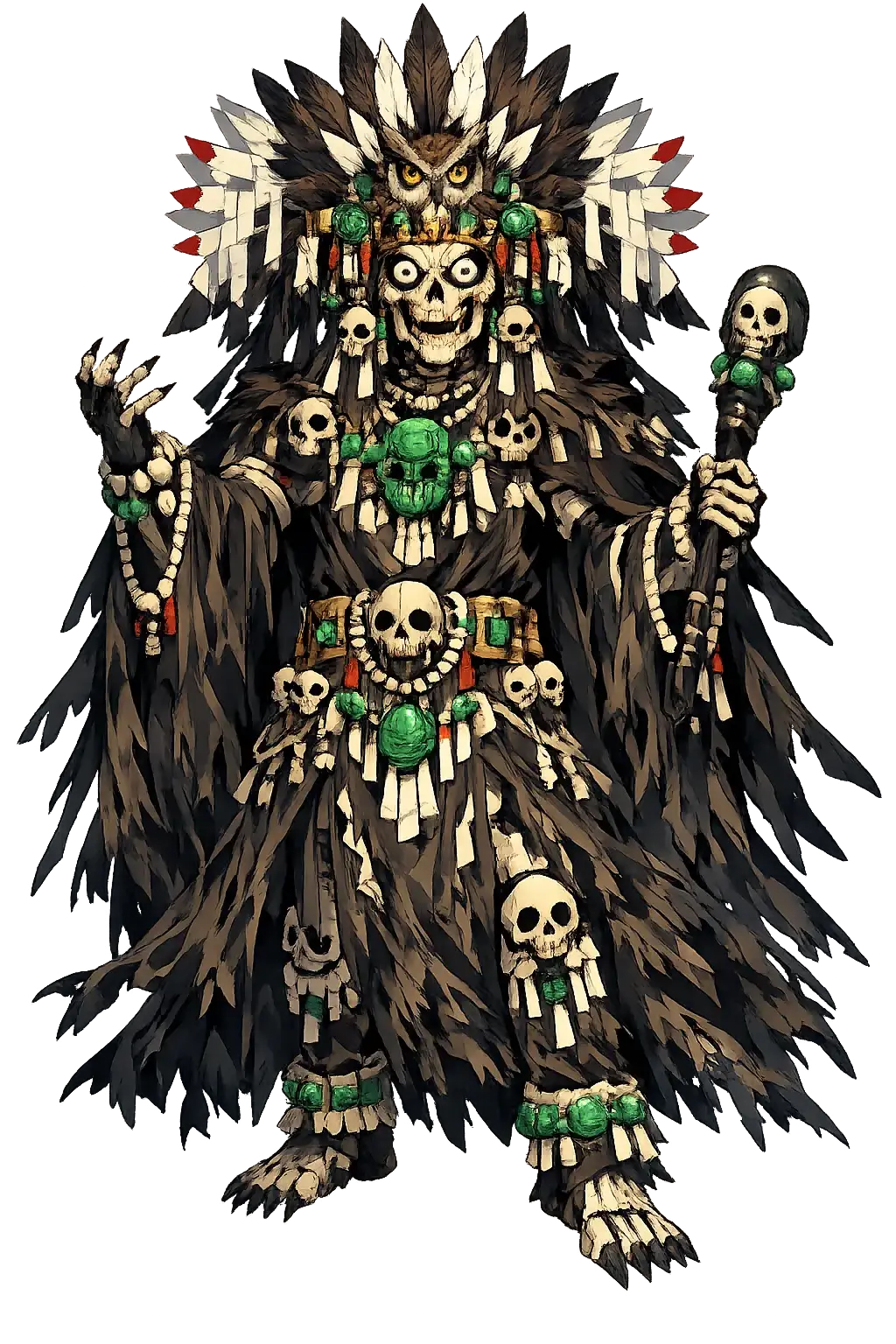
Stories of Mictlāntēcutli
Mictlāntēcutli’s myths are few but pivotal: he is the custodian of the bones of an extinguished humanity, the landlord of the stars, and the end of every road that does not end in battle. The future of the Fifth Sun depends on outwitting him, and every ordinary death in the Aztec world spends four years travelling down to his door.
After the Fourth Sun perished in flood, the gods gathered at Teotihuacan to make a new race, and they needed raw material: the bones of the people of the previous ages, kept in the deepest house of Mictlān. Quetzalcōātl volunteered for the theft. The lord of the dead received him politely and set a condition — that he walk four times around Mictlān blowing a conch shell that had no holes. Quetzalcōātl called worms to bore the shell and bees to hum inside it, and the trumpet sounded. He seized the bones and ran; Mictlāntēcutli sent a quail to startle him at the boundary, and the bones fell into a pit and shattered. The story, told in the Leyenda de los Soles and remembered by Sahagún, ends with the gods grinding the fragments in a bowl: from the broken bones of the dead they fashion human beings of every stature. The meaning is the myth’s quiet engine — the new humanity is built literally from death’s losses, and human difference itself is the scar tissue of mortality.
Aztec cosmology handed the night sky to the dead. The stars that wheel overhead were read as the host of Mictlāntēcutli — in the great screenfold of the Codex Borgia he presides over the nocturnal hours flanked by skeletal powers — and the most dangerous of them, the tzitzimime, were star-demons who could leave heaven and fall upon the earth. Sahagún records the terror of the eclipse: when the tzitzimime descended to attack the sun, the whole city raised a din of shouts and slaps to drive them back, for if the sun were devoured the Fifth Sun would end and the demons would feast on humankind. The calendar’s five unlucky days, the nemontemi, were likewise watched in fear as days when the star-demons pressed closest. The lord of bones thus ruled not only beneath the earth but across the dome of night: every darkness, subterranean or celestial, answered to the same throne.
The dead do not arrive at once; they travel. Sahagún’s informants describe a journey of four years: first the crossing of the river at the ninefold place, then a long descent past the nine hills of the underworld — where mountains clash together, where the obsidian wind cuts flesh, where beasts and serpents wait, where arrows fly and the icy blast never rests. Only then, at the ninth and lowest level, does the traveller stand before Mictlāntēcutli in his ash-coloured stillness. The road was not for everyone: those who died in war or on the sacrificial stone went up to the sun’s paradise, and the drowned and lightning-struck were kept by Tlāloc in the watery garden of Tlalōcān. Mictlān received everyone else — merchants, weavers, infants — without judgment or torture, for the Aztec underworld was not a prison for the wicked but a destination. The four-year descent turns dying into a long apprenticeship in letting go.
At the winter feast of Tititl, the Mexica dramatized their relationship with death in a scene of calculated insult. A living captive was dressed in the regalia of Mictlāntēcutli — the paper banners, the skull mask — and raised on the shoulders of priests to be carried through the streets. The crowd pelted the image with mud, refuse, and abuse, howling mockery at the lord who would one day receive them all; then, the abuse spent, the impersonator was brought down and sacrificed. Sahagún’s account makes the logic explicit: the mockery was a plea. By abusing the god’s image the people begged him to hold back his hand a little longer — ‘let him not come for us yet’. The rite stages the exact psychology of a warrior state that lived permanently in debt to death: it defied its creditor publicly, and paid him on schedule. Nothing in the New World shows more clearly that the Mexica did not love Mictlāntēcutli — and could not afford to ignore him.
Death, the Underworld, and the Nine Descents
Mictlāntēcutli is the terrible king of Mictlān, the deepest underworld beneath the earth. He does not judge souls; he receives them. After a long descent through nine perilous levels, the dead arrive at his ash-coloured realm, where life is finally, utterly extinguished.
The soul descends four years through wind, mountains, jaguars, and knives before reaching rest.
He appears as a flayed or skeletal figure with staring eyes and a jawless skull, adorned with paper banners.
Mictlān is not hellish punishment but the necessary destination of most mortals; new life rises from decay.
A living ixiptla wore the god's regalia and was sacrificed at the feast of Tititl.
From the original script to the living URL
Mictlāntēcutli
The name survives only in scholarly transliteration. Mictlāntēcutli is the standard Nahuatl romanisation, documented in academic sources — “Lord of the Land of the Dead”. Its macron-length vowels preserve distinctions lost in plain ASCII.
No indigenous writing system is securely attested for individual nahuatl names. The form shown is a modern scholarly transliteration.
mictlantecutli
Reduced to plain mictlantecutli, the name loses everything that made it specific: macron-length vowels. What remains is an ASCII string that machines can parse but that no longer speaks with its original voice.
Mictlāntēcutli
The Unicode restoration recovers what ASCII flattened. Mictlāntēcutli restores macron-length vowels, returning the name to its original written dignity. The domain encodes to Punycode, but the browser displays the truth.
Mictlāntēcutli.com → xn--mictlntcutli-cnb8w.com
The non-ASCII characters in Mictlāntēcutli are encoded while the ASCII remains visible. To the DNS, it is Punycode. To humanity, it is Mictlāntēcutli.
Owned, ideal, and ASCII forms of Mictlāntēcutli
Mictlāntēcutli
The live temple domain — mictlāntēcutli.com.
mictlantecutli
The plain ASCII fallback — what DNS and legacy systems see.
How Mictlāntēcutli was spoken
How Mictlāntēcutli is preserved in writing
No indigenous writing system is securely attested for individual nahuatl names. The form shown is a modern scholarly transliteration.
Contribute scholarly provenance →The lore you have read is the living myth. Extended Lore opens the scholarly vault beneath it: the cult and its material remains, a history of the image, the name after antiquity, a meditation on what the name still means, and the full scholarly apparatus — etymology, orthography, sources.
Enter Extended Lore