
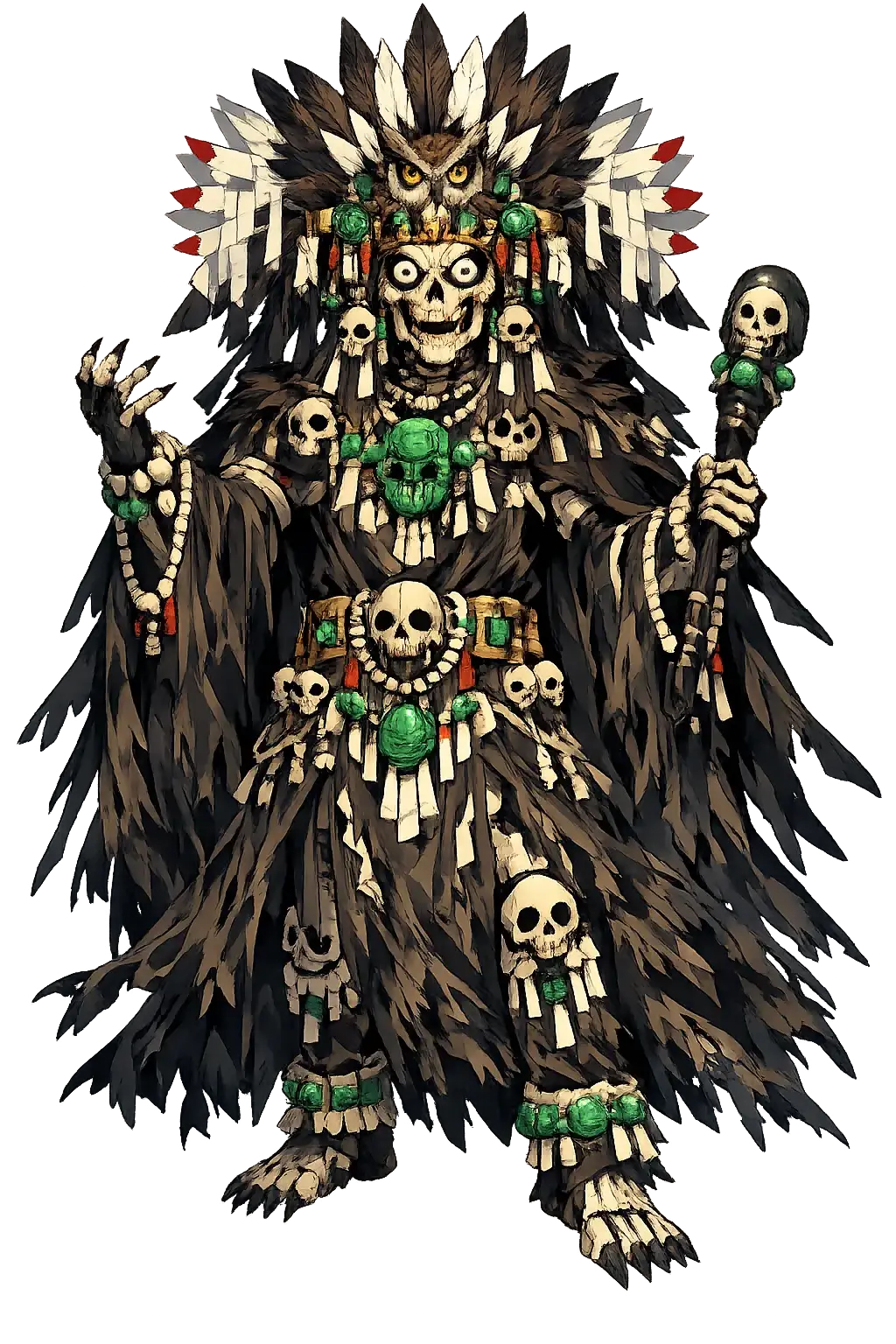
The provenance file on Mictlāntēcutli
The provenance file for Mictlāntēcutli. Nothing here is unsourced; that is what the file is for.
Provenance
1. The attestation. —, from the tradition's own record. On record: Sahagún, Florentine Codex, Leyenda de los Soles, Karttunen, An Analytical Dictionary of Nahuatl, López Austin, The Human Body and Ideology.
2. The preserved evidence. a → ā (Macron: long vowel); e → ē (Macron: long vowel) — absent from the ASCII form mictlantecutli, present in the restoration, verifiable against the sources above.
3. The narrative record. The Bones of the Old Age — After the Fourth Sun perished in flood, the gods gathered at Teotihuacan to make a new race, and they needed raw material: the bones of the people of the previous ages, kept in the deepest house of Mictlān. Quetzalcōātl volunteered for the theft. Lord of the Starry Host — Aztec cosmology handed the night sky to the dead. The stars that wheel overhead were read as the host of Mictlāntēcutli — in the great screenfold of the Codex Borgia he presides over the nocturnal hours flanked by skeletal powers — and the most dangerous of them, the tzitzimime, were star-demons who could leave heaven and fall upon the earth.
4. The physical record. The most arresting artifact is the monumental stone figure of Mictlāntēcutli excavated in Mexico City in the 1930s and now the centerpiece of the Mexica hall of the Museo Nacional de Antropología — nearly two metres of basalt, arms raised, eye-sockets once inlaid, its torso stripped of flesh in the god’s flayed aspect. The great double pyramid of the Templo Mayor was dedicated to Huitzilopochtli and Tlāloc, but the precinct beneath it is layered with the lord of bones’ own archaeology: caches of skulls, sacrificial victims interred with death-god regalia, and — excavated beside the temple in 2015 — a massive tzompantli, a skull rack that once displayed the heads of the sacrificed above the sacred precinct. The painted record survives equally well: the Codex Borgia, a screenfold produced around 1500 in the Puebla–Cholula region and now in the Vatican Library, devotes whole registers to the skeletal lords of the underworld enthroned among the night hours.
5. The current holding. The temple at /mictlantecutli/, classified Tier 1. Tier-1 is not a compliment; it is a measurement. This restoration keeps something the ASCII form provably loses, and the measurement is repeatable.
6. The documented resonances. Funerary & Memorial Services, Music, Arts & Performance, Astrology, Tarot & Esoteric Services — seats argued and weighted in the pattern atlas, read through the myths in this temple's Resonance File.
7. The continuing record. Mictlāntēcutli presides over one of the world’s most visually powerful death traditions, and his modern presence is out of proportion to his few surviving myths. The great monolith in the Museo Nacional de Antropología — its goggle eyes, fanged jaw, and paper banners frozen mid-snarl — has become an emblem of Mexica antiquity as recognizable as any object in the Americas.
At a Glance
- Restored name: Mictlāntēcutli
- ASCII form: mictlantecutli
- Meaning: "Lord of the Land of the Dead"
- Domain of influence: Lord of Mictlān, Death, Underworld
- Pantheon: Nahuatl
- Classification: Tier 1
- Original script: —
- Series: The Restoration Files, No. 310 of 546
The File Continues
Read the founding dispatch for the name's full story, the Resonance File for the archetype at work — or the whole archive in one sitting.
Continue the series — previous file: Metztli (read it here) · next file: Mídas (read it here).
The Restoration Files are written from the same canonical record as the temples themselves: the lexicon, the lore catalog, the pattern atlas, and the cited scholarly sources. If a file ever disagrees with its temple, the temple is right — tell us, and the file will be corrected.