PuniCodex

Extended Lore

媽祖 Māzǔ

Etymology · Orthography · Cult · Iconography · Reception · Sources

Tier 1 Māzǔ.com
Māzǔ — Sea, Protection, Seafaring
01

Quick Facts

Essential information about Māzǔ, Sea, Protection, Seafaring

Original Script媽祖
Unicode RestorationMāzǔ
Reconstructed Pronunciation/ma˥ tsu˨˩˦/
PantheonChinese
DomainSea, Protection, Seafaring
MeaningMother ancestor
ClassificationTier 1
Primary DomainMāzǔ.com
Sacred SymbolsThe red robe, The lantern, The two generals
02

Etymology & Word Family

From original script to Unicode restoration

Original Script 媽祖 Māzǔ — "Mother ancestor"
Unicode Restoration Māzǔ Restored stress, length, and script
Modern ASCII mazu Plain-ASCII fallback

The name Māzǔ carries the orthographic signature of the chinese tradition: 媽祖. Unicode restoration recovers what ASCII flattens.

03

Unicode Character Breakdown

Character-by-character philological analysis

CharacterUnicodeNameBlockPhonetic Role
MU+004DLatin Capital Letter MBasic LatinSame, capitalized
āU+0101Latin Small Letter A with MacronLatin Extended-ALong vowel
zU+007ALatin Small Letter ZBasic LatinSame
ǔU+01D4Latin Small Letter U with CaronLatin Extended-BSpecial character

The Tier 1 classification reflects how much of the original phonology this restoration preserves — stress and vowel length for Greek names, distinctive letters and diacritics for every other tradition.

04

Cult & Worship

How the sacred was kept — rites, sanctuaries, remains

The Cult

Māzǔ’s cult grew from a Song-dynasty Fujianese coastal shrine into an imperially titled sea protectress. The Meizhou Ancestral Temple remains her focal sanctuary, while the Dajia Jenn Lann Temple and Taipei’s Tianhou palaces stage the great birthday pilgrimage on the twenty-third day of the third lunar month. Sailors traditionally offered incense before voyages across the Taiwan Strait, and Macau’s A-Ma Temple preserves her oldest colonial shore shrine. Today the cult is a living transnational religion, especially strong in Taiwan and among maritime Chinese communities.

In the Earth

The Meizhou Ancestral Temple on her home island — rebuilt repeatedly from the Song original, crowded with imperial plaques — is her Nazareth; the Dajia Jenn Lann Temple and Taipei's grand Tianhou temples are her living capitals. Macau's A-Ma Temple (15th c., older than the Portuguese) marks her oldest colonial-era shore, and the Mazu statues of the Taiwan Strait's temples document eight centuries of her iconography.

05

Iconography

How Māzǔ was imaged across the ages

The Image

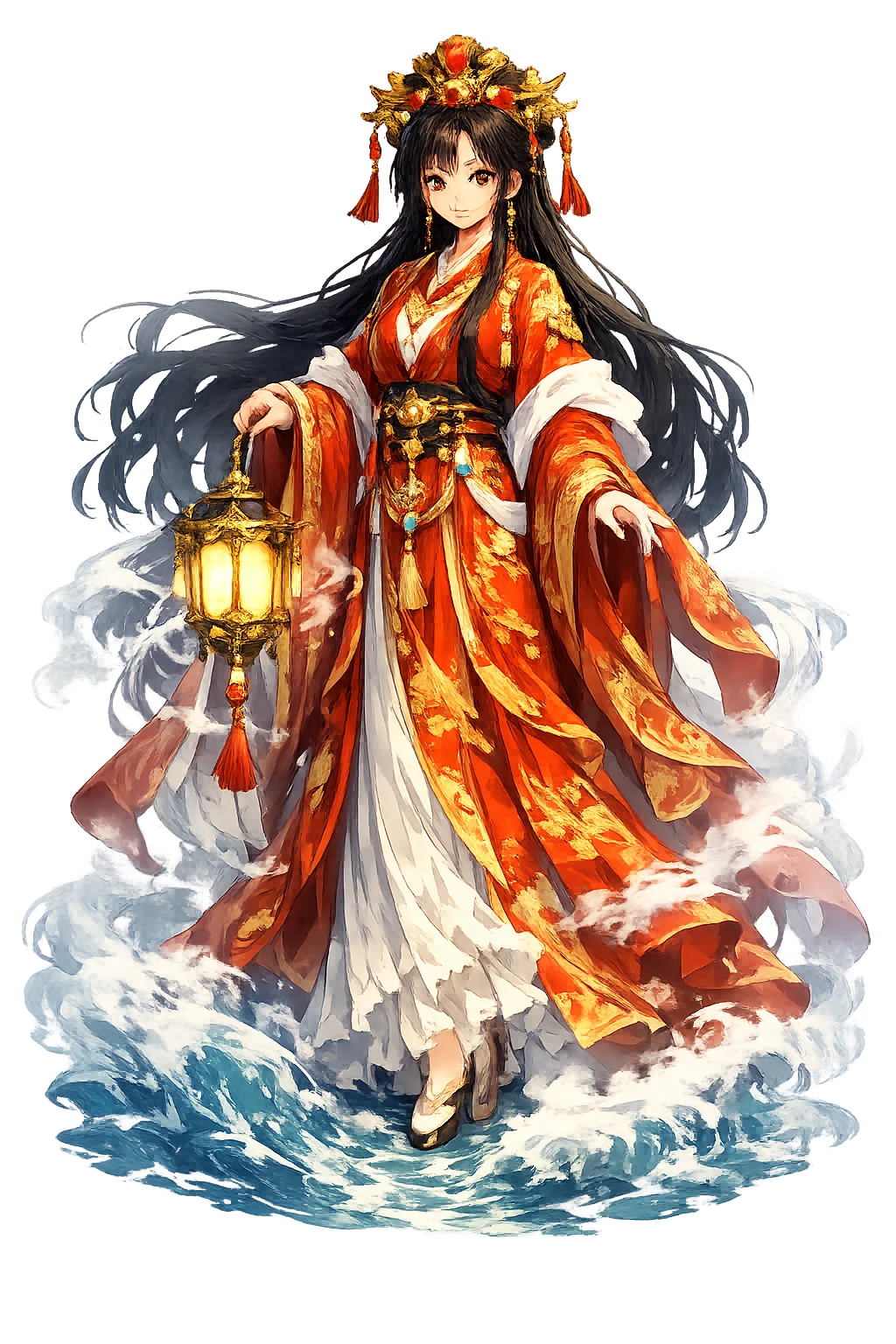
She is depicted as a seated empress in red or gold robes, wearing an imperial crown and often flanked by the guardian generals Qianliyan and Shunfeng’er, or standing on a wave with a lantern to guide ships. Temple statues range from Song-Yuan wood carvings to the colossal effigies of the Taiwan Strait; roof ceramics, incense coils, and dragon guardians frame her in nautical imagery. The black-faced images of some southern temples record miracle stories in which she rescued sailors during violent storms.

06

Reception & Transformation

The name after its own age — transmission, translation, survival

Afterlives

From Fujian, Māzǔ worship spread with seafaring merchants along maritime trade routes to Taiwan, Ryukyu, and the Chinese diaspora communities of Southeast Asia, becoming one of the most widely shared Chinese folk cults and the patron of countless temple networks. Imperial courts from the Song to the Qing promoted her with titles such as Tianhou and left stele inscriptions at major shrines, while twentieth-century regimes on both sides of the Taiwan Strait have used her pilgrimages for cultural diplomacy. UNESCO recognized Mazu belief and customs as intangible cultural heritage in 2009, and the annual Dajia procession now draws millions of participants across multiple continents. Her afterlife thus moves between temple incense, state recognition, and the cultural politics of maritime Chinese identity.

Identifications Across Traditions

She absorbs the coast's other sea-powers: associated with Guānyīn (who is sometimes her patron in the legends), honored in Daoist and Buddhist temples alike, and worshipped as Tin Hau in Hong Kong and A-Ma in Macau — whose very name, some say, comes from her ("A-Ma-Gau," Bay of A-Ma). The diaspora carried her to every Chinese port from San Francisco to Sydney: wherever junks and container ships anchor, her shrine overlooks the harbor.

Modern Legacy

Her temples number in the thousands — over 1,500 in Taiwan alone; her birthday (23rd of the 3rd lunar month) shuts down the island's coasts; her Dajia procession is a national institution watched by millions more online. Fishermen, sailors, the navy, and migrants all claim her: the goddess who was once a girl watching the sea is now the sea's own government, elected annually by the crowds who walk behind her statue.

07

The Meditation

What Māzǔ means — beyond the dictionary

Māzǔ is the goddess of being watched for. Not of the sea — of the people on it: the daughter who never stopped standing on the shore. She asks the question every sailor, parent, and lighthouse-keeper knows: who is watching the water for you — and for whom, tonight, are you the lantern?

Watch the procession and you see the whole theology: no priest lectures, no scripture is read — the statue simply walks, and a million people walk after it. The sea-faith never needed a doctrine; it needed a mother on the shore. Every year she makes the circuit, and every year the coast remembers that someone is watching the water.

The two generals at her flanks are the liturgy in one image: see far, hear far. Everything else — the titles, the temples, the processions — is commentary.

Her sea is the busiest water in human history — the straits that carried tea, silk, migrants, and war — and her temples face it still, unmoved by cargo schedules. The junks are gone; the lantern remains. Every container ship passing the Taiwan Strait sails through the parish of a fisherman's daughter, whether it knows it or not.

She is proof that the largest religions are made of gratitude, not doctrine. Nobody was ever converted to Māzǔ. They were simply rescued, and remembered.

The generals' statues unsettle children and reassure sailors: ugliness conscripted into vigilance, the demons made watchmen. It is the sea's whole covenant in two figures — the dangers are not banished but put on guard duty. Her temples teach it without a single sermon: what you cannot calm, you can still set to watching.

Her economy is miracles per capita, and her ledger is full: every coastal family keeps one — the grandfather guided home, the net that held, the storm that turned. Gratitude at that scale stops being sentiment and becomes infrastructure, the sea's own safety service, funded by incense, staffed by a daughter of Fujian, open every hour of every storm.

08

Frequently Asked Questions

Common questions about Māzǔ, Sea, Protection, Seafaring, and Unicode restoration

01How do you pronounce Māzǔ?

In reconstructed pronunciation, Māzǔ is /ma˥ tsu˨˩˦/ — approximately MAH-tsoo — level tone, then a dip-and-rise.

02What does Māzǔ mean?

Māzǔ means Mother ancestor in the chinese tradition.

03What are the symbols of Māzǔ?

Māzǔ is associated with The red robe (Her temple color — protection worn bright against the grey sea), The lantern (The guide-light of the storm-tossed), The two generals (Sight and hearing deified — vigilance in both directions).

04Why restore Māzǔ in Unicode?

Plain ASCII mazu strips the stress, length, and script that make the name specific. Unicode restoration returns the name to its original written dignity.

05What is the most important myth about Māzǔ?

“The Silent Girl of Meizhou” — the The Maiden story that anchors the mythology of Māzǔ, told in full on the lore page.

09

Scholarly Sources

The philological foundations of this restoration

Every claim on this page is grounded in established scholarship. The orthographic restorations follow disciplinary convention. The etymological chain follows the best available reference works. This is not invention — it is resurrection through scholarship.

◈

Lexicography & Philology

  • Chinese folklore
  • Daoist Canon
◎

Primary Texts

  • Primary sources in the chinese tradition for Māzǔ.
◉

Archaeology & Art History

  • Material evidence — iconography, inscriptions, and temple archaeology — for Māzǔ and related cults.
✦

Religious Studies

  • Tianfei xiansheng lu (Records of the Heavenly Consort's Efficacious Manifestations), Ming miracle-gazetteer
  • Chifeng Tianhou zhi (Imperially Commissioned Gazetteer of the Empress of Heaven), 1817
  • Zhèng Hè's Liújiāgǎng and Changle steles (1413, 1431)
  • James L. Watson, "Standardizing the Gods" (1985)
  • Chinese Text Project
Return

The Surface Awaits

You have traced the name from its earliest attestation to its Unicode restoration. Now return to the myth. The story is where the name lives.

Back to Lore
Māzǔ mascot