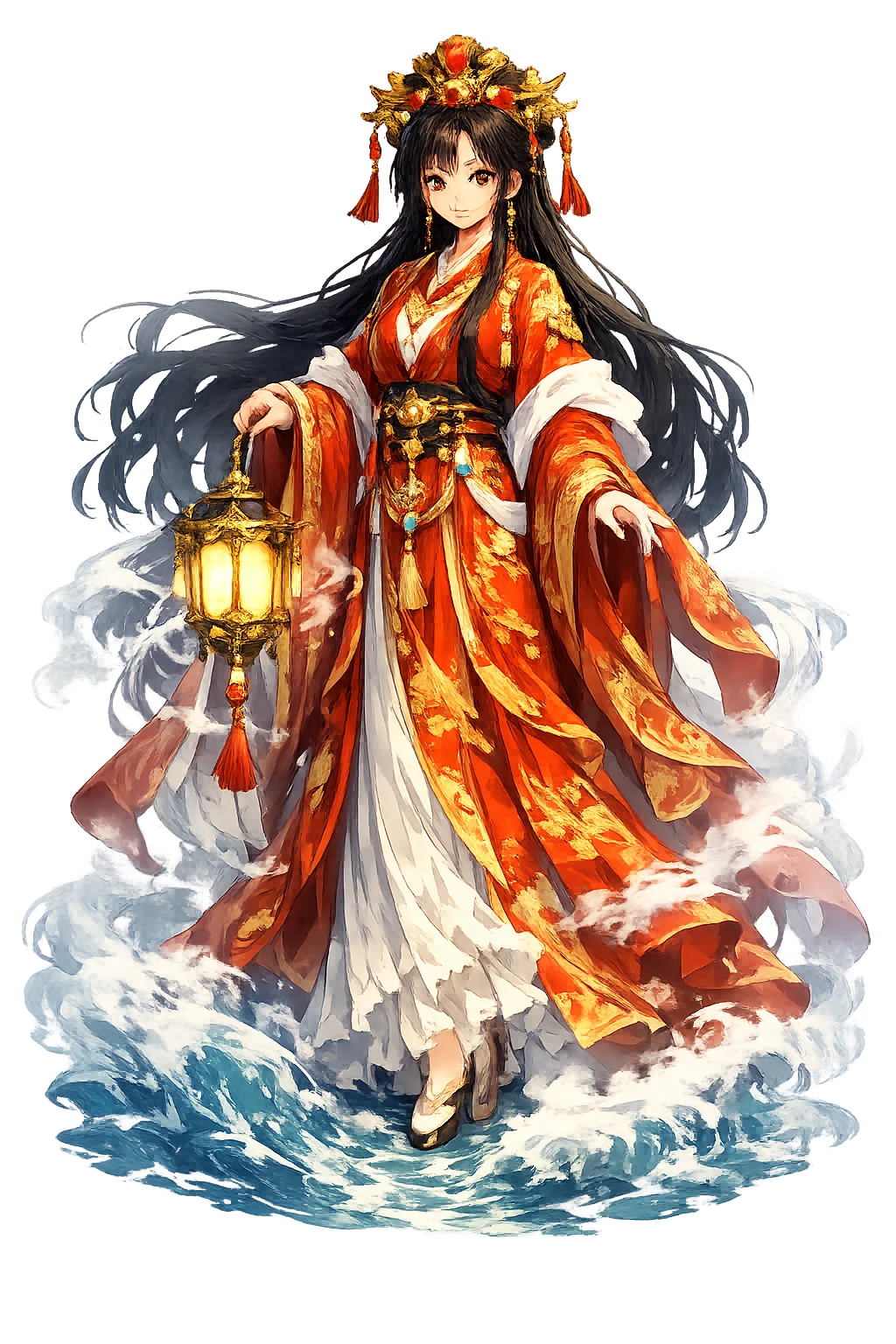
Stories of Māzǔ
Māzǔ's myth is a life, not a legend-cycle: the historical Lín Mòniáng of 10th-century Meizhou, whose silence, visions, and early death became the sea's own religion — a canon written not in scripture but in rescue-stories kept at harbors, and crowned by twelve centuries of imperial gratitude.
The historical Lín Mòniáng was born on Meizhou Island, off the Fujian coast, in 960 CE, as the Five Dynasties gave way to the Song — and the tradition remembers that she did not cry at birth, which is why the world calls her the Silent Maiden. She learned the sea on her father's fishing junk, stood watch on the cliffs in her red dress, and was said to fall into trances in which her spirit walked the waves beside foundering ships, guiding them home. The legend insists she died at twenty-eight, in 987, ascending bodily from the island's peak on a ribbon of incense smoke; other tellings say she drowned searching for her father's lost boat in a typhoon. The sources are late — the miracle collections were compiled centuries afterward — so the facts inside the legend cannot be audited. But the outline is stable, and it is the whole theology: a daughter who never stopped watching the water.
The titles came as the rescues accumulated. The Song court's first recognition was modest — after the diplomat Lù Yùndì's storm-battered embassy to Korea came safely home in 1122–23, the Huizong emperor granted her island temple the plaque Shùnjì, "Facilitating Succor" (1123). The Southern Song made her Consort (1155) and then raised her again (1190); Kublai Khan's Yuan made her Heavenly Consort, Tiānfēi, in 1278, after her winds saw the grain fleets safely to Dàdū; Zhèng Hè thanked her on ocean-facing steles before his voyages; and the Kangxi emperor, after her waves helped Shi Lang's fleet take Taiwan in 1683, raised her at last to Tiānhòu — Empress of Heaven (1684). The ladder is a ledger. Every rank commemorates a storm survived, and the imperial bureaucracy kept promoting the fisherman's daughter until she outranked every other god in the register.
Flanking her throne in every temple stand two of the fiercest statues in Chinese religion: Qiānlǐyǎn, Thousand-Mile Eye, and Shùnfēng'ěr, Wind-Following Ear — demons of the coast whom the young goddess subdued on the beach and bound to her service. The legend is a parable of conscription: the sea's own dangers made watchmen. The eye sees a ship's distress a thousand li off; the ear hears a prayer through a gale; between them, nothing that happens on her water goes unseen or unheard. Sailors cherish the corollary — that in fair weather the two generals stand visibly bored, since vigilance with nothing to watch is the hardest duty in the world. The theology of an entire sea fits inside their pairing. The goddess does not herself need eyes or ears: she has tamed the very powers that threaten her people and set them, forever, at her door.
Her living myth walks. The Dajia pilgrimage carries the statue of Māzǔ from the Jenn Lann temple in Taichung three hundred and forty kilometers around Taiwan over nine days, through a moving river of kneeling devotees, firecrackers, and rival sedan chairs, while hundreds of thousands walk with her and millions more follow on live broadcasts. It is among the largest annual religious processions on earth — and it contains almost no doctrine. No sermon is preached; no scripture is read; the statue simply makes her circuit like a magistrate inspecting her district, and the crowds confirm her jurisdiction by surging forward to touch her palanquin as it passes. Pilgrims speak of walking to repay a rescue — the grandfather guided home, the net that held, the storm that turned. The procession is the sea-faith's whole argument made mobile: salvation remembered annually, on foot, at the pace of gratitude.
On storm nights off the Fujian coast, sailors swore, a red lantern would appear on the black water — above the temple roof, or drifting at the harbor mouth — and every boat that steered for it came through. The red lantern became her emblem in every coastal household: painted on prows, hung in shrines, sewn into the little amulets fishermen pinned inside their coats. Later centuries gave the miracle an institutional form — lighthouses on the headlands where her temples already stood, their keepers often her devotees — so the boundary between goddess and lighthouse-keeper blurred deliberately: the lamp was the same service, only mechanized. The myth's genius is its modesty. No thunder, no parted sea — only a light, placed exactly where a fisherman's daughter would know a drowning man would look for one. It is the smallest miracle in this catalog, and the most believed.
Sailors, Storms, and the Red Lantern
Māzǔ is the most-worshipped sea goddess on earth: the fisherman's daughter who became the guardian of everyone who works the water, whose temples line every coast of the Chinese world, and whose red lanterns guide sailors home through a thousand years of storms. The historical Lín Mòniáng of Meizhou Island was deified not by doctrine but by rescue — and the rescues never stopped.
The goddess of everyone who goes to sea — the busiest answering voice on the water.
Her signal in the storm — the light sailors pray to see.
Qiānlǐyǎn and Shùnfēng'ěr — her thousand-mile eyes and wind-sharp ears.
Her island home off Fujian — the Nazareth of the sea-faith.
From the original script to the living URL
媽祖
The name in its original Chinese form. Māzǔ (媽祖) is attested in the source tradition — “Mother ancestor”. Its macron-length vowels carry the full phonetic and orthographic weight of the source tradition.
mazu
Reduced to plain mazu, the name loses everything that made it specific: macron-length vowels. What remains is an ASCII string that machines can parse but that no longer speaks with its original voice.
Māzǔ
The Unicode restoration recovers what ASCII flattened. Māzǔ restores macron-length vowels, returning the name to its original written dignity. The domain encodes to Punycode, but the browser displays the truth.
Māzǔ.com → xn--mz-dla95f.com
The non-ASCII characters in Māzǔ are encoded while the ASCII remains visible. To the DNS, it is Punycode. To humanity, it is Māzǔ.
Owned, ideal, and ASCII forms of Māzǔ
Māzǔ
Restores 媽祖. The live temple domain — māzǔ.com.
mazu
Flattens 媽祖. The plain ASCII fallback — what DNS and legacy systems see.
How Māzǔ was spoken
How Māzǔ is preserved in writing
A bespoke provenance study for Māzǔ is being prepared by the PUNICODEX scholarly team.
Contribute scholarly provenance →The lore you have read is the living myth. Extended Lore opens the scholarly vault beneath it: the cult and its material remains, a history of the image, the name after antiquity, a meditation on what the name still means, and the full scholarly apparatus — etymology, orthography, sources.
Enter Extended Lore